
Last updated on
Oct 19, 2026

Canada Form 74.15 2015 free printable template
We are not affiliated with any brand or entity on this form

Fill out
Complete the form online in a simple drag-and-drop editor.

eSign
Add your legally binding signature or send the form for signing.

Share
Share the form via a link, letting anyone fill it out from any device.

Export
Download, print, email, or move the form to your cloud storage.
Why pdfFiller is the best tool for your documents and forms


End-to-end document management
From editing and signing to collaboration and tracking, pdfFiller has everything you need to get your documents done quickly and efficiently.
Accessible from anywhere
pdfFiller is fully cloud-based. This means you can edit, sign, and share documents from anywhere using your computer, smartphone, or tablet.
Secure and compliant
pdfFiller lets you securely manage documents following global laws like ESIGN, CCPA, and GDPR. It's also HIPAA and SOC 2 compliant.
What is Canada Form 74.15
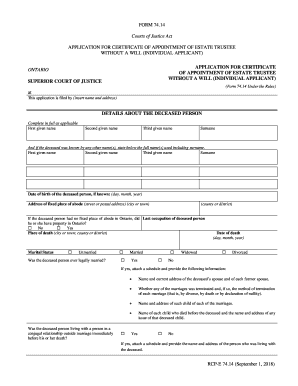
The Ontario Application for Certificate of Appointment of Estate Trustee Without a Will is a legal document used by trust officers to apply for the appointment of an estate trustee when the deceased did not leave a will.
pdfFiller scores top ratings on review platforms




Who needs Canada Form 74.15?
Explore how professionals across industries use pdfFiller.

Canada Form 74.15 is needed by:
-
Trust officers managing estates
-
Corporate entities acting as estate trustees
-
Individuals dealing with estate matters in Ontario
-
Legal representatives for estates
-
Beneficiaries requiring formal appointment
-
Real estate professionals handling property of deceased
Comprehensive Guide to Canada Form 74.15
Understanding the Ontario Application for Certificate of Appointment of Estate Trustee Without a Will
The Ontario Application for Certificate of Appointment of Estate Trustee Without a Will, commonly referred to as Form 74.15, serves a critical role in the estate management process. This legal document is necessary for those seeking to address the affairs of a deceased individual without a will, particularly benefiting corporate entities involved in the estate or trust process. It is essential in the broader context of the Ontario estate trustee application and the Ontario probate application process.
Form 74.15 is significant in its capacity to formally recognize the appointed estate trustee, providing them the legal authority to manage the estate according to the governing laws.
Benefits of Filing the Ontario Estate Trustee Application
Obtaining the Certificate of Appointment allows the estate trustee to fulfill their role in managing and settling the deceased’s affairs legally and efficiently. This legal document not only empowers the estate trustee but also streamlines communication and administrative processes for both the estate and its beneficiaries.
-
Facilitates legitimate estate management and financial transactions.
-
Clarifies the roles and responsibilities of the estate trustee.
-
Ensures compliance with legal requirements, protecting the interests of beneficiaries.
Key Features of the Ontario Application for Certificate of Appointment
The Ontario Application, Form 74.15, requires comprehensive details regarding the deceased individual. This includes personal information such as name, marital status, and specific details about their assets. Moreover, it includes an affidavit section that mandates signature and notarization to enhance its legal validity.
-
Essential information on the deceased’s identity and marital status.
-
List of assets that form part of the estate.
-
Notarization requirement to validate the affidavit section.
Eligibility Criteria for the Certificate of Appointment
Eligibility for applying for the Certificate of Appointment is defined by specific legal standards. Generally, an estate trustee without a will can include individuals or corporate entities that meet the prerequisite conditions. Understanding these qualifications helps streamline the application process for potential corporate estate trustee candidates.
-
Individual beneficiaries related to the deceased.
-
Corporate entities abiding by Ontario’s legal framework.
-
Legal restrictions that may apply to certain applicants.
How to Complete the Ontario Application for Certificate of Appointment
Completing the Ontario Application for Certificate of Appointment requires careful preparation. Before initiating the process, applicants need to gather specific information about the deceased's assets and personal history. Following a systematic approach can help ensure accuracy and compliance.
-
Gather necessary information about the deceased.
-
Fill in the required fields in Form 74.15 accurately.
-
Review for common errors before submission.
Notarization and Signature Requirements for the Application
The application mandates specific signature and notarization requirements to maintain its integrity and legality. Understanding what constitutes a valid signature is crucial, especially with variations between digital and wet signatures.
-
A valid signature must match the identity of the applicant.
-
Notarization ensures that the affidavit is acknowledged formally.
-
Recognition of wet versus digital signatures in legal contexts.
Submission Process for the Ontario Application for Certificate of Appointment
Submitting the completed application is a pivotal step in the process. The Superior Court of Justice is the designated location for submitting Form 74.15. Applicants should be mindful of potential fees and timelines associated with their submission.
-
Submission must take place at the appropriate court location.
-
Awareness of any applicable fees for processing.
-
Estimated processing times to receive feedback on the application.
Post-Submission Steps and Tracking Your Ontario Application
After submitting the application, it's important for applicants to understand how to track their application’s status. Being aware of common rejection reasons can facilitate timely corrections or amendments if needed.
-
Process for tracking application status online or via court contact.
-
Common reasons for application rejection and how to address them.
Security and Compliance for Sensitive Estate Documents
When handling sensitive estate documents, security is paramount. Utilizing platforms like pdfFiller provides peace of mind, as it implements stringent security measures, including encryption and legal compliance.
-
256-bit encryption for document safety.
-
Compliance with privacy laws to protect user information.
Transform Your Experience with pdfFiller
pdfFiller enhances the experience of managing the estate trustee application process through its user-friendly features. By providing fillable forms, eSigning options, and easy document sharing, managing legal paperwork becomes more accessible and efficient.
-
Fillable forms streamline the completion of necessary documents.
-
eSigning simplifies the signature processes significantly.
-
Document sharing capabilities ensure collaboration with stakeholders.
How to fill out the Canada Form 74.15
-
1.Access pdfFiller and search for 'Ontario Application for Certificate of Appointment of Estate Trustee Without a Will'.
-
2.Open the form in pdfFiller's editor to view the content and available fields.
-
3.Gather necessary information about the deceased, including personal details, marital status, and assets, before starting.
-
4.Begin filling in the required fields provided in the form, ensuring all sections relevant to your situation are properly completed.
-
5.Utilize pdfFiller’s tools to navigate between sections using tabs and checkboxes for accuracy and ease.
-
6.Incorporate your signed affidavit section as required, ensuring the signature field is completed by the trust officer.
-
7.After filling in all necessary fields, carefully review the entire form for completeness and accuracy.
-
8.Use the preview function on pdfFiller to double-check the filled details before finalizing your document.
-
9.Save your completed form within your pdfFiller account to keep a backup.
-
10.Download the finalized form to your device or submit it directly to the Superior Court of Justice in Ontario through the options available in pdfFiller.

Who is eligible to complete this form?
Trust officers or corporate entities acting as estate trustees in Ontario are eligible to complete this form for appointment without a will.
Are there any deadlines for submitting the application?
There are typically no specific deadlines, but it’s best to apply as soon as possible to avoid delays in the estate settlement process.
How do I submit the completed form?
The completed form must be submitted to the Superior Court of Justice in Ontario. You can do this either by mail or in-person, depending on court guidelines.
What supporting documents are required with this form?
You will need to provide a completed affidavit section and any necessary identification documents related to the deceased and the applicant.
What are common mistakes to avoid when filling out this form?
Be sure to complete all required fields accurately, avoid leaving any sections blank, and ensure the affidavit is properly signed and notarized.
How long does processing take after submission?
Processing times can vary, but it usually takes several weeks after submission for the court to review and approve the application.
What should I do if I encounter issues while filling out the form?
If you experience problems, consult the help documentation on pdfFiller or seek professional legal advice to ensure the form is completed correctly.
Canada Form 74.15 Form Versions
Related Forms



Get the latest insights from our blog


If you believe that this page should be taken down, please follow our DMCA take down process
here
.
This form may include fields for payment information. Data entered in these fields is not covered by PCI DSS compliance.