
Last updated on
Nov 6, 2026

MI Quit Claim Deed - Muskegon County 2015-2026 free printable template
pdfFiller is not affiliated with any government organization

Fill out
Complete the form online in a simple drag-and-drop editor.

eSign
Add your legally binding signature or send the form for signing.

Share
Share the form via a link, letting anyone fill it out from any device.

Export
Download, print, email, or move the form to your cloud storage.
Why pdfFiller is the best tool for your documents and forms


End-to-end document management
From editing and signing to collaboration and tracking, pdfFiller has everything you need to get your documents done quickly and efficiently.
Accessible from anywhere
pdfFiller is fully cloud-based. This means you can edit, sign, and share documents from anywhere using your computer, smartphone, or tablet.
Secure and compliant
pdfFiller lets you securely manage documents following global laws like ESIGN, CCPA, and GDPR. It's also HIPAA and SOC 2 compliant.
What is MI Quit Claim Deed - Muskegon County
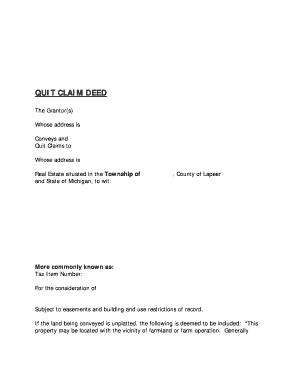
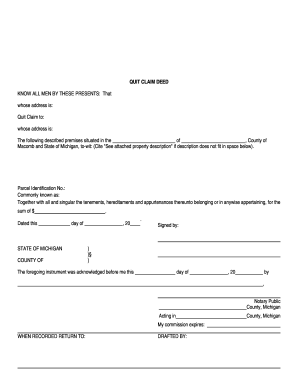
The Michigan Quit Claim Deed is a legal document used by property owners in Michigan to formally transfer ownership of real estate without warranties.
pdfFiller scores top ratings on review platforms




Great service
I would have preferred a quarterly or 6 month subscription renewed automatically.
Nice application for editing
Nice application for editing. Takes a bit of getting used to but plenty of form filling options.
Easy to download and share files.
Pricing is ok.
Who needs MI Quit Claim Deed - Muskegon County?
Explore how professionals across industries use pdfFiller.

MI Quit Claim Deed - Muskegon County is needed by:
-
Homeowners looking to transfer property
-
Real estate agents assisting clients
-
Title companies managing property details
-
Notary publics witnessing the signing
-
Estate executors handling property distributions
-
Anyone involved in Michigan real estate transactions
Comprehensive Guide to MI Quit Claim Deed - Muskegon County
What is the Michigan Quit Claim Deed?
The Michigan Quit Claim Deed is a vital legal document designed to facilitate the transfer of property ownership in the state of Michigan. It defines the roles of the grantor and grantee, and it includes critical components such as the property description. This deed serves an important purpose in property ownership transfer, ensuring clarity and legal compliance during transactions.
Within this document, the grantor, who is the current property owner, provides a deed to the grantee, the individual receiving the property. Understanding the significance of the quit claim deed is essential, as it helps in establishing clear ownership records and aids in simplifying the transfer process.
Purpose and Benefits of the Michigan Quit Claim Deed
People often choose to use the Michigan Quit Claim Deed due to its speed and simplicity in transferring property. This type of deed is particularly beneficial for grantors and grantees in various scenarios.
-
Facilitates quick property transfers between family members.
-
Minimizes complexity compared to other deed types.
-
Commonly used for dividing property assets during legal proceedings.
Its straightforward nature makes it an attractive option for those who need to transfer ownership without the complexities involved in traditional real estate sales.
Who Needs the Michigan Quit Claim Deed?
The Michigan Quit Claim Deed is commonly utilized by various individuals and professionals involved in property transactions. Individuals who need to transfer property ownership can benefit immensely from this deed.
-
Homeowners transferring property to family members.
-
Real estate professionals assisting clients in property transfers.
-
Legal representatives managing estate divisions or settlements.
Understanding who typically requires this deed helps streamline the transfer process for all parties involved.
How to Fill Out the Michigan Quit Claim Deed Online (Step-by-Step)
Completing the Michigan Quit Claim Deed online can be straightforward when following these steps:
-
Access the fillable fields for grantor and grantee information.
-
Enter a clear property description and consideration amount.
-
Navigate the signing and notary acknowledgment sections within the pdfFiller platform.
These steps ensure a proper and efficient submission of the quit claim deed, making the process easier for users.
State-Specific Rules for the Michigan Quit Claim Deed
In Michigan, there are specific legal guidelines governing the use of quit claim deeds. Familiarity with these rules is essential for compliance during the property transfer process.
-
Adherence to state statutes that govern quit claim deeds.
-
Requirements for notary acknowledgment in Michigan.
-
Process for recording the deed with the Muskegon County Register of Deeds.
Following these guidelines ensures that the deed remains valid and legally binding.
Common Errors and How to Avoid Them
While filling out the Michigan Quit Claim Deed, users should be mindful of common errors that might impact the transfer process. Accuracy is crucial, particularly in details regarding grantors and grantees.
-
Ensure all names and addresses are spelled correctly.
-
Double-check the property description for completeness.
-
Use a review checklist to confirm all necessary information is included.
Avoiding these mistakes helps streamline the recording process and minimizes delays.
Fees and Submission Process for the Michigan Quit Claim Deed
Understanding the fees associated with filing the Michigan Quit Claim Deed is essential for budgeting. Costs can vary based on several factors.
-
Recording fees charged by the Muskegon County Register of Deeds.
-
Potential additional costs related to tax certificates.
-
Options for submitting the deed either in-person or online.
Knowing the submission timeline and processing details can help prepare users for next steps.
Security and Compliance When Using the Michigan Quit Claim Deed
When handling sensitive documents like the Michigan Quit Claim Deed, security should be a top priority. Ensuring compliance with regulations can protect personal information during this process.
-
Utilization of pdfFiller’s security features, including encryption.
-
Compliance with HIPAA and GDPR regulations.
-
Methods for safely managing sensitive information during filling and signing.
Understanding the security measures involved helps provide peace of mind while managing property transfers.
After Submission: What Happens Next?
After submitting the Michigan Quit Claim Deed, it’s important to know the subsequent steps in the process. Users can expect several outcomes that require attention.
-
Receipt of confirmation regarding the deed submission.
-
Options available if the deed is rejected due to errors.
-
Steps for amending or correcting the deed if necessary.
Being aware of these procedures helps users navigate any complexities that may arise following submission.
Your Partner in Filling Out the Michigan Quit Claim Deed
pdfFiller offers valuable resources for users looking to fill out the Michigan Quit Claim Deed. With a variety of features designed for ease of use, it simplifies the document preparation process.
-
Editing tools to modify text and images as necessary.
-
eSignature capabilities for secure sign-offs.
-
Cohesive workflow for document management, including sharing options.
Utilizing pdfFiller's features not only streamlines the process but also ensures the security and compliance of the document.
How to fill out the MI Quit Claim Deed - Muskegon County
-
1.To access the Michigan Quit Claim Deed on pdfFiller, visit the website and use the search bar to find the form by its name. Click on the form to open it in the editor.
-
2.Once the form is opened, familiarize yourself with the interface. You will see blank fields where you need to input information related to the property and the parties involved.
-
3.Before you begin filling out the fields, gather necessary information such as the grantor's and grantee's names, their addresses, a detailed property description, and the amount of consideration being given.
-
4.Now start with the relevant sections. Fill in the grantor's and grantee's information in the designated fields. Ensure accuracy, as this information is critical for the transfer.
-
5.Input a clear description of the property in the appropriate field. Be specific to avoid ambiguity, as this will help in legal identification of the property.
-
6.Once you have filled out all sections, thoroughly review the form for any errors or omissions. Ensure all necessary fields are completed, including signature lines.
-
7.After reviewing, finalize the form by clicking on 'Save' or 'Submit' depending on your needs. You can choose to download a copy for your records or send it directly to the required authority.
-
8.To submit the form, follow the instructions provided by pdfFiller. This may include entering email addresses for submission or directly placing a printed copy in your local register of deeds.

Who is eligible to use the Michigan Quit Claim Deed?
Any individual or entity authorized to transfer property ownership in Michigan can use the Quit Claim Deed. Typically, this includes property owners, real estate agents, and legal representatives.
Is there a deadline for submitting the Quit Claim Deed?
Yes, after signing, the Michigan Quit Claim Deed must be recorded promptly with the Muskegon County Register of Deeds to be legally effective. Delays could lead to complications in ownership status.
What is the method for submitting this deed?
The Michigan Quit Claim Deed should be completed and then submitted to the Muskegon County Register of Deeds either in person or via mail, depending on your preference and local regulations.
What supporting documents are required with the Quit Claim Deed?
Typically, you may need to provide a copy of the original deed, tax certificates, and payment for any applicable recording fees when submitting the Quit Claim Deed.
What common mistakes should I avoid when filling out the Quit Claim Deed?
Ensure all names are correctly spelled, all fields are filled, and the form is signed by the Grantor and the Notary Public. Omissions or errors can invalidate the deed.
How long does it take to process the Quit Claim Deed?
Processing times can vary, but generally, registration at the Muskegon County Register of Deeds should be completed within a few business days after submission, barring any issues.
Do I need to notarize the Quit Claim Deed?
Yes, the Quit Claim Deed in Michigan requires notarization to be valid. You must have it signed in the presence of a Notary Public who will acknowledge the signature.
Related Forms



Related Catalogs
Get the latest insights from our blog


If you believe that this page should be taken down, please follow our DMCA take down process
here
.
This form may include fields for payment information. Data entered in these fields is not covered by PCI DSS compliance.