
Last updated on
Nov 9, 2026

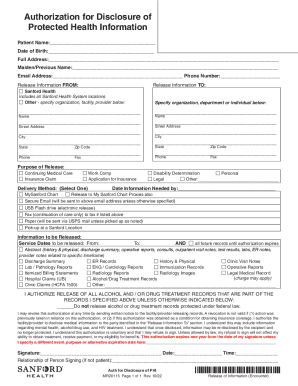
Sanford Health Authorization for Disclosure of Protected Health Information 2012 free printable ...
pdfFiller is not affiliated with any government organization

Fill out
Complete the form online in a simple drag-and-drop editor.

eSign
Add your legally binding signature or send the form for signing.

Share
Share the form via a link, letting anyone fill it out from any device.

Export
Download, print, email, or move the form to your cloud storage.
Why pdfFiller is the best tool for your documents and forms


End-to-end document management
From editing and signing to collaboration and tracking, pdfFiller has everything you need to get your documents done quickly and efficiently.
Accessible from anywhere
pdfFiller is fully cloud-based. This means you can edit, sign, and share documents from anywhere using your computer, smartphone, or tablet.
Secure and compliant
pdfFiller lets you securely manage documents following global laws like ESIGN, CCPA, and GDPR. It's also HIPAA and SOC 2 compliant.
What is Sanford Health Authorization for Disclosure of Protected Health Information
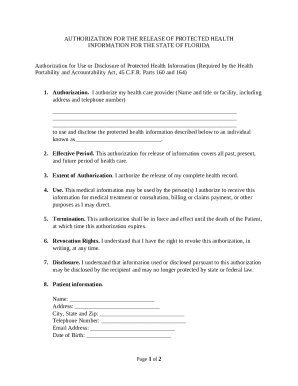
The Authorization for Disclosure of Protected Health Information is a legal document used by patients to grant permission for the release of their medical records.
pdfFiller scores top ratings on review platforms




Who needs Sanford Health Authorization for Disclosure of Protected Health Information?
Explore how professionals across industries use pdfFiller.

Sanford Health Authorization for Disclosure of Protected Health Information is needed by:
-
Patients seeking to access their medical records
-
Legal guardians or conservators handling health affairs
-
Health care agents managing patient care decisions
-
Parents requiring access to their children's health information
-
Healthcare providers requesting authorization for record sharing
-
Legal professionals involved in medical-related cases
Comprehensive Guide to Sanford Health Authorization for Disclosure of Protected Health Information
What is the Authorization for Disclosure of Protected Health Information?
The Authorization for Disclosure of Protected Health Information is a crucial form that grants permission for the release of a patient's medical records. This document serves as a patient consent form, playing a significant role in healthcare and legal contexts. Understanding the purpose and functionality of this healthcare authorization form ensures that patient rights are respected while managing sensitive health information.
The form necessitates the patient's signature or that of an authorized representative, and it outlines details such as the type of information to be disclosed, the designated recipient, and the intended purpose of the release. This not only facilitates compliance with legal requirements but also reinforces the importance of patient agency in their own health care.
Benefits of Using the Authorization for Disclosure of Protected Health Information
Utilizing the medical records release form provides various advantages for both patients and guardians. Primarily, it facilitates timely access to essential health information, which is critical for ongoing medical care and treatment planning. By leveraging the health information authorization form, patients ensure that their rights are honored under the Health Insurance Portability and Accountability Act (HIPAA).
-
This form clarifies the recipient of the information and outlines the specific purpose for which the data will be used.
-
It supports transparency and trust between patients and healthcare providers.
-
Increased efficiency in obtaining necessary medical records can expedite care decisions.
Who Needs the Authorization for Disclosure of Protected Health Information?
The use of the authorization form is relevant to several key individuals involved in the healthcare process. Patients, legal guardians, health care agents, and parents may all be required to fill out this form under various circumstances. Each role plays a distinct part in the healthcare continuum, and understanding these roles is essential for effective health information management.
-
Patients often need to authorize their own medical records for sharing with other healthcare providers.
-
Legal guardians may use the form to access medical information for patients who are unable to provide consent themselves.
-
Health care agents require the form to ensure they can make informed decisions on behalf of the patient.
-
Parents may need to sign on behalf of minor children to grant access to their medical records.
How to Fill Out the Authorization for Disclosure of Protected Health Information Online
Filling out the authorization for disclosure of protected health information online is a straightforward process. Users can access the form on pdfFiller, which offers a user-friendly interface for form completion. Begin by locating the document and ensuring you have all necessary information on hand.
-
Identify the specific details regarding the information to be released.
-
Input the recipient's information, including their name and contact details.
-
Complete all mandatory sections and ensure that you sign the document where indicated.
-
Review the form carefully before submission to avoid any errors.
Field-by-Field Instructions for the Authorization Form
Each section of the authorization form requires careful attention to detail. Understanding the specific fields helps prevent common mistakes that can delay processing. The key fields include patient name, specific health information to be disclosed, and details about the recipient.
-
Ensure your name and contact details are accurate.
-
Clearly specify the types of health information you wish to share.
-
Double-check that all required signatures are collected to validate the form.
Taking the time to validate entries before submitting the form can lead to a smoother experience.
Submission Methods for the Authorization Form
Once you have completed the authorization form, submitting it can be done through several methods, providing flexibility to meet your needs. You can choose to submit via email, mail, or in-person delivery to the designated recipient.
-
Confirm the submission method that is preferred or required by the receiving party.
-
Be aware of any deadlines associated with submissions to ensure timely processing.
-
Utilize tracking options where available to confirm that your submission was received.
Consequences of Not Filing or Late Filing the Authorization
Failing to file or submitting the authorization form late can have significant repercussions. Delays in filing can hinder timely access to necessary medical records, potentially impacting patient care.
-
Patients may experience interruptions in treatment due to unavailability of information.
-
Legal implications may arise for individuals authorized to manage health records and decisions.
Being proactive in filing the form can minimize risks and ensure health information flows smoothly.
Security and Compliance when Using the Authorization Form
Handling sensitive health information comes with a great responsibility to ensure security and compliance. pdfFiller places a high priority on document security, employing 256-bit encryption to protect data integrity.
This platform adheres to HIPAA compliance standards, emphasizing the importance of safeguarding patient information. Users can rest assured that when filling out and submitting the authorization form, their sensitive documents are handled securely throughout the process.
Example of a Completed Authorization for Disclosure of Protected Health Information
Seeing a completed authorization form can aid in understanding how to accurately fill out yours. A sample filled-out form illustrates the correct entry of patient details, health information specifics, and recipient information.
-
Reviewing an example can help you identify what a correctly filled form looks like.
-
Common areas of confusion may be clarified by studying completed samples.
Your Trusted Partner in Managing Medical Forms with pdfFiller
pdfFiller stands out as an efficient solution for filling out and managing medical forms, including the Authorization for Disclosure of Protected Health Information. The platform’s capabilities, such as editing, signing, and securely handling documents, simplify the form-filling process.
Given its ease of use and comprehensive features, pdfFiller is an excellent choice for users looking to navigate their healthcare documentation effortlessly.
How to fill out the Sanford Health Authorization for Disclosure of Protected Health Information
-
1.Begin by accessing the Authorization for Disclosure of Protected Health Information form on pdfFiller's website.
-
2.Once the form is open, familiarize yourself with the layout and available fields. Use the zoom feature for clarity.
-
3.Before filling out the form, collect necessary information including patient details, the type of information to be disclosed, and the recipient's contact information.
-
4.Use the 'Text' tool to fill in the patient’s name, the type of protected health information, and the purpose of the disclosure in the designated fields.
-
5.If applicable, indicate the duration for which the authorization is valid. This can be set for one year or a specific duration as needed.
-
6.Review all entered information to ensure accuracy. Use pdfFiller’s review panel to check for any missing or incorrectly filled fields.
-
7.Once confirmed, add the required signature. You can sign using the 'Signature' tool or by typing your name, depending on your preference.
-
8.Incorporate the date of signing within the specified section. Ensure to follow any provided instructions specific to this requirement.
-
9.After completing the form, utilize the save function to store the document securely. You can also back it up to your pdfFiller account.
-
10.Finally, choose the download option to save your completed form as a PDF to your computer. You can also directly submit the form as instructed by the receiving organization.

Who is eligible to use this authorization form?
This authorization form can be used by patients or their authorized representatives, such as legal guardians, healthcare agents, or parents, who wish to disclose protected health information.
Is there a specific deadline for submitting this form?
The form itself does not impose submission deadlines. However, it is valid for one year from the signing date unless indicated otherwise. Always check specific recipient requirements.
How do I submit the completed form?
After completion, the form can be submitted directly to the healthcare provider or organization that requested the authorization. Make sure to follow their submission guidelines for processing.
What supporting documents are required?
Typically, no additional documents are required for this authorization; however, you may need to provide identification verification in some cases, depending on the recipient’s policies.
What are common mistakes to avoid when filling out this form?
Common mistakes include incomplete fields, not signing or dating the form, and failing to specify the exact information to be disclosed. Double-check all entries before submission.
How long does it take for the authorization to process?
Processing times can vary depending on the recipient organization. Typically, it may take a few days to a couple of weeks. Always inquire about specific timelines.
Can the authorization be revoked after signing it?
Yes, patients can revoke the authorization at any time, provided they notify the organization in writing. It's recommended to verify the revocation process with the specific recipient.
Sanford Health Authorization for Disclosure of Protected Health Information Form Versions
Related Content
Related Forms



Related Catalogs
Get the latest insights from our blog


If you believe that this page should be taken down, please follow our DMCA take down process
here
.
This form may include fields for payment information. Data entered in these fields is not covered by PCI DSS compliance.