
Last updated on
Oct 2, 2026

Get the free Quantitative Data in One Variable: The Empirical Rule
We are not affiliated with any brand or entity on this form

Fill out
Complete the form online in a simple drag-and-drop editor.

eSign
Add your legally binding signature or send the form for signing.

Share
Share the form via a link, letting anyone fill it out from any device.

Export
Download, print, email, or move the form to your cloud storage.
Why pdfFiller is the best tool for your documents and forms


End-to-end document management
From editing and signing to collaboration and tracking, pdfFiller has everything you need to get your documents done quickly and efficiently.
Accessible from anywhere
pdfFiller is fully cloud-based. This means you can edit, sign, and share documents from anywhere using your computer, smartphone, or tablet.
Secure and compliant
pdfFiller lets you securely manage documents following global laws like ESIGN, CCPA, and GDPR. It's also HIPAA and SOC 2 compliant.
What is Empirical Rule Worksheet
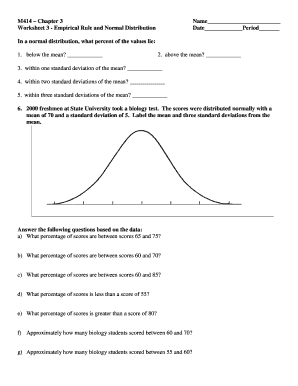
The Quantitative Data in One Variable: The Empirical Rule is a worksheet template used by students to practice statistics concepts like the empirical rule, normal distribution, mean, and standard deviation.
pdfFiller scores top ratings on review platforms




Who needs Empirical Rule Worksheet?
Explore how professionals across industries use pdfFiller.

Empirical Rule Worksheet is needed by:
-
Students studying statistics
-
Educators teaching statistics
-
Tutors responsible for statistics homework
-
Schools using academic evaluation tools
-
Parents supporting children's education
Comprehensive Guide to Empirical Rule Worksheet
Understanding the Empirical Rule in Statistics
The empirical rule is a vital concept in statistics that aids in understanding the distribution of data, especially within a normal distribution. This rule states that approximately 68% of data falls within one standard deviation of the mean, about 95% within two standard deviations, and nearly 99.7% within three standard deviations. Grasping this rule is instrumental in statistical analysis as it provides a framework for interpreting data sets.
The empirical rule relies heavily on the computations surrounding the mean and standard deviation, making it essential for anyone studying statistics. For those practicing with worksheets, the relationship between normal distribution and empirical data becomes clearer.
Purpose and Benefits of Using the Empirical Rule Worksheet
The empirical rule worksheet serves as an effective tool for students studying statistics. By working through various statistics practice problems, students can enhance their comprehension of these key concepts. The structured format of the worksheet is designed to improve the understanding of both the mean and standard deviation, making the learning process more intuitive.
Moreover, filling out worksheets promotes active learning and aids retention, which is particularly beneficial for homework practice. Engaging with the material through a worksheet not only solidifies knowledge but also boosts confidence in applying statistical principles.
Key Features of the Empirical Rule Worksheet
The empirical rule worksheet includes several essential elements that facilitate effective learning. Users will find problem types focused on normal distribution, providing practical examples that bring theory to life. The design incorporates fill-in-the-blank fields and checkboxes, allowing students to monitor their progress and understand their answers comprehensively.
This format not only supports self-assessment but also enhances the learning experience by fostering clarity in statistical concepts. Such features ensure that students are well-equipped to tackle statistics assignments confidently.
Who Can Benefit from the Empirical Rule Worksheet?
This worksheet is designed for a diverse audience, encompassing students, educators, and anyone interested in mastering statistics. It is particularly invaluable in classroom settings and tutoring sessions, where guided practice can help students grasp complex concepts effectively.
Moreover, the accessibility of the empirical rule worksheet ensures that learners at all levels, from beginners to advanced, can utilize it to reinforce their understanding of statistics. It is a versatile resource suitable for anyone studying these foundational principles.
How to Use the Empirical Rule Worksheet Effectively
To maximize the benefits from the empirical rule worksheet, users should follow these steps:
-
Gather all necessary information, including the mean and standard deviation for the data set.
-
Reference course materials and textbooks to ensure accuracy while filling out the worksheet.
-
Complete the worksheet methodically, using the fill-in-the-blank fields provided.
-
Review your answers thoroughly and use the validation checklist included in the worksheet.
By adhering to these best practices, users can deepen their understanding of statistics and the empirical rule.
Enhancing Your Experience with pdfFiller
pdfFiller offers an efficient platform for editing and filling out the empirical rule worksheet. With its cloud-based solution, users can easily access and complete their worksheets from anywhere without the need for software downloads. Key features include the ability to annotate, create fillable forms, and securely share completed documents.
Notably, the extensive community of over 100 million users demonstrates the platform's effectiveness in supporting academic success through enhanced functionality and ease of use.
Security and Compliance When Using pdfFiller
When utilizing pdfFiller, users can rest assured about the safety of their documents. The platform employs stringent security measures, including 256-bit encryption and compliance with SOC 2, HIPAA, and GDPR standards. Choosing a secure solution for completing sensitive assignments ensures that users' data is handled with utmost care.
This focus on security underlines the importance of trusting your platform for completing crucial educational documents and assignments.
Getting Started with pdfFiller for Your Empirical Rule Worksheet
Begin using pdfFiller for your empirical rule worksheet by following these steps:
-
Access the empirical rule worksheet directly on pdfFiller.
-
Utilize the intuitive interface to fill out the necessary sections of the worksheet online.
-
Save your completed document securely within your pdfFiller account.
-
If needed, eSign the finished document for formal submission.
This straightforward approach enables seamless integration of pdfFiller into your academic workflow.
Final Thoughts on Mastering the Empirical Rule
Utilizing the empirical rule worksheet alongside pdfFiller can be a transformative experience for mastering key statistics concepts. The combination of guided practice and effective document management supports deeper learning and academic achievement. Engaging with the resources available through pdfFiller fosters a robust understanding of the empirical rule and its application in statistics.
How to fill out the Empirical Rule Worksheet
-
1.To access the Quantitative Data in One Variable: The Empirical Rule worksheet on pdfFiller, open your web browser and visit the pdfFiller website.
-
2.Log into your pdfFiller account or create a new one if you don't have an account yet.
-
3.Once logged in, use the search bar to look for the form by entering its title, 'Quantitative Data in One Variable: The Empirical Rule.'
-
4.Click on the form title to open it in the pdfFiller editor.
-
5.Familiarize yourself with the layout of the worksheet, noting the areas with blank fields and checkboxes for completion.
-
6.Before you start filling out the form, gather any necessary data such as statistical values, percentages, mean, and standard deviation related to normal distribution.
-
7.Begin completing the worksheet by clicking on the first blank field and entering the required information.
-
8.Continue moving through each blank field by clicking on them in sequence, filling in answers based on your calculations.
-
9.If the worksheet includes checkboxes, click on the boxes to select the appropriate options based on your understanding.
-
10.Once you’ve filled out all required fields, review your answers carefully to ensure accuracy.
-
11.To finalize the worksheet, look for the 'Save' option on the pdfFiller interface and click it to save your progress.
-
12.If you need to download the completed form, access the 'Download' option.
-
13.You can also submit the form directly through pdfFiller if there is an option for direct submission to your instructor or school.

Who can use the Quantitative Data in One Variable worksheet?
The Quantitative Data in One Variable worksheet is designed for students studying statistics, educators teaching the subject, and tutors assisting students with homework. Anyone eager to practice these statistical concepts can benefit from this form.
Are there any specific prerequisites to fill out this worksheet?
While there are no formal prerequisites to completing the worksheet, having a foundational understanding of statistical concepts such as mean, standard deviation, and normal distribution will greatly enhance your experience and outcomes.
How can I submit the completed worksheet?
You can submit the completed worksheet by clicking on the submission option within pdfFiller, if available. Otherwise, you may download the worksheet and submit it via email or as instructed by your educator.
Is there a deadline for submitting this worksheet?
Deadlines for submitting the worksheet depend on the specific requirements set by your instructor or educational institution. Always check with your teacher for any specific submission timelines.
What common mistakes should I avoid while filling out this form?
Common mistakes to avoid include not double-checking calculations, skipping blank fields, and failing to review answers before submission. Careful attention to detail will improve accuracy.
How long does it take to complete the worksheet?
The time required to complete the worksheet varies based on your familiarity with the material. On average, it may take 30 to 60 minutes to fill out depending on your proficiency in statistics.
Is there a support system if I have questions about the worksheet?
If you have questions about the worksheet, it is advisable to reach out to your instructor for clarification. Additionally, many educational resources online might help you understand statistical concepts better.
Related Forms




Related Catalogs
Get the latest insights from our blog


If you believe that this page should be taken down, please follow our DMCA take down process
here
.
This form may include fields for payment information. Data entered in these fields is not covered by PCI DSS compliance.