
Last updated on
Oct 16, 2026
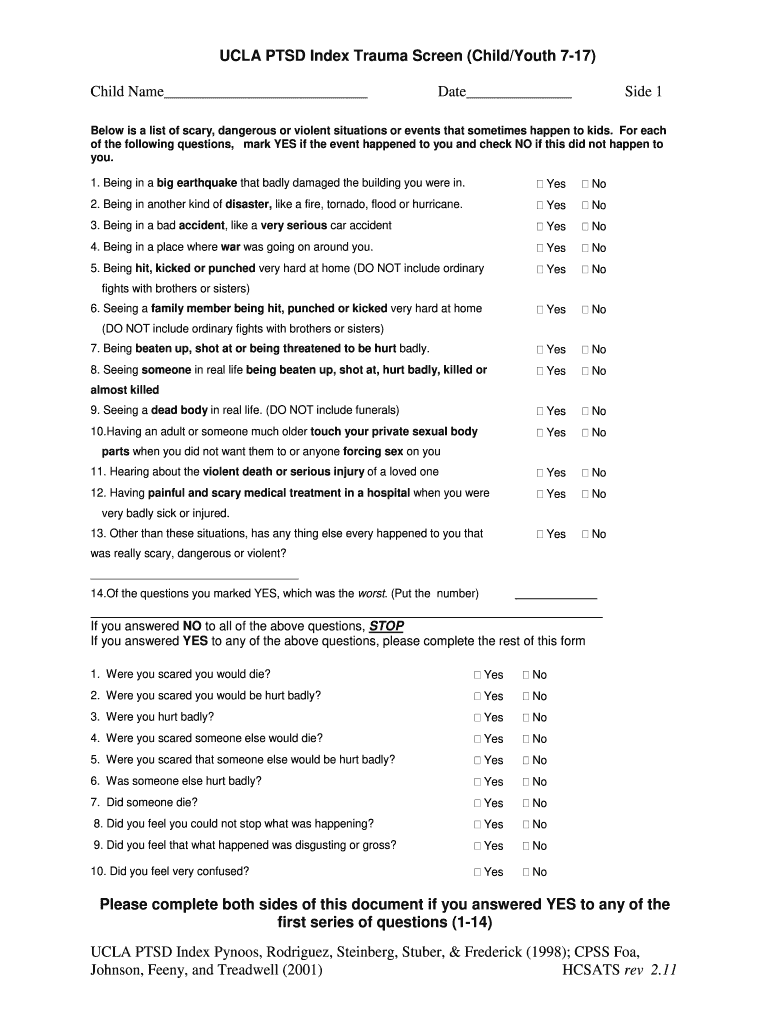
WA UCLA PTSD Index Trauma Screen (Child/Youth 7-17) 2011-2026 free printable template
pdfFiller is not affiliated with any government organization

Fill out
Complete the form online in a simple drag-and-drop editor.

eSign
Add your legally binding signature or send the form for signing.

Share
Share the form via a link, letting anyone fill it out from any device.

Export
Download, print, email, or move the form to your cloud storage.
Why pdfFiller is the best tool for your documents and forms


End-to-end document management
From editing and signing to collaboration and tracking, pdfFiller has everything you need to get your documents done quickly and efficiently.
Accessible from anywhere
pdfFiller is fully cloud-based. This means you can edit, sign, and share documents from anywhere using your computer, smartphone, or tablet.
Secure and compliant
pdfFiller lets you securely manage documents following global laws like ESIGN, CCPA, and GDPR. It's also HIPAA and SOC 2 compliant.
What is WA UCLA PTSD Index Trauma Screen (Child/Youth 7-17)
The UCLA PTSD Index Trauma Screen is a healthcare form used by medical professionals to assess traumatic events and PTSD symptoms in children and youth aged 7-17.
pdfFiller scores top ratings on review platforms




Who needs WA UCLA PTSD Index Trauma Screen (Child/Youth 7-17)?
Explore how professionals across industries use pdfFiller.

WA UCLA PTSD Index Trauma Screen (Child/Youth 7-17) is needed by:
-
Healthcare providers assessing childhood trauma
-
Mental health professionals evaluating PTSD in youth
-
School counselors supporting students with trauma histories
-
Researchers studying childhood trauma impact
-
Parents seeking to understand their child's trauma experiences
Comprehensive Guide to WA UCLA PTSD Index Trauma Screen (Child/Youth 7-17)
What is the UCLA PTSD Index Trauma Screen?
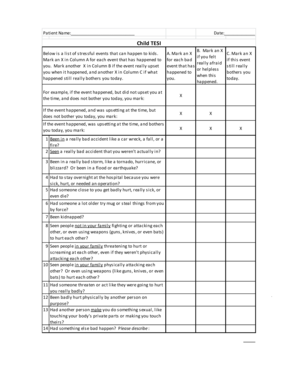
The UCLA PTSD Index Trauma Screen is an essential tool for assessing trauma in children aged 7 to 17 years. This PTSD assessment form allows users to identify significant traumatic events by marking 'YES' or 'NO' for each item listed. By systematically evaluating these responses, healthcare professionals can effectively gauge symptoms of PTSD, making it a vital component in the trauma screening process.
This form serves as a trauma screening tool that offers insights into the mental health of youth, aiding in timely and informed diagnoses.
Purpose and Benefits of the UCLA PTSD Index Trauma Screen
The purpose of the UCLA PTSD Index Trauma Screen extends beyond simple data collection; it paves the way for early trauma detection. By identifying trauma promptly, healthcare providers can intervene effectively, leading to better health outcomes. This form not only assists in diagnosing PTSD symptoms but also plays a crucial role in outlining tailored treatment plans.
Using this child trauma questionnaire, professionals can enhance their understanding of a child's experiences, ensuring that appropriate support is provided. The implications for treatment and intervention are profound, as timely assessments can lead to quicker recovery strategies.
Who Needs the UCLA PTSD Index Trauma Screen?
This healthcare form is designed for children and youth who have been exposed to trauma. It is often completed directly by the affected individuals, but parents or guardians may fill it out on behalf of younger children who may not fully understand or articulate their experiences. Additionally, healthcare professionals, including psychologists and counselors, frequently utilize this form to gauge the mental health of their young clients.
Understanding the target audience ensures that the screening process is both relevant and effective in addressing the needs of those impacted by trauma.
How to Fill Out the UCLA PTSD Index Trauma Screen Online
To complete the UCLA PTSD Index Trauma Screen digitally, follow these simple steps:
-
Access the form through pdfFiller’s platform.
-
Read each traumatic event statement carefully.
-
Indicate your responses by marking 'YES' or 'NO' for each item.
-
If 'YES' is selected for any event, provide further details as requested.
-
Navigate through the fillable patterns and checkboxes seamlessly.
This process ensures a user-friendly experience while maintaining the integrity of the information provided.
Field-by-Field Instructions for the UCLA PTSD Index Trauma Screen
Completing the UCLA PTSD Index Trauma Screen requires attention to detail. Here’s a breakdown of the key sections:
-
The trauma event questions require respondents to reflect on specific incidents in their lives.
-
The impact assessment section evaluates the psychological effects of those events on the individual.
-
Complex fields may require examples for clarity; ensure you provide precise information when filling them out.
Common mistakes to avoid include misinterpreting questions and failing to answer all sections thoroughly, which can impair the assessment's accuracy.
Security and Compliance When Using the UCLA PTSD Index Trauma Screen
Ensuring data security is paramount when completing the UCLA PTSD Index Trauma Screen. pdfFiller employs state-of-the-art security features, including 256-bit encryption, to protect sensitive information. Users can rest assured knowing that pdfFiller adheres to HIPAA and GDPR compliance standards, safeguarding health data throughout the process.
The platform's commitment to data privacy ensures that all personal information is managed responsibly and securely, allowing users to focus on the completion of their forms without concern.
How to Submit the UCLA PTSD Index Trauma Screen
Submitting the UCLA PTSD Index Trauma Screen can be accomplished through various methods:
-
Online submission via pdfFiller directly to your chosen healthcare provider.
-
Print the completed form and physically deliver it to a hospital, clinic, or therapist's office.
Tracking your submission is also crucial; check in with the respective healthcare facility for confirmation and inquire about any associated fees for processing the form.
What Happens After You Submit the UCLA PTSD Index Trauma Screen?
After submission, healthcare professionals review the form to analyze the responses. This evaluation is crucial for determining the subsequent steps, which may include further assessments, therapy recommendations, or additional interventions based on results. Engaging proactively with mental healthcare providers is important for effectively addressing trauma and supporting recovery.
Users should remain informed about the potential need for follow-up appointments to ensure a comprehensive approach to mental health care.
Experience the Ease of Using pdfFiller for the UCLA PTSD Index Trauma Screen
pdfFiller enhances the experience of completing the UCLA PTSD Index Trauma Screen by offering convenient features such as eSigning, cloud storage, and easy editing capabilities. This platform simplifies the form-filling process, making it secure and accessible for all users.
Moreover, pdfFiller provides a wide array of healthcare forms, making it a comprehensive solution for managing medical documentation.
How to fill out the WA UCLA PTSD Index Trauma Screen (Child/Youth 7-17)
-
1.Access the UCLA PTSD Index Trauma Screen on pdfFiller by searching for the document or uploading it directly from your device.
-
2.Once the form is open, use pdfFiller's toolbar to navigate through the document. Locate the 'Yes' or 'No' checkboxes for each traumatic event listed.
-
3.Gather the necessary information regarding specific traumatic events experienced by the child or youth before starting the form. Ensure to discuss these events openly to complete the form accurately.
-
4.Begin by marking 'YES' if the event happened to the child and 'NO' if it did not. Complete each checkbox accordingly.
-
5.If any events are marked 'YES', follow the instructions for the subsequent questions. Fill in the additional information requested in the blank fields where necessary.
-
6.Ensure that both sides of the document are completed if you answered 'YES' to any of the first series of questions (1-14).
-
7.Once all fields are filled in, review the form for any errors or missing information. Make necessary corrections directly on pdfFiller.
-
8.Finalize the form by saving your progress. Use the download option to save it as a PDF or submit it digitally through pdfFiller's integrated options.

Who is eligible to complete the UCLA PTSD Index Trauma Screen?
The form is primarily used for children and youth aged 7-17. It should be completed by the child or youth with the guidance of a parent or healthcare professional.
Are there any deadlines for submitting this form?
While there are typically no strict deadlines for trauma assessments, it is recommended to complete the UCLA PTSD Index Trauma Screen as soon as possible after traumatic events to ensure timely evaluation and support.
How can I submit the completed form?
You can submit the UCLA PTSD Index Trauma Screen through pdfFiller by downloading the completed form and emailing it to the relevant healthcare provider or by using the electronic submission features within pdfFiller.
What additional documents are needed with this form?
Generally, no additional documents are required with the UCLA PTSD Index Trauma Screen. However, healthcare providers may request previous medical records or consent forms based on their evaluation needs.
What are common mistakes to avoid when filling out this form?
Avoid leaving any checkboxes blank if applicable. Ensure that all required fields are filled out, especially if you answered 'YES' to any of the initial trauma questions. Double-check that the form is signed and dated appropriately.
How long does it take to process the form after submission?
Processing times can vary and typically depend on the healthcare provider's policies. It's advisable to follow up with the provider after submitting the form to inquire about timing.
What concerns should I address specifically about PTSD assessments?
It is important to ensure that all completed information is shared with the relevant health professionals. Discuss any symptoms or concerns expressed by the child regarding their trauma experiences during the assessment process.
Related Forms

Get the latest insights from our blog


If you believe that this page should be taken down, please follow our DMCA take down process
here
.
This form may include fields for payment information. Data entered in these fields is not covered by PCI DSS compliance.