
Last updated on
Oct 31, 2026

Get the free Daily Chlorine Residual Log Sheet
We are not affiliated with any brand or entity on this form

Fill out
Complete the form online in a simple drag-and-drop editor.

eSign
Add your legally binding signature or send the form for signing.

Share
Share the form via a link, letting anyone fill it out from any device.

Export
Download, print, email, or move the form to your cloud storage.
Why pdfFiller is the best tool for your documents and forms


End-to-end document management
From editing and signing to collaboration and tracking, pdfFiller has everything you need to get your documents done quickly and efficiently.
Accessible from anywhere
pdfFiller is fully cloud-based. This means you can edit, sign, and share documents from anywhere using your computer, smartphone, or tablet.
Secure and compliant
pdfFiller lets you securely manage documents following global laws like ESIGN, CCPA, and GDPR. It's also HIPAA and SOC 2 compliant.
What is Chlorine Log Sheet
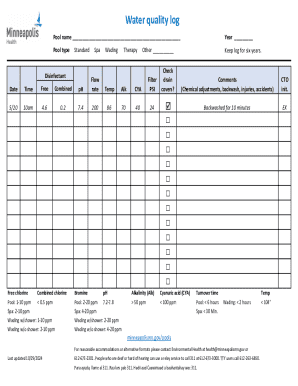
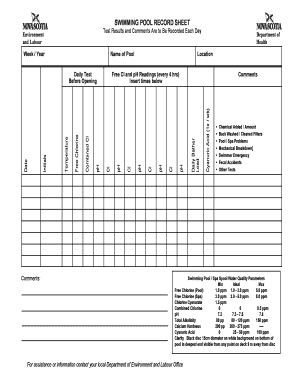
The Daily Chlorine Residual Log Sheet is a healthcare form used by medical facilities to record and monitor daily chlorine levels in their water systems.
pdfFiller scores top ratings on review platforms




Who needs Chlorine Log Sheet?
Explore how professionals across industries use pdfFiller.

Chlorine Log Sheet is needed by:
-
Healthcare Facility Managers
-
Water Quality Technicians
-
Medical Personnel in Hospitals
-
Environmental Health Officers
-
Safety Compliance Officers
Comprehensive Guide to Chlorine Log Sheet
What is the Daily Chlorine Residual Log Sheet?
The Daily Chlorine Residual Log Sheet is a crucial form designed for recording chlorine levels in water systems on a daily basis. It plays a vital role in water system monitoring, ensuring that facilities maintain safe water quality. This form helps track chlorine levels, which is essential for the health and safety of users.
By consistently monitoring these levels, facilities can mitigate potential health risks associated with inadequate chlorine residuals. The Daily Chlorine Residual Log Sheet helps organizations meet regulatory standards and promotes a safe environment for all users.
Purpose and Benefits of the Daily Chlorine Residual Log Sheet
The Daily Chlorine Residual Log Sheet is particularly essential for healthcare facilities, where water quality is paramount. Regular monitoring of chlorine levels using this water quality monitoring form safeguards against contamination that could compromise patient health.
An ongoing record of chlorine levels allows organizations to ensure compliance with health standards, demonstrating their commitment to maintaining a safe water supply. Additionally, the chlorine level recording sheet serves as a protective measure, helping to identify issues before they escalate into larger problems.
Key Features of the Daily Chlorine Residual Log Sheet
-
Date and time entries for precise tracking.
-
Sample location to identify specific testing points.
-
Initials of the personnel conducting the tests to ensure accountability.
The user-friendly format and organization of the log sheet expose its intuitive design, making it easy for users to complete daily water testing log entries without confusion.
Who Needs the Daily Chlorine Residual Log Sheet?
This form is indispensable for various facilities, including healthcare providers and municipal water systems that prioritize safe water management. Regular users of the Daily Chlorine Residual Log Sheet should establish routine monitoring practices to ensure consistency in water quality.
By implementing systematic tracking routines, organizations can proactively address changes in chlorine levels that could pose risks to health. Understanding the specific needs of healthcare water monitoring is paramount for compliance and safety.
How to Fill Out the Daily Chlorine Residual Log Sheet Online
To fill out the Daily Chlorine Residual Log Sheet online, follow these steps:
-
Access the log sheet through pdfFiller.
-
Fill in the date and time of the test.
-
Record the sample location and initial the entry.
These field-by-field instructions help users complete the daily chlorine test log accurately, ensuring each entry is recorded correctly for future reference.
Review and Validation Checklist
Before submitting the Daily Chlorine Residual Log Sheet, users should check for common errors that may occur when completing the form. Some critical points to remember include:
-
Ensure all required fields are filled out.
-
Double-check dates and times for accuracy.
-
Validate sample locations to confirm they match testing points.
Implementing these tips for validating information can significantly reduce errors and improve the reliability of data collected.
How to Download and Save the Daily Chlorine Residual Log Sheet PDF
To save the completed Daily Chlorine Residual Log Sheet securely, follow these steps:
-
Click the download option on pdfFiller after filling out the form.
-
Choose a secure storage location on your device.
It is crucial to handle and store these documents securely to protect sensitive information and ensure compliance with data protection standards.
Where and How to Submit the Daily Chlorine Residual Log Sheet
Once completed, the Daily Chlorine Residual Log Sheet needs to be submitted through designated channels. Submission methods can include:
-
Digital uploads via pdfFiller.
-
Physical delivery to respective health departments.
Users should be aware of the timeline expectations for feedback or processing after submission to ensure timely updates on the water quality monitoring efforts.
Security and Compliance for the Daily Chlorine Residual Log Sheet
The Daily Chlorine Residual Log Sheet incorporates essential security features to protect sensitive information. pdfFiller employs 256-bit encryption, ensuring that user data remains confidential and secure during the form-filling process.
Compliance with regulations such as HIPAA safeguards the privacy necessary for all health-related forms, reinforcing the importance of privacy and data protection while handling the log sheet.
Create Your Daily Chlorine Residual Log Sheet with pdfFiller
Utilizing pdfFiller for creating and managing your Daily Chlorine Residual Log Sheet is both simple and efficient. This cloud-based tool allows users to fill out forms effortlessly while maintaining security and compliance.
By integrating pdfFiller into your process, you can easily create, edit, and submit your log sheet online, enhancing your water quality monitoring efforts without complications.
How to fill out the Chlorine Log Sheet
-
1.Access the Daily Chlorine Residual Log Sheet by navigating to pdfFiller's website and using the search function to locate the form.
-
2.Open the form in the pdfFiller interface where you can see the editable fields on the document.
-
3.Before starting, gather necessary information including the name of the water system, the month, the year, and specific dates and times for testing.
-
4.Begin filling out the form by entering the water system name and selecting the appropriate month and year from the dropdown menus.
-
5.Proceed to the section provided for daily entries. Input the date and time of each chlorine level reading in the designated fields.
-
6.In the sample location field, specify where the water sample was taken, ensuring that this information is clear and accurate.
-
7.Initial the form next to each entry to confirm the validity of the recorded data. This will serve as your personal verification.
-
8.Once you have filled in all required fields, review your entries for any errors or omissions to ensure all information is accurate.
-
9.Finalize the form by saving your changes. You may also choose to download a copy for your records or submit it directly if required.
-
10.To save or submit the form, click on the respective options provided in pdfFiller. You may choose to export it as a PDF, print it out, or share it via email.

Who needs to fill out the Daily Chlorine Residual Log Sheet?
This form is essential for healthcare facility managers, water quality technicians, and medical personnel responsible for monitoring water safety in healthcare settings.
What information is required to complete the form?
You'll need the water system name, the month and year, dates and times for testing, sample locations, and your initials to validate records.
Are there any deadlines for submitting this form?
While specific deadlines may vary based on regulations, it is advisable to complete and submit the Daily Chlorine Residual Log Sheet daily to ensure consistent monitoring.
What should I do if I make a mistake on the log sheet?
If errors are made, it's best to cross out the incorrect entry and write the correct information next to it. Always initial any changes for verification.
How can I submit the Daily Chlorine Residual Log Sheet?
After completing the form on pdfFiller, you can submit it directly via email or download and print it for manual submission to the relevant authority.
Is notarization required for this form?
No, notarization is not required for the Daily Chlorine Residual Log Sheet, as it is primarily an internal monitoring document.
What are common mistakes to avoid when filling out this form?
Ensure all fields are filled out accurately, particularly the date and time of testing. Avoid leaving any field blank, as this can lead to compliance issues.
Related Forms




Related Catalogs
Get the latest insights from our blog


If you believe that this page should be taken down, please follow our DMCA take down process
here
.
This form may include fields for payment information. Data entered in these fields is not covered by PCI DSS compliance.