
Last updated on
Oct 31, 2026

VA PTSD Checklist for DSM-5 (PCL-5) 2018 free printable template
pdfFiller is not affiliated with any government organization

Fill out
Complete the form online in a simple drag-and-drop editor.

eSign
Add your legally binding signature or send the form for signing.

Share
Share the form via a link, letting anyone fill it out from any device.

Export
Download, print, email, or move the form to your cloud storage.
Why pdfFiller is the best tool for your documents and forms


End-to-end document management
From editing and signing to collaboration and tracking, pdfFiller has everything you need to get your documents done quickly and efficiently.
Accessible from anywhere
pdfFiller is fully cloud-based. This means you can edit, sign, and share documents from anywhere using your computer, smartphone, or tablet.
Secure and compliant
pdfFiller lets you securely manage documents following global laws like ESIGN, CCPA, and GDPR. It's also HIPAA and SOC 2 compliant.
What is VA PTSD Checklist for DSM-5 (PCL-5)
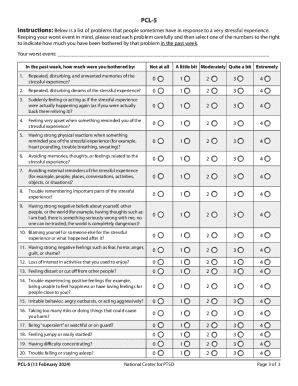
The PTSD Checklist for DSM-5 (PCL-5) is a healthcare form used by professionals to assess and measure the severity of PTSD symptoms in adults.
pdfFiller scores top ratings on review platforms




Who needs VA PTSD Checklist for DSM-5 (PCL-5)?
Explore how professionals across industries use pdfFiller.

VA PTSD Checklist for DSM-5 (PCL-5) is needed by:
-
Mental health professionals assessing PTSD
-
Healthcare providers conducting patient evaluations
-
Researchers studying trauma-related disorders
-
Veterans' healthcare programs, including the National Center for PTSD
-
Counselors aiding trauma survivors
-
Clinics offering psychological assessments
Comprehensive Guide to VA PTSD Checklist for DSM-5 (PCL-5)
What is the PTSD Checklist for DSM-5 (PCL-5)?
The PTSD Checklist for DSM-5, or PCL-5, serves as a standardized assessment tool specifically designed for evaluating post-traumatic stress disorder symptoms. This useful PTSD assessment tool consists of 20 items that gauge various types of symptoms, including intrusive memories and negative changes in mood. Each item aligns with the diagnostic criteria outlined in the DSM-5, making it a reliable measure for those experiencing PTSD.
Purpose and Benefits of the PTSD Checklist for DSM-5 (PCL-5)
This checklist plays a crucial role in diagnosing PTSD effectively while also tracking the severity of symptoms over time. Clinicians find it beneficial for evaluating treatment progress, which contributes to more tailored therapeutic approaches. Additionally, standardized assessments like the PCL-5 are vital in the mental health field, providing consistent measurements for symptom evaluation.
How to Fill Out the PTSD Checklist for DSM-5 (PCL-5) Online (Step-by-Step)
Completing the PCL-5 online is straightforward. Follow these steps to ensure an accurate submission:
-
Access the fillable form electronically via pdfFiller.
-
Review the key sections of the form, ensuring you understand each item.
-
Answer all items honestly to reflect your experiences accurately.
-
Double-check your responses for completeness before submission.
Following these instructions will assist in achieving a reliable self-assessment.
Key Features of the PTSD Checklist for DSM-5 (PCL-5)
The PCL-5 boasts several features that enhance its usability:
-
It includes fillable fields and a convenient checkbox format to simplify responses.
-
The ability to complete the form electronically ensures flexibility and accessibility.
-
Security measures for electronic submissions are backed by the National Center for PTSD.
Who Needs the PTSD Checklist for DSM-5 (PCL-5)?
This form is tailored for healthcare professionals and individuals who believe they may be experiencing PTSD symptoms. Situations that necessitate the use of the PCL-5 include evaluations following trauma or ongoing symptom monitoring. Eligibility for using the form typically includes those who have faced traumatic events that impact their mental health.
Common Errors to Avoid When Completing the PTSD Checklist for DSM-5 (PCL-5)
To ensure accuracy in your assessment, be mindful of common mistakes, including:
-
Skipping questions, which can lead to incomplete data.
-
Failing to review responses, potentially causing inconsistencies.
Utilizing resources or validation tools can further help in confirming the accuracy of your filled form.
Security and Compliance for Submitting the PTSD Checklist for DSM-5 (PCL-5)
When submitting your completed PCL-5, it's essential to consider the security of your sensitive information. pdfFiller employs robust security measures, including 256-bit encryption and HIPAA compliance, ensuring your data remains protected throughout the submission process. By understanding and utilizing these security features, you can confidently share your form with healthcare providers.
What Happens After You Submit the PTSD Checklist for DSM-5 (PCL-5)?
After submitting the PCL-5, you can anticipate various next steps. Typically, the results will be evaluated by a healthcare professional, which is crucial for determining any necessary follow-up actions. It is important to maintain ongoing communication with your provider to address any concerns that may arise from your submitted symptoms.
How to Correct or Amend the PTSD Checklist for DSM-5 (PCL-5)
If you find errors after submitting, prompt action is necessary. Follow these steps to amend your submission:
-
Identify the errors that need correction.
-
Contact your healthcare provider or support staff for guidance.
-
Ensure timely corrections to maintain accurate mental health records.
Timeliness in addressing discrepancies is essential for the integrity of your assessment.
Experience the Ease of Filling Out the PTSD Checklist for DSM-5 (PCL-5) with pdfFiller
pdfFiller provides an excellent platform for completing the PCL-5, highlighted by its user-friendly interface and robust tools. The features designed for easy form completion allow users to tackle the assessment efficiently while maintaining the security of sensitive information. Users can be assured of a streamlined and secure experience throughout the entire process.
How to fill out the VA PTSD Checklist for DSM-5 (PCL-5)
-
1.Access the PTSD Checklist for DSM-5 (PCL-5) on pdfFiller by searching for the form's name in the pdfFiller platform.
-
2.Once located, click on the form to open it in the pdfFiller editor.
-
3.Gather necessary information before starting, including details about the patient's symptoms over the past month.
-
4.Proceed to fill out the form by clicking on the applicable response checkboxes for each of the 20 items presented.
-
5.Utilize pdfFiller’s tools to navigate between questions, ensuring each field is adequately completed before moving on.
-
6.After completion, thoroughly review all responses for accuracy and completeness.
-
7.To finalize the form, use the option to save your work or download the completed document in your preferred format.
-
8.Choose to submit the form electronically through pdfFiller, or print it for manual submission, depending on your requirements.

Who can use the PTSD Checklist for DSM-5 (PCL-5)?
The PTSD Checklist for DSM-5 (PCL-5) can be utilized by healthcare professionals, mental health providers, and researchers who need to assess PTSD symptoms in adults.
Is there a deadline for completing the PCL-5 form?
There is no specific deadline for completing the PCL-5 form. However, it’s important to fill it out as part of the evaluation process during patient assessments.
How should I submit the completed PCL-5 form?
The completed PCL-5 form can be submitted electronically through pdfFiller or printed for manual submission to the relevant healthcare provider or institution.
What supporting documents are needed for the PCL-5 form?
Typically, no supporting documents are required for the completion of the PCL-5 form. Ensure you have access to the patient's symptoms and history to fill out the form accurately.
What common mistakes should I avoid when completing the form?
Avoid skipping items, as each question is important for the thorough assessment of PTSD symptoms. Ensure that responses accurately reflect the patient’s experiences in the past month.
How long does it take to process the PCL-5 form?
Processing time for the PCL-5 form may vary depending on the evaluation context. Completing the form itself takes about 10-15 minutes, but results depend on the provider’s review.
What does the PCL-5 form measure?
The PCL-5 form measures the severity of PTSD symptoms by assessing the presence and impact of various trauma-related responses experienced by the individual.
VA PTSD Checklist for DSM-5 (PCL-5) Form Versions
Related Forms



Related Catalogs
Get the latest insights from our blog


If you believe that this page should be taken down, please follow our DMCA take down process
here
.
This form may include fields for payment information. Data entered in these fields is not covered by PCI DSS compliance.