
Last updated on
Nov 13, 2026

CA FL-140 2003 free printable template
pdfFiller is not affiliated with any government organization

Fill out
Complete the form online in a simple drag-and-drop editor.

eSign
Add your legally binding signature or send the form for signing.

Share
Share the form via a link, letting anyone fill it out from any device.

Export
Download, print, email, or move the form to your cloud storage.
Why pdfFiller is the best tool for your documents and forms


End-to-end document management
From editing and signing to collaboration and tracking, pdfFiller has everything you need to get your documents done quickly and efficiently.
Accessible from anywhere
pdfFiller is fully cloud-based. This means you can edit, sign, and share documents from anywhere using your computer, smartphone, or tablet.
Secure and compliant
pdfFiller lets you securely manage documents following global laws like ESIGN, CCPA, and GDPR. It's also HIPAA and SOC 2 compliant.
What is CA FL-140
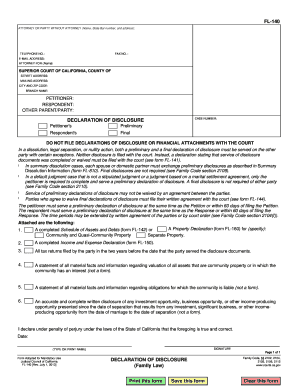
The California Declaration of Disclosure is a legal document used by parties in California family law cases to disclose financial information pertinent to dissolution, legal separation, and nullity actions.
pdfFiller scores top ratings on review platforms




Who needs CA FL-140?
Explore how professionals across industries use pdfFiller.

CA FL-140 is needed by:
-
Divorcing couples in California
-
Individuals filing for legal separation
-
Petitioners in nullity actions
-
Family law attorneys in California
-
Parties involved in asset distribution
Comprehensive Guide to CA FL-140
What is the California Declaration of Disclosure?
The California Declaration of Disclosure, specifically Form FL-140, plays an essential role in family law cases including dissolution, legal separation, and nullity actions. This form addresses the requirement for parties to disclose financial information, which is crucial for maintaining transparency during legal proceedings. By defining financial disclosure obligations, it ensures all relevant assets, debts, income, and expenses are appropriately shared.
Form FL-140 applies to multiple family law scenarios, emphasizing the significance of full financial disclosure to support fair asset distribution and liability allocation. Utilizing this form not only aligns with California's family law requirements but also protects the interests of both parties involved.
Purpose and Benefits of the California Declaration of Disclosure
The California Declaration of Disclosure serves essential purposes in legal proceedings by fostering transparency regarding financial matters. This transparency is vital for both parties as it can lead to a smoother negotiation process and help in establishing trust during potentially contentious legal actions.
Moreover, this form plays a key role in ensuring that there is a fair division of assets and liabilities, thereby aiding in equitable resolutions. Its completion secures a structured and comprehensive approach to financial disclosure, which benefits all individuals involved in divorce and separation cases.
Key Features of the California Declaration of Disclosure (Form FL-140)
Form FL-140 includes several key features that facilitate the financial disclosure process. Required fields encompass personal details such as names, addresses, and comprehensive financial information. Additionally, two important attachments need to be included for successful completion:
-
Schedule of Assets and Debts (Form FL-142)
-
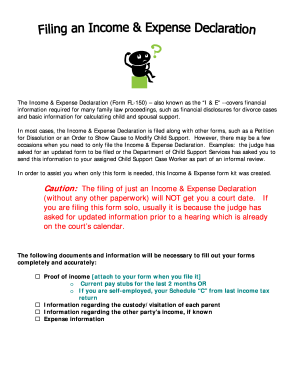
Income and Expense Declaration (Form FL-150)
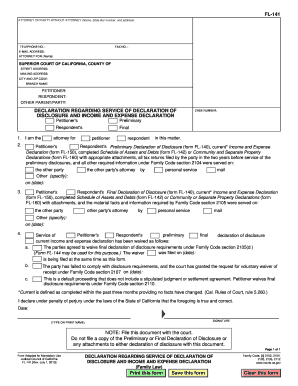
It is important to note that this form must be served to the other party but does not need to be filed with the court directly. Instead, a declaration of service for the final disclosure is required.
Who Needs the California Declaration of Disclosure?
Both the Petitioner and Respondent in family law cases need to be familiar with the California Declaration of Disclosure. Both roles have distinct responsibilities during the process, particularly when needing to disclose financial details accurately and completely.
The form is necessary for anyone participating in legal separation or nullity actions, emphasizing the importance of acknowledging who is required to sign and submit the documentation. This ensures compliance with the regulations governing family law cases, ultimately leading to a clearer legal process.
How to Fill Out the California Declaration of Disclosure Online
Filling out the California Declaration of Disclosure online is a straightforward process when approached systematically. Follow these steps to complete the form accurately:
-
Access the form and review all required sections thoroughly.
-
Fill in your personal information, including the names and addresses as instructed.
-
Carefully document your financial information to ensure accuracy.
-
Utilize tools from pdfFiller to edit and eSign your document before submission.
It's essential to prioritize accuracy and completeness to avoid complications throughout the legal process.
Submission Process for the California Declaration of Disclosure
The submission process for the California Declaration of Disclosure involves specific steps to ensure compliance with legal requirements. First, you must serve the form to the other party without directly submitting it to the court. It is also vital to collect proof of service for record-keeping purposes.
Additionally, it's advisable to be aware of the expected timeframes for submission and the responses that may follow. Ensuring that all necessary attachments are included can significantly reduce the risk of errors during this process.
Security and Compliance for the California Declaration of Disclosure
Handling the California Declaration of Disclosure securely is crucial due to the sensitivity of financial information. pdfFiller maintains high standards of document security, including the use of 256-bit encryption and adherence to HIPAA and GDPR compliance.
To ensure your documents remain private, follow best practices such as using strong passwords and limiting access to sensitive information. Understanding record retention requirements is also important to safeguard personal data when filling out the form.
How pdfFiller Can Assist You with the California Declaration of Disclosure
pdfFiller offers valuable tools to simplify your experience with the California Declaration of Disclosure. The platform provides features that allow you to create, manage, fill, and e-sign legal forms seamlessly online.
Utilizing pdfFiller not only streamlines the completion process but also enhances document management capabilities, enabling you to focus on what matters most—your legal proceedings. Consider experimenting with pdfFiller's services for an efficient online form management experience.
Practical Tips for Successful Submission of the California Declaration of Disclosure
To ensure a smooth submission process for the California Declaration of Disclosure, follow these practical tips:
-
Verify the completion and accuracy of all entries before submission.
-
Double-check that all necessary attachments are included with your form.
-
Be aware of common reasons for form rejection and how to avoid them.
By taking these steps, you can enhance the likelihood of a successful submission.
Final Thoughts on Completing the California Declaration of Disclosure
Completing the California Declaration of Disclosure is a pivotal step in navigating family law cases effectively. Utilizing the form ensures compliance with legal requirements and promotes transparency between both parties involved.
By opting for tools and resources, such as those provided by pdfFiller, you can enhance your experience while ensuring a streamlined and efficient process for financial disclosure.
How to fill out the CA FL-140
-
1.Access pdfFiller and search for 'California Declaration of Disclosure' or 'Form FL-140' to locate the document.
-
2.Open the form in pdfFiller's interface. Once open, familiarize yourself with the layout and sections of the form.
-
3.Before filling, gather the required financial information, such as assets, debts, income, and expenses to ensure accuracy.
-
4.Begin completing the blank fields. Start by filling in your name and address as the attorney or party without attorney at the top of the form.
-
5.Clearly indicate whether you are the 'Petitioner' or 'Respondent' by checking the appropriate box.
-
6.Proceed to systematically enter your financial information in the designated fields. Utilize pdfFiller's tools to input numerical values and text into the form.
-
7.If applicable, gather additional supporting documents such as the Schedule of Assets and Debts (Form FL-142) and Income and Expense Declaration (Form FL-150) to attach with the final declaration.
-
8.Regularly save your progress to avoid losing any information by using pdfFiller’s save feature.
-
9.Once completed, review the filled form thoroughly for accuracy and completeness to avoid common mistakes.
-
10.If everything is correct, use pdfFiller's option to finalize the form and prepare for submission.
-
11.You can then save or download the final copy in your desired format, or share it directly from pdfFiller as needed.

Who is eligible to use the California Declaration of Disclosure?
Anyone involved in a family law case in California, such as those seeking divorce, legal separation, or nullity, is eligible to use this form to disclose financial information.
What is the deadline for submitting the California Declaration of Disclosure?
While there isn't a specific deadline for submitting the Declaration of Disclosure itself, it must be served to the other party and should coincide with case deadlines set by the court.
How do I submit the completed California Declaration of Disclosure?
The completed form must be served to the other party involved in the family law case. It does not need to be filed with the court unless accompanied by a declaration of service for final disclosures.
What supporting documents are required with the Declaration of Disclosure?
You may need to attach supporting documents like the Schedule of Assets and Debts (Form FL-142) and the Income and Expense Declaration (Form FL-150) to provide complete financial disclosure.
What common mistakes should I avoid when filling out the form?
To avoid mistakes, ensure all fields are completed accurately, double-check financial figures, and confirm that the correct party roles are identified as either Petitioner or Respondent.
How long does it take to process the California Declaration of Disclosure?
The processing time for the Declaration of Disclosure can vary since it does not get filed with the court immediately; however, serving the document is often immediate, while responses may take longer.
Can I fill out the Declaration of Disclosure online?
Yes, you can fill out the California Declaration of Disclosure online using pdfFiller, which provides a user-friendly interface for completing and saving the form electronically.
CA FL-140 Form Versions
Related Content
Related Forms



Get the latest insights from our blog


If you believe that this page should be taken down, please follow our DMCA take down process
here
.
This form may include fields for payment information. Data entered in these fields is not covered by PCI DSS compliance.