
Last updated on
Nov 12, 2026
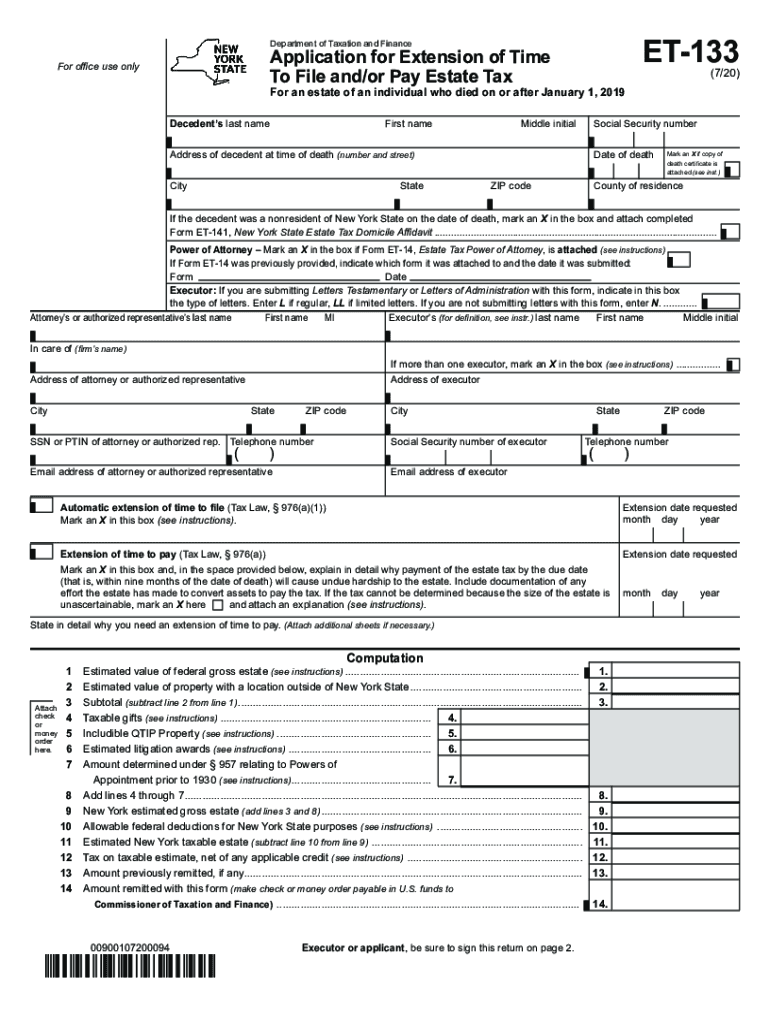
NY DTF ET-133 2020 free printable template
pdfFiller is not affiliated with any government organization

Fill out
Complete the form online in a simple drag-and-drop editor.

eSign
Add your legally binding signature or send the form for signing.

Share
Share the form via a link, letting anyone fill it out from any device.

Export
Download, print, email, or move the form to your cloud storage.
Why pdfFiller is the best tool for your documents and forms


End-to-end document management
From editing and signing to collaboration and tracking, pdfFiller has everything you need to get your documents done quickly and efficiently.
Accessible from anywhere
pdfFiller is fully cloud-based. This means you can edit, sign, and share documents from anywhere using your computer, smartphone, or tablet.
Secure and compliant
pdfFiller lets you securely manage documents following global laws like ESIGN, CCPA, and GDPR. It's also HIPAA and SOC 2 compliant.
What is NY DTF ET-133
The New York Estate Tax Extension Form ET-133 is a tax document used by executors or attorneys to request an extension of time for filing and/or paying estate tax for individuals who died on or after January 1, 2019.
pdfFiller scores top ratings on review platforms




Who needs NY DTF ET-133?
Explore how professionals across industries use pdfFiller.

NY DTF ET-133 is needed by:
-
Executors managing deceased estates
-
Attorneys representing estates in New York
-
Individuals seeking an extension for estate tax payments
-
Tax professionals assisting with estate tax filings
-
Family members involved in estate matters
-
Estate administrators dealing with tax obligations
Comprehensive Guide to NY DTF ET-133
What is the New York Estate Tax Extension Form ET-133?
The New York Estate Tax Extension Form ET-133 is designed to assist executors and attorneys in requesting additional time to file and/or pay estate tax for individuals who died on or after January 1, 2019. This form is vital in the estate tax process as it allows necessary time to gather the required information and complete tax calculations accurately. Completing the form with precision is crucial to ensure compliance with state regulations and avoid any potential penalties.
Typically, the form is utilized by individuals managing estate matters, specifically executors and attorneys, who play key roles in navigating the complexities of estate tax liabilities in New York.
Purpose and Benefits of the New York Estate Tax Extension Form ET-133
Applying for the estate tax extension using the ET-133 form comes with significant benefits for stakeholders. One primary advantage is the alleviation of immediate financial pressure, as estate taxes can be substantial and time-consuming to calculate. The extension provided by this form allows individuals to manage their estate tax responsibilities more effectively, particularly in situations where obtaining necessary documents or valuations may take longer than expected.
Extensions are especially beneficial when there are complications such as contested wills, missing documentation, or when additional time is needed to secure accurate valuations of estate assets.
Who Needs the New York Estate Tax Extension Form ET-133?
The ET-133 form is necessary for several key parties involved in estate administration. Executors, designated by the deceased individual, are primarily responsible for filing the form, although they often work closely with attorneys to ensure proper completion and adherence to legal requirements. Any executor or attorney should consider filing this form when facing complexities in the estate, such as unexpected delays or extensive paperwork.
Examples of situations that necessitate the use of the ET-133 form include managing estates with significant assets, unresolved family conflicts, or ongoing legal proceedings related to the estate.
Eligibility Criteria for the New York Estate Tax Extension Form ET-133
To successfully file the ET-133 form, applicants must meet certain eligibility requirements. Basic criteria include being the executor or authorized attorney of the estate and submitting the request for an extension before the initial due date of the estate tax. Additionally, the reasons provided for requesting an extension must be valid, typically based on the need for more time to gather required tax-related documents.
If an individual is determined to be ineligible for the extension, they may face immediate tax filing deadlines, potentially resulting in penalties or interest on unpaid taxes.
How to Fill Out the New York Estate Tax Extension Form ET-133 Online
Filling out the ET-133 form online is a straightforward process. Follow these steps to ensure accurate completion:
-
Access the ET-133 form through a secure online platform.
-
Enter the decedent’s details, including their name and date of death.
-
Provide information regarding the estate and any tax calculations required.
-
Clearly explain the reason for the extension request in the designated section.
-
Review the completed form for accuracy before submitting.
To avoid common mistakes, double-check all entries, particularly numerical values and dates, and ensure all required fields are filled out completely.
Key Features of the New York Estate Tax Extension Form ET-133
The ET-133 form incorporates several key features that facilitate ease of use. Notable attributes include fillable fields that guide users through the completion process, along with explicit instructions for each section of the form. Additionally, the necessity for signatures from the executor or attorney ensures that accurate representation is maintained throughout the submission.
This form also gathers comprehensive information about the estate, including estimates of its value and specific tax obligations, which are critical for assessment by tax authorities.
Submission Methods for the New York Estate Tax Extension Form ET-133
Once completed, the ET-133 form can be submitted through various methods to accommodate user preferences. Submissions may include online options, postal mail, or in-person delivery to designated offices, ensuring flexibility based on the executor's or attorney's situation.
It is essential to be aware of submission deadlines to avoid complications, as extensions have specific timelines within which they must be filed to be considered valid.
What Happens After You Submit the New York Estate Tax Extension Form ET-133?
After submitting the ET-133 form, users should anticipate certain next steps. An important aspect is tracking the status of the extension request, which can typically be done through the submission platform used. Understanding the potential outcomes, including approval or denial of the request, is crucial for effective estate management.
If an extension is denied, the executor or attorney needs to be prepared to meet original filing deadlines to ensure compliance and avoid penalties.
Security and Compliance for the New York Estate Tax Extension Form ET-133
When utilizing platforms like pdfFiller to complete the ET-133 form, security and compliance are paramount. The platform employs 256-bit encryption and is compliant with regulations such as HIPAA and GDPR, safeguarding sensitive estate information throughout the filing process. Protecting this data is critical, particularly given the nature of financial documentation.
Easily Complete Your New York Estate Tax Extension ET-133 Form with pdfFiller
Utilizing pdfFiller for the ET-133 form simplifies the process of filling out and submitting the form. The platform offers a user-friendly interface along with cloud-based features, making document management seamless. Users benefit from tools that allow easy eSigning and editing, enhancing the overall experience when managing tax forms.
How to fill out the NY DTF ET-133
-
1.To access the New York Estate Tax Extension Form ET-133 on pdfFiller, visit the pdfFiller website and search for the form using the search bar.
-
2.Once you find the form, click on it to open it in the pdfFiller editor.
-
3.Before you start filling in the form, gather all the necessary information, such as the decedent's details, date of death, estimated estate value, and reasons for the extension.
-
4.Begin filling in the required fields, including the decedent’s last name and date of death, by clicking on the text fields within the form.
-
5.Use pdfFiller's tools to enter information accurately; you may also use checkboxes where applicable.
-
6.As you proceed, take advantage of pdfFiller’s auto-save feature to ensure your work is not lost.
-
7.Review each section of the form carefully, checking for completeness and accuracy, as any mistakes could delay processing.
-
8.Once completed, finalize the form by clicking on the ‘Done’ button.
-
9.To save or download the completed form, click on the ‘Save’ or ‘Download’ option located on the toolbar.
-
10.If you need to submit the form, follow the submission instructions provided in the form and use pdfFiller's features to send it electronically or print it for mailing.

Who is eligible to use the New York Estate Tax Extension Form ET-133?
The New York Estate Tax Extension Form ET-133 can be used by executors or attorneys representing estates for individuals who passed away on or after January 1, 2019. Eligibility is contingent upon needing an extension for filing or paying estate taxes.
What is the deadline for submitting the ET-133 form?
The ET-133 form must be submitted before the original estate tax return due date. It's essential to file this extension to ensure you do not incur penalties for late filing or payment.
How do I submit the ET-133 form once completed?
You can submit the ET-133 form electronically through the New York State Department of Taxation and Finance website, or print it to mail along with any required supporting documents as indicated on the form.
What supporting documents are needed with the ET-133 form?
When submitting the ET-133 form, ensure to include any necessary documentation that supports your request for an extension, such as details about the estate’s financial situation and justification for the extension.
What are common mistakes to avoid when filling out the ET-133 form?
Common mistakes include failing to complete required fields, incorrect calculations of estimated taxes, and submitting after the deadline. Thoroughly review the form before submitting to avoid these issues.
How long does it take to process the ET-133 form?
Processing times can vary, but typically, the New York Department of Taxation and Finance will notify you regarding your extension status within a few weeks. Ensure to file early to facilitate timely processing.
Is notarization required for the ET-133 form?
No, notarization is not required for the New York Estate Tax Extension Form ET-133. It simply needs to be signed by the executor or attorney.
NY DTF ET-133 Form Versions
Related Content
Related Forms



Get the latest insights from our blog


If you believe that this page should be taken down, please follow our DMCA take down process
here
.
This form may include fields for payment information. Data entered in these fields is not covered by PCI DSS compliance.