
Last updated on
Nov 6, 2026

CA FL-320 2025 free printable template
pdfFiller is not affiliated with any government organization

Fill out
Complete the form online in a simple drag-and-drop editor.

eSign
Add your legally binding signature or send the form for signing.

Share
Share the form via a link, letting anyone fill it out from any device.

Export
Download, print, email, or move the form to your cloud storage.
Why pdfFiller is the best tool for your documents and forms


End-to-end document management
From editing and signing to collaboration and tracking, pdfFiller has everything you need to get your documents done quickly and efficiently.
Accessible from anywhere
pdfFiller is fully cloud-based. This means you can edit, sign, and share documents from anywhere using your computer, smartphone, or tablet.
Secure and compliant
pdfFiller lets you securely manage documents following global laws like ESIGN, CCPA, and GDPR. It's also HIPAA and SOC 2 compliant.
What is CA FL-320
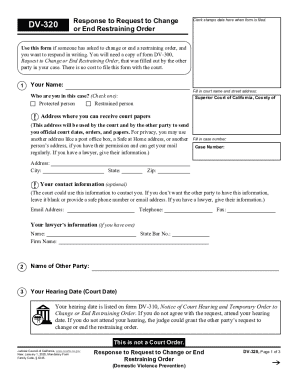
The California Responsive Declaration to Request for Order is a legal document used by parties in California family law cases to respond to a Request for Order regarding custody, support, and other orders.
pdfFiller scores top ratings on review platforms




I HAD NOT FOUND ONE THAT WOULD WORK SO…
I HAD NOT FOUND ONE THAT WOULD WORK SO WELL
THAY ARE AMAZING LITTERALLY!
THAY ARE AMAZING LITTERALLY!
Kara was very helpful in transferring…
Kara was very helpful in transferring my account over to a different email. Thank you!
Great tool
Great tool, very flexible and handy
App was user friendly and easy to navigate.
very user friendly
Who needs CA FL-320?
Explore how professionals across industries use pdfFiller.

CA FL-320 is needed by:
-
Petitioners involved in family law disputes
-
Respondents receiving Requests for Orders
-
Other parents or parties in custody or support cases
-
Attorneys representing clients in family law matters
-
Individuals seeking modifications to existing court orders
Comprehensive Guide to CA FL-320
What is the California Responsive Declaration to Request for Order?
The California Responsive Declaration to Request for Order, known as the FL-320 form, is a pivotal document in California family law. This form serves the purpose of allowing a respondent to formally respond to requests made regarding child custody, spousal support, and various other family-related issues. Understanding the significance of the FL-320 form is essential for those involved in legal proceedings.
This declaration involves three main parties: the Petitioner, the Respondent, and potentially the Other Parent/Party. Each of these roles plays a critical part in family law matters, ensuring all voices are heard in court, especially when it comes to sensitive issues like child custody and support.
Purpose and Benefits of the California Responsive Declaration to Request for Order
The FL-320 serves a crucial role in the legal process, facilitating structured responses to court requests. By utilizing this California family law form, individuals enhance their legal standing during proceedings. It is not merely a procedural formality; it provides a platform for delivering vital information that influences court decisions.
Among the benefits, the form allows parties to present requested orders or alternatives effectively. This proactive measure significantly bolsters legal protection, ensuring that responses are comprehensive and aligned with court expectations.
Key Features of the California Responsive Declaration to Request for Order
The FL-320 form contains several essential features designed to simplify the response process. First, it includes multiple fillable fields and checkboxes that guide users through the completion of vital sections. Additionally, each declaration must be signed under penalty of perjury, emphasizing the seriousness of the information provided.
Specific sections are tailored to address different types of requests, such as custody arrangements or support obligations, ensuring users have clarity on what is required for various family law scenarios.
Who Needs the California Responsive Declaration to Request for Order?
This form is essential for individuals involved in family law cases, particularly those who hold the roles of Petitioner, Respondent, and Other Parent/Party. It is crucial for parties currently engaged in ongoing legal proceedings to understand when they must utilize this document.
Family law situations where the FL-320 is applicable include those related to child custody, spousal support, and other related legal matters. Its proper use is vital for ensuring that court requests are addressed effectively.
How to Fill Out the California Responsive Declaration to Request for Order Online (Step-by-Step)
Filling out the FL-320 form online involves several key steps. First, gather all necessary information relevant to the case, including personal details and specifics regarding the requests being made.
-
Access the form on a secure platform.
-
Carefully enter personal and case details in the designated fields.
-
Review and ensure accuracy for each section, especially where critical responses are required.
-
Sign the form electronically, ensuring adherence to regulations regarding the penalty of perjury.
-
Save a copy for your records before submission.
Verifying accuracy before submission is essential to avoid complications or delays in the court process.
Submission Methods for the California Responsive Declaration to Request for Order
Once completed, the FL-320 can be submitted through various methods. Users can choose to submit the form online, via mail, or in-person at the appropriate court.
When submitting, it's important to include any required documentation that accompanies the form. Additionally, users should be aware of any associated fees and deadlines for submission, as these factors can influence processing times and court schedules.
What Happens After You Submit the California Responsive Declaration to Request for Order?
After the submission of the FL-320, the court initiates specific processes concerning the case. Users can expect to receive notifications regarding the acceptance or rejection of their declaration. Timelines for these notifications can vary based on court workloads and procedures.
Monitoring the application status is crucial, as it allows individuals to stay informed about their case developments and respond promptly to any additional requests from the court.
Security and Compliance When Dealing with the California Responsive Declaration to Request for Order
When handling the California Responsive Declaration to Request for Order, security and compliance are paramount. Users can rest assured knowing that robust security measures, such as 256-bit encryption and adherence to GDPR and HIPAA regulations, are in place to protect sensitive legal documents.
Confidentiality remains a critical aspect when submitting documents, ensuring that personal and case information is safeguarded throughout the legal process.
Using pdfFiller to Efficiently Complete the California Responsive Declaration to Request for Order
pdfFiller offers a user-friendly platform that streamlines the process of completing the FL-320 form. With features like editing, eSigning, and sharing, users can manage their legal documents efficiently without the need for downloads.
The cloud-based access allows for easy management of documents, ensuring that users can fill out forms, save progress, and retrieve documents from any browser at their convenience.
Sample of a Completed California Responsive Declaration to Request for Order
To aid in understanding the proper completion of the FL-320 form, a visual representation of a filled-out sample can be invaluable. This example provides annotations that clarify the context and completion tips for each section of the form, guiding users in their submissions.
Additional resources for assistance, including guidelines and contact information for legal aid, are available to support users seeking further clarification on the form completion process.
How to fill out the CA FL-320
-
1.To access the California Responsive Declaration to Request for Order form on pdfFiller, visit their website and utilize the search function to locate the FL-320 form.
-
2.Open the form in the pdfFiller editor, which allows you to navigate through the document easily using the on-screen tools and form fields.
-
3.Before starting, gather necessary information including prior court orders, details surrounding the request, and any relevant financial documentation.
-
4.Begin completing the form by filling in all required fields. Utilize pdfFiller’s features to add text, checkboxes, and to digitally sign where necessary.
-
5.Make sure you carefully read each section and provide accurate responses as incorrect information can affect your legal standing.
-
6.Review your completed form for any errors or missing fields to ensure you have included all necessary information.
-
7.Once satisfied with your entries, save your progress, and choose to either download a copy of the form, print it, or submit it electronically through pdfFiller’s submission features.

Who is eligible to use the California Responsive Declaration to Request for Order?
This form is intended for individuals involved in family law cases in California, specifically those responding to legal requests for custody or support modifications.
Is there a deadline for submitting this form?
Yes, it is typically advised to submit the Responsive Declaration before the scheduled hearing date. Check with your local court for specific time requirements.
How do I submit the completed Responsive Declaration form?
After completing the form on pdfFiller, you may print and file it with the court in person or submit it electronically if your court allows electronic filings.
What supporting documents do I need to attach?
While not always mandatory, it is advisable to include any prior court orders, financial statements, and relevant evidence that support your declaration.
What are common mistakes to avoid when filling out the form?
Common mistakes include leaving fields blank, providing inaccurate information, or failing to sign the declaration, which can lead to delays in processing.
How long does it typically take to process the Responsive Declaration?
Processing times can vary, but most courts aim to review filed documents within a few weeks. Inquiries regarding specific timelines should be made directly to the court.
Can I edit the Responsive Declaration after submitting it?
Once submitted, you might not be able to modify the original declaration. For changes, you may need to file another motion or document with the court.
CA FL-320 Form Versions
Related Content
Related Forms




Get the latest insights from our blog


If you believe that this page should be taken down, please follow our DMCA take down process
here
.
This form may include fields for payment information. Data entered in these fields is not covered by PCI DSS compliance.