What is College Student Budget?
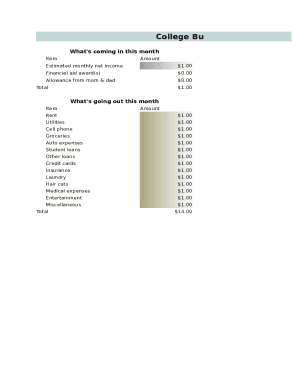
A College Student Budget is a financial plan that helps students manage their expenses and income while attending college. It includes tracking all sources of income, such as part-time jobs or financial aid, as well as expenses like tuition, books, housing, and entertainment.
What are the types of College Student Budget?
There are two main types of College Student Budgets: Basic Budget and Detailed Budget.
Basic Budget - This type focuses on tracking overall income and expenses without detailed breakdowns.
Detailed Budget - This type involves tracking every single expense category and source of income to create a more accurate financial plan.
How to complete College Student Budget
Completing a College Student Budget is crucial for financial stability. Here are some steps to guide you through the process:
01
Calculate your total income including part-time job earnings, financial aid, scholarships, etc.
02
List all your expenses such as tuition, books, housing, food, transportation, and entertainment.
03
Subtract your total expenses from your total income to determine your remaining balance.
04
Adjust your budget as needed to ensure you are living within your means.
05
Use tools like pdfFiller to create and manage your budget easily and effectively.
pdfFiller empowers users to create, edit, and share documents online. Offering unlimited fillable templates and powerful editing tools, pdfFiller is the only PDF editor users need to get their documents done.
Thousands of positive reviews can’t be wrong
Read more or give pdfFiller a try to experience the benefits for yourself
Questions & answers
Is the 50 30 20 rule good?
A lot of money experts recommend the 50/30/20 budget, where 50% of your income goes to needs, 30% goes to wants, and 20% goes to savings and debt.
Can you live off $1,000 a month after bills?
If you're trying to live on a $1,000-a-month budget, all of it can't go to housing. Unfortunately, the national average fair market rent for a one-bedroom apartment or home is $1,105 per month. So even if you cut your budget in half to account for housing, you'll still fall way short.
What's the 50 30 20 budget rule?
One of the most common percentage-based budgets is the 50/30/20 rule. The idea is to divide your income into three categories, spending 50% on needs, 30% on wants, and 20% on savings. Learn more about the 50/30/20 budget rule and if it's right for you.
How much money does a student need per week?
Cost of living in London: How much is it? Imperial College notes that students moving to London for the term 2022-23 may require about 360 British pounds a week. This totals about 1,500 pounds per month and £18,000 a year. Meanwhile, King's College London recommends students budget approximately £1,250 per month.
What is the 50 40 10 budgeting rule and how is it broken down?
that doesn't involve detailed budgeting categories. Instead, you spend 50% of your after-tax pay on needs, 40% on wants, and 10% on savings or paying off debt.
Does 50 30 20 include 401k?
Important reminder: The 50/30/20 budget rule only considers your take-home pay for the month, so anything automatically deducted from your paycheck — like your work health insurance premium or 401k retirement contribution — doesn't count in the equation.