Social Media Questionnaire Templates

Get eSignatures done in a snap

Prepare, sign, send, and manage documents from a single cloud-based solution.

What are Social Media Questionnaire Templates?

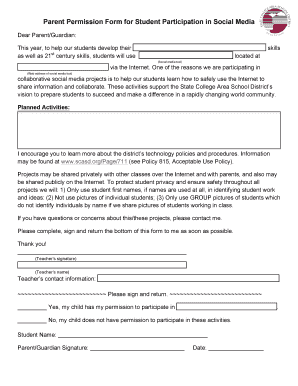
Social Media Questionnaire Templates are pre-designed forms or documents that help businesses gather information from their target audience on social media platforms. These templates allow users to create customized surveys or questionnaires to collect valuable feedback, opinions, or data from followers and potential customers.
What are the types of Social Media Questionnaire Templates?

There are several types of Social Media Questionnaire Templates available, including but not limited to: 1. Customer Satisfaction Surveys 2. Product Feedback Forms 3. Market Research Questionnaires 4. Social Media Engagement Polls 5. Brand Awareness Surveys
Customer Satisfaction Surveys
Product Feedback Forms
Market Research Questionnaires
Social Media Engagement Polls
Brand Awareness Surveys

How to complete Social Media Questionnaire Templates
Completing Social Media Questionnaire Templates is easy and straightforward. Here are some steps to help you get started:
01
Start by choosing the right template that suits your purpose
02
Customize the questions to align with your objectives
03
Share the questionnaire on your social media channels or website
04
Collect and analyze the responses
05
Use the insights gathered to improve your social media strategy

pdfFiller empowers users to create, edit, and share documents online. Offering unlimited fillable templates and powerful editing tools, pdfFiller is the only PDF editor users need to get their documents done.

Video Tutorial How to Fill Out Social Media Questionnaire Templates
Thousands of positive reviews can’t be wrong

Read more or give pdfFiller a try to experience the benefits for yourself
5.0
Hows just about any forum you need Hows just about any forum you need.
Hows just about any forum you need Hows just about any forum you need. Saved me a lot of time trying to search for what I was looking for.
spenceralayman
5.0
PDFFILLER HAS CHANGED MY PRACTICE - FOR THE BETTER
I use this software everyday and have found it a necessity in my practice.
Julia
4.0
So far, so good.
So far, so good. Was hoping for more font editing tools for the price, but it does the basic trick. Thanks!
Andrea L
4.0
Not intuitive as to how to upload your PDF for edit and also, confusing as how t...
Not intuitive as to how to upload your PDF for edit and also, confusing as how to use the tools to add text to a document.
JFSEA

Questions & answers

A good questionnaire should be valid, reliable, clear, succinct and interesting. It is important to design the questionnaire based on a conceptual framework, scrutinise each question for relevance and clarity, and think of the analysis you are going to perform at the end of the day.
These 5 basic questions—how, why, who, when, and what—don't get as much attention as the more popular questions you include in your survey. But they should.
Which of the following social media website do you currently have an account with? How often do you check-in to your social media accounts in any given week? In a week, which of the following social media websites do you visit most frequently? What is your go-to device to access your social media feed?
Product Survey Questions Examples How often do you use our products? Which features are most valuable to you. How would you compare our products to our competitors'? What important features are we missing? What are you trying to solve by using our product? What other types of people could find our product useful?
A social media survey, as the name implies, is a method of gathering opinion and observational data through a social media platform. Whether it's via Facebook or LinkedIn, Instagram or Tik Tok, marketers can use social media channels to ask a target audience to participate in surveys.
While there isn't an official book of survey questions or survey taxonomy, I find it helpful to break down survey questions into four classes: open-ended, closed-ended (static), closed-ended (dynamic), and task-based.