
Last updated on
Oct 31, 2026
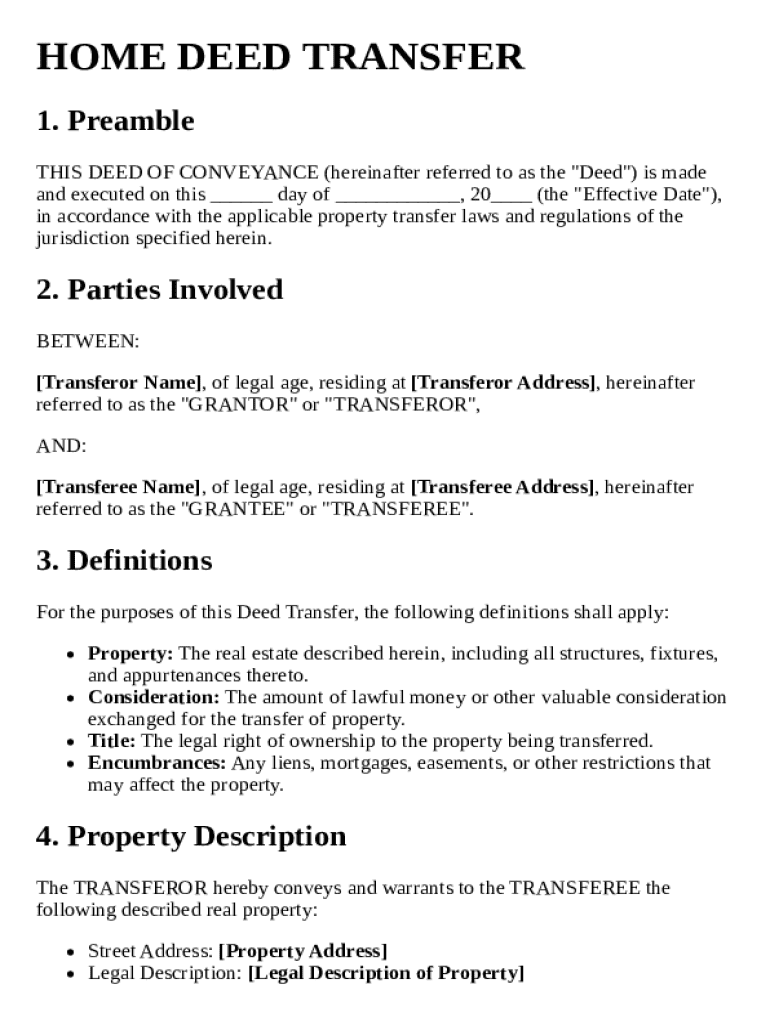
Home Deed Transfer Template free printable template
We are not affiliated with any brand or entity on this form

Fill out
Complete the form online in a simple drag-and-drop editor.

eSign
Add your legally binding signature or send the form for signing.

Share
Share the form via a link, letting anyone fill it out from any device.

Export
Download, print, email, or move the form to your cloud storage.
Why pdfFiller is the best tool for your documents and forms


End-to-end document management
From editing and signing to collaboration and tracking, pdfFiller has everything you need to get your documents done quickly and efficiently.
Accessible from anywhere
pdfFiller is fully cloud-based. This means you can edit, sign, and share documents from anywhere using your computer, smartphone, or tablet.
Secure and compliant
pdfFiller lets you securely manage documents following global laws like ESIGN, CCPA, and GDPR. It's also HIPAA and SOC 2 compliant.
What is Home Deed Transfer Template
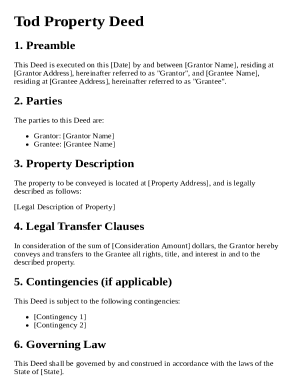
The Home Deed Transfer is a legal document used by property owners to transfer ownership of real estate from one party to another.
pdfFiller scores top ratings on review platforms




i like it
Good product with good support
Good product with good support
Excellent and is user friendly.
Excellent and is user friendly.
good feature
good feature
There are many template options to…
There are many template options to choose from, which is very helpful. PdfFiller is also easy to navigate. I would highly recommend it!
Good Learning Program, and definitely interested in future Webinars and the alike. Would definitely Recommend pdfiller
Who needs Home Deed Transfer Template?
Explore how professionals across industries use pdfFiller.

Home Deed Transfer Template is needed by:
-
Homeowners wanting to sell their property
-
Buyers acquiring real estate
-
Real estate agents facilitating transactions
-
Legal professionals handling property transfers
-
Notaries public verifying signatures
Comprehensive Guide to Home Deed Transfer Template
What is the Home Deed Transfer?
The Home Deed Transfer is a legal document used to facilitate the transfer of ownership of real property in the United States. This form outlines essential details regarding the property, ensuring a clear and efficient property ownership transfer from the transferor (grantor) to the transferee (grantee). Understanding the roles of these parties is crucial in the process of property transactions.
-
The Home Deed Transfer serves as an official record of ownership.
-
This legal document is vital for establishing the rights of the new owner.
-
It clarifies the responsibilities of both the transferor and transferee.
Purpose and Benefits of the Home Deed Transfer
A Home Deed Transfer is essential for securely and clearly transferring property ownership between parties. Its legal recognition is pivotal for mitigating disputes and ensuring that the transfer is valid.
-
Ownership is securely passed on, minimizing legal risks.
-
Legal recognition protects all parties in property transactions.
-
Notarization enhances the document's validity and credibility.
Key Features of the Home Deed Transfer
The Home Deed Transfer includes several critical components that must be completed to ensure its effectiveness. Each section serves to provide clarity and legal backing to the transaction.
-
Sections include names of both parties and property details.
-
Consideration paid for the property is clearly defined.
-
Signature lines prompt required approval from both the transferor and transferee.
-
A notary acknowledgment block confirms the authenticity of the signatures.
Who Needs the Home Deed Transfer?
The Home Deed Transfer is necessary for any individuals looking to legally convey ownership of a property. Both buyers and sellers must understand their roles in this process.
-
Transferors are typically sellers who convey their property rights.
-
Transferees are usually buyers acquiring ownership.
-
Anyone involved in real estate transactions requires this document for legal compliance.
State-Specific Considerations for the Home Deed Transfer
Variations in state laws mean that requirements for the Home Deed Transfer can differ significantly across jurisdictions. Understanding these differences is vital for successful submissions.
-
State laws dictate the specifics of how the form is filled out and executed.
-
Notarization requirements may vary significantly by state.
-
Consult resources to familiarize yourself with local submission protocols.
How to Fill Out the Home Deed Transfer Online (Step-by-Step)
Filling out the Home Deed Transfer form online can be simplified through a few systematic steps. Accuracy is of paramount importance to prevent future disputes.
-
Access the Home Deed Transfer form through an online platform.
-
Fill in the required fields with accurate details.
-
Review the completed form to ensure completeness.
-
Save the form for your records and retrieval.
How to Sign or Notarize the Home Deed Transfer
Signing and notarizing the Home Deed Transfer are crucial steps that validate the document for submission. Understanding this process will streamline your transaction.
-
Both parties must provide their signatures on the document.
-
Notary acknowledgment is necessary for formal validation.
-
Differentiate between digital signatures and traditional wet signatures based on your needs.
Submission Methods and Delivery of the Home Deed Transfer
There are various methods for submitting the Home Deed Transfer, and understanding these options is key to timely submission and processing.
-
Online submissions often yield quicker processing times.
-
Mail submissions require awareness of postal timelines.
-
In-person submissions can facilitate immediate confirmation.
Importance of Security and Compliance
Ensuring security and compliance during the document management process is critical for protecting sensitive information. pdfFiller employs robust security measures to uphold data integrity.
-
256-bit encryption safeguards sensitive information during transfers.
-
Compliance with HIPAA and GDPR ensures strict privacy standards.
-
pdfFiller's reputation is built on secure document handling protocols.
Start Your Home Deed Transfer with pdfFiller
Utilizing pdfFiller simplifies the process of completing your Home Deed Transfer. The platform's user-friendly features make filing and compliance straightforward.
-
Access tools designed to facilitate quicker form completion.
-
Ensure proper filing to avoid future legal complications.
-
Take advantage of available support and resources for a seamless experience.
How to fill out the Home Deed Transfer Template
-
1.To start, access pdfFiller and log into your account. Use the search function to locate the Home Deed Transfer form.
-
2.Once you open the form, familiarize yourself with the layout. It contains various fields where you will enter necessary information.
-
3.Before filling out the form, gather essential details such as the names and addresses of the transferor and transferee, property details, and the effective date of the transfer.
-
4.Begin filling in the form by entering the 'Transferor Name' and 'Transferor Address' in the respective fields. Follow up with the 'Transferee Name' and 'Transferee Address'.
-
5.Continue by specifying the legal description of the property and any other relevant details concerning the transfer.
-
6.Ensure you complete the section regarding consideration paid, clearly stating the amount involved in the transfer.
-
7.Look for the signature lines designated for both the transferor and transferee. Use the 'Signature' function in pdfFiller to add digital signatures.
-
8.After completing all the necessary fields, review the form for any errors or omissions to ensure all information is accurate.
-
9.When ready, save your progress. You can either download the form as a PDF or submit directly through the pdfFiller interface.
-
10.If you need to notarize the document, print the form after saving. Ensure it is signed in front of a notary public.
-
11.Finally, make a copy of the finalized form for your records before submitting it to the appropriate state office, if required.

Who is eligible to use the Home Deed Transfer form?
The Home Deed Transfer form can be used by any homeowner (transferor) looking to sell their property to a buyer (transferee). Both parties must be legally capable of entering into a contract.
Are there any deadlines for completing the form?
While there are no specific deadlines for filling out the Home Deed Transfer, timely completion is advisable to align with property sale contracts and to avoid delays in the transfer process.
How should I submit the completed form?
After completing the Home Deed Transfer form, submit it to the appropriate county or state office where the property is located. This may involve mailing the document or submitting it in person.
What supporting documents are required?
Generally, supporting documents may include a current tax bill, property prior deeds, and possibly proof of identity for notarization. Check local regulations for specific requirements.
What mistakes should I avoid when completing the form?
Common mistakes include failing to enter accurate legal descriptions of the property, missing signatures, or not notarizing the document when required. Always double-check your entries.
How long does processing take after submission?
Processing times can vary depending on local government offices. Typically, it may take a few weeks for the deed to be officially recorded after submission.
Do I need a lawyer to complete the Home Deed Transfer?
While it is not legally required to have a lawyer, consulting a real estate attorney might be beneficial to ensure compliance with local laws and protect your interests during the transfer.
Related Forms


Get the latest insights from our blog



If you believe that this page should be taken down, please follow our DMCA take down process
here
.
This form may include fields for payment information. Data entered in these fields is not covered by PCI DSS compliance.