
Last updated on
Oct 31, 2026
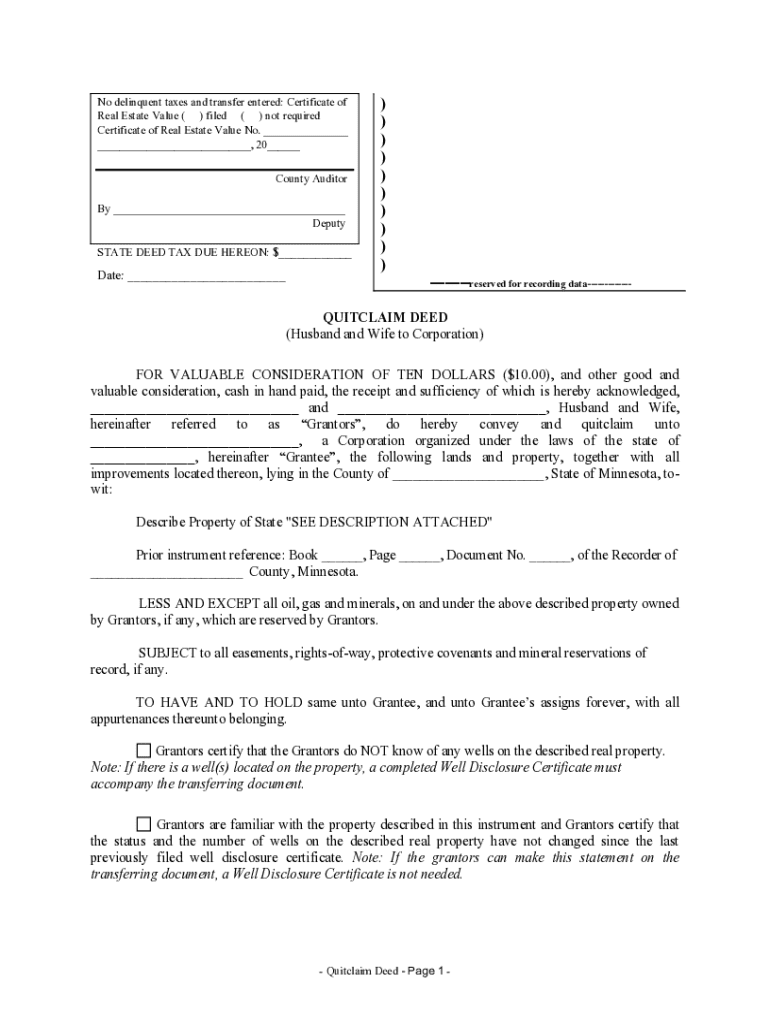
Get the free Quitclaim Deed Husband and Wife to Corporation
We are not affiliated with any brand or entity on this form

Fill out
Complete the form online in a simple drag-and-drop editor.

eSign
Add your legally binding signature or send the form for signing.

Share
Share the form via a link, letting anyone fill it out from any device.

Export
Download, print, email, or move the form to your cloud storage.
Why pdfFiller is the best tool for your documents and forms


End-to-end document management
From editing and signing to collaboration and tracking, pdfFiller has everything you need to get your documents done quickly and efficiently.
Accessible from anywhere
pdfFiller is fully cloud-based. This means you can edit, sign, and share documents from anywhere using your computer, smartphone, or tablet.
Secure and compliant
pdfFiller lets you securely manage documents following global laws like ESIGN, CCPA, and GDPR. It's also HIPAA and SOC 2 compliant.
What is Quitclaim Deed
The Quitclaim Deed is a legal document used by property owners to transfer their interest in a property to another party without warranties. It serves to ensure a clear title transfer between spouses or other relatives.
pdfFiller scores top ratings on review platforms




Who needs Quitclaim Deed?
Explore how professionals across industries use pdfFiller.

Quitclaim Deed is needed by:
-
Spouses transferring property between each other
-
Family members who wish to gift property
-
Real estate investors managing titles
-
Individuals settling estates or inheritance issues
-
Anyone needing to clarify property ownership
Comprehensive Guide to Quitclaim Deed
What is a Quitclaim Deed Between Husband and Wife?
A quitclaim deed is a legal document that transfers ownership of property between spouses without a warranty of title. This type of deed is commonly used in situations where a husband and wife need to transfer property rights, such as during a divorce settlement or when one spouse wants to remove themselves from the title. With a quitclaim deed, the transferring spouse relinquishes any claim to the property to the other spouse.
One primary advantage of using a quitclaim deed for married couples is its simplicity. The process requires minimal paperwork and can be processed quickly, making it ideal for situations where an immediate transfer of ownership is necessary.
Purpose and Benefits of a Quitclaim Deed for Couples
Couples often find themselves in situations where a quitclaim deed is necessary. This may occur during a divorce when property needs to be divided, or in estate planning when one spouse wishes to add the other as a co-owner. This type of deed facilitates property transfers without requiring the lengthy process of title insurance, which is typically needed for other types of deeds.
The benefits of using a quitclaim deed for property transfers between spouses include:
-
Ease of use, as complete legal descriptions are usually not required.
-
Quick transfers, allowing couples to finalize arrangements efficiently.
-
Cost-effectiveness, since there are often no associated closing costs.
Key Features of the Quitclaim Deed Between Husband and Wife
Essential components of a quitclaim deed include the names of the parties involved and a detailed description of the property being transferred. The deed must also include the signatures of both spouses for it to be valid, along with witnessing requirements as dictated by state laws.
Key features of a quitclaim deed are:
-
Identification of the granter (the transferring spouse) and the grantee (the receiving spouse).
-
Accurate legal description of the property being transferred.
-
Signatures, which are necessary to finalize the transfer.
Who Needs a Quitclaim Deed Between Husband and Wife?
A quitclaim deed may be necessary in various circumstances, such as during the purchase of a new home, transferring property as part of estate planning, or changing the title following marriage. This deed is especially relevant for couples who need to clarify ownership or resolve property disputes.
Common users of quitclaim deeds include:
-
Couples going through a divorce.
-
Newly married couples seeking to add a spouse to the property title.
-
Couples managing shared assets in estate planning.
How to Fill Out the Quitclaim Deed for Spouses (Step-by-Step)
Filling out a quitclaim deed is straightforward if the correct steps are followed. Here is a step-by-step guide:
-
Obtain a blank quitclaim deed template suitable for your state.
-
Enter the granter’s name and the grantee’s name at the top of the form.
-
Clearly describe the property being transferred, including the address and parcel number.
-
Include the date of the transfer and make necessary declarations.
-
Sign the deed in the presence of a notary public for validation.
Required Documents and Supporting Materials for a Quitclaim Deed
To successfully complete a quitclaim deed, several supporting documents may be required. These typically include:
-
Identification documents for both spouses, such as driver's licenses.
-
Any existing deeds showing previous ownership.
-
Property tax information that may be relevant for accurate filing in some states.
Additionally, be aware of any state regulations that may require specific documentation or forms when filing a quitclaim deed.
How to Sign and Notarize the Quitclaim Deed
The signing and notarization process for a quitclaim deed between a husband and wife is crucial for its validity. Both parties must sign the document, and typically a notary public needs to witness these signatures. This step helps prevent disputes regarding ownership down the line.
A digital signature can often be accepted today, but it is important to check local laws as they may differ regarding signature requirements in property transactions.
Where to Submit the Quitclaim Deed After Completion
Once the quitclaim deed is completed and signed, it must be submitted to the appropriate county recorder’s office where the property is located. The filing process usually involves paying a fee and ensuring that the document is recorded with the appropriate government entity.
Timelines for filing may vary, so it is advisable to submit the quitclaim deed promptly to avoid potential complications related to ownership transfers.
Security and Compliance When Using a Quitclaim Deed
When handling a quitclaim deed, it is important to address security concerns. pdfFiller ensures sensitive documents are managed securely, safeguarding against unauthorized access. Compliance with regulations such as HIPAA and GDPR reflects its commitment to data protection.
Utilizing secure platforms for document handling can enhance privacy and ensure that personal information remains confidential throughout the process.
Take the Next Step in Completing Your Quitclaim Deed with pdfFiller
Experience how pdfFiller can transform your quitclaim deed completion process through user-friendly tools and professional support.
How to fill out the Quitclaim Deed
-
1.To start, visit pdfFiller's website and log in to your account or sign up if you're a new user.
-
2.Once logged in, use the search bar to find the Quitclaim Deed form or browse through the document templates.
-
3.Open the form by clicking on it; the pdfFiller editor will load the document into your workspace.
-
4.Before filling out the form, gather all necessary information including the names of the grantor and grantee, the legal description of the property, and any required signatures.
-
5.Begin filling out the form by clicking on the text fields. Enter the relevant information about the property and the parties involved in the transaction.
-
6.If needed, use pdfFiller's tools to add checkboxes or other elements that enhance clarity, ensuring that all required fields are filled in accurately.
-
7.Once you have completed entering all necessary details, review the form thoroughly for any errors or omissions to ensure precision in the information provided.
-
8.Utilize pdfFiller’s preview function to see how the completed form will look, making adjustments as necessary.
-
9.After confirming that all information is correct, save your document to your account or download it directly to your device in your preferred format.
-
10.To finalize, if you're ready to submit the Quitclaim Deed, consult your local regulations for filing instructions or continue with e-filing options provided by pdfFiller.

Who is eligible to use a Quitclaim Deed?
Anyone who holds an ownership interest in a property can use a Quitclaim Deed to transfer their interest. This is commonly used among spouses, family members, or in cases of property settlements.
Are there any deadlines for submitting the Quitclaim Deed?
While there are generally no strict deadlines for filling out the Quitclaim Deed, timely submission is crucial if the transfer needs to be recorded for legal or financial purposes, especially during property transactions.
What are the typical submission methods for a Quitclaim Deed?
A Quitclaim Deed can usually be submitted through mail or in-person at the local county recorder's office. Check with your local jurisdiction for specific submission guidelines and options.
What supporting documents are needed with a Quitclaim Deed?
Generally, supporting documents may include a current title report, previous deeds, and identification proof of the parties involved. Check local regulations for any additional requirements.
What common mistakes should be avoided when filling out the Quitclaim Deed?
Common mistakes include failing to include all necessary parties, incorrect property descriptions, and neglecting to sign the document. Always double-check all details before submission.
How long does processing take for a Quitclaim Deed?
Processing times for Quitclaim Deeds can vary by location. Generally, it may take anywhere from a few days to several weeks, depending on the local office workload.
Are there any fees associated with filing a Quitclaim Deed?
Yes, there are typically fees for filing a Quitclaim Deed that vary by county. It may include recording fees, which are assessed by the local recorder’s office.
Related Forms




Get the latest insights from our blog


If you believe that this page should be taken down, please follow our DMCA take down process
here
.
This form may include fields for payment information. Data entered in these fields is not covered by PCI DSS compliance.