
Last updated on
Oct 19, 2026

Get the free Colorado Deed of Trust Due on Transfer Strict
We are not affiliated with any brand or entity on this form

Fill out
Complete the form online in a simple drag-and-drop editor.

eSign
Add your legally binding signature or send the form for signing.

Share
Share the form via a link, letting anyone fill it out from any device.

Export
Download, print, email, or move the form to your cloud storage.
Why pdfFiller is the best tool for your documents and forms


End-to-end document management
From editing and signing to collaboration and tracking, pdfFiller has everything you need to get your documents done quickly and efficiently.
Accessible from anywhere
pdfFiller is fully cloud-based. This means you can edit, sign, and share documents from anywhere using your computer, smartphone, or tablet.
Secure and compliant
pdfFiller lets you securely manage documents following global laws like ESIGN, CCPA, and GDPR. It's also HIPAA and SOC 2 compliant.
What is TD72 Deed
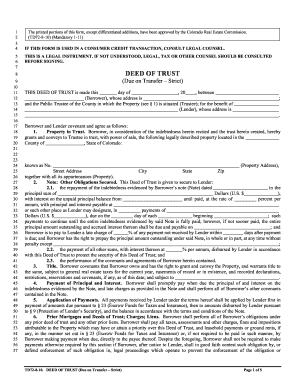
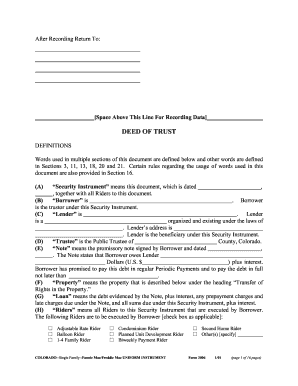
The Colorado Deed of Trust Due on Transfer Strict is a legal document used in Colorado for securing loans on real estate properties.
pdfFiller scores top ratings on review platforms




Who needs TD72 Deed?
Explore how professionals across industries use pdfFiller.

TD72 Deed is needed by:
-
Homebuyers looking to finance a property purchase
-
Lenders offering mortgage loans
-
Real estate professionals managing transactions
-
Trustees overseeing property trust arrangements
-
Real estate investors securing property loans
Comprehensive Guide to TD72 Deed
Understanding the Colorado Deed of Trust Due on Transfer Strict
The Colorado Deed of Trust Due on Transfer Strict is a pivotal legal document in real estate transactions across Colorado. This form serves as a security agreement, granting lenders a lien on the property, thereby protecting their financial interests. The primary parties involved in this agreement include the borrower, who secures the loan; the lender, who provides the financing; and the trustee, who holds the property deed on behalf of the lender.
Purpose and Benefits of the Colorado Deed of Trust Due on Transfer Strict
This form is crucial for safeguarding the interests of the lender while providing structure to the borrowing process. The Colorado Deed of Trust offers several advantages:
-
Legal protection for lenders by establishing a lien on the property.
-
Clear and concise terms regarding repayment deadlines and conditions.
-
Due-on-transfer clauses that help ensure lender interests remain secure through the life of the loan.
Understanding these benefits helps borrowers and lenders navigate real estate transactions with greater confidence.
Key Features of the Colorado Deed of Trust Due on Transfer Strict
The form boasts several key characteristics that enhance its usability:
-
Fillable fields and checkboxes that allow for personalized input.
-
Detailed information requirements regarding the borrower, lender, and property specifics.
-
Terms clearly laid out for repayment schedules and applicable interest rates.
These features ensure that all necessary information is included, minimizing errors during completion.
Who Needs the Colorado Deed of Trust Due on Transfer Strict?
This form is particularly beneficial for a variety of participants in real estate transactions, including:
-
Borrowers looking to secure a loan backed by real estate.
-
Lenders who are extending financing under strict terms.
-
Realtors and legal professionals facilitating such transactions.
Whether you are a borrower or a lender, understanding who needs this form is essential for transaction success.
How to Fill Out the Colorado Deed of Trust Due on Transfer Strict Online (Step-by-Step)
Completing the Colorado Deed of Trust Due on Transfer Strict can be straightforward when following these step-by-step instructions:
-
Access the form via the pdfFiller platform.
-
Begin with the borrower’s information, ensuring accuracy in names and addresses.
-
Fill in lender details, remembering that this is generally optional for their signature.
-
Complete the property description with accurate details.
-
Review all fields to guarantee completeness and correctness.
Employing these best practices can significantly reduce common errors encountered during the filling process.
Signing and Notarization Requirements for the Colorado Deed of Trust Due on Transfer Strict
When it comes to signing the Colorado Deed of Trust, it's important to understand the requirements:
-
Typically, a digital signature is acceptable, although a wet signature may be required in certain cases.
-
The borrower must sign the document, while the lender's signature is optional.
-
If notarization is needed, ensure to check local requirements for proper execution.
These requirements help legitimize the agreement and its enforceability.
Submission and Delivery of the Colorado Deed of Trust Due on Transfer Strict
After completing the form, it is essential to submit it correctly. Here’s how:
-
Submit the completed form online through the pdfFiller platform or deliver it in-person as required.
-
Be aware of any associated fees or processing times during submission.
-
Keep track of submissions to confirm receipt effectively.
Following these guidelines helps ensure that your submission is accurate and timely.
After Submission: What Happens Next?
Once the form is submitted, understanding the subsequent steps is critical:
-
Check the status of your submitted form through the relevant tracking service.
-
Be aware of common reasons for rejection, such as incomplete information, and how to rectify them.
-
Know the process for amendments or renewals if required.
Staying informed enhances the likelihood of a smooth transaction moving forward.
Security and Privacy with the Colorado Deed of Trust Due on Transfer Strict
Users can rest assured concerning the security and privacy of their information:
-
The form is protected with 256-bit encryption and complies with key standards like HIPAA and GDPR.
-
Take care to handle any sensitive information securely during processing.
-
Using a trustworthy platform like pdfFiller for document management ensures protection throughout.
Prioritizing security fosters confidence in the document handling process.
Start Filling Out Your Colorado Deed of Trust Due on Transfer Strict Today
Utilizing pdfFiller for your form needs is an excellent way to streamline the process. The platform offers ease of use and accessibility, making it simple to complete your deed of trust accurately. With added benefits such as cloud document management and eSigning features, you can manage your forms efficiently and securely.
How to fill out the TD72 Deed
-
1.Access pdfFiller and log into your account. Search for the Colorado Deed of Trust Due on Transfer Strict form in the template library.
-
2.Open the form in the pdfFiller interface. Familiarize yourself with the layout, including fillable fields and checkboxes.
-
3.Before starting, gather all necessary information, including details about the property, borrower, lender, and terms of the loan.
-
4.Begin filling in the form. Click on the fields to enter information. Use the tab key to navigate between fields efficiently.
-
5.Make sure to complete all required fields, including borrower and lender information, plus loan terms like interest rates and repayment schedules.
-
6.Review the completed form for accuracy. Double-check all entries to ensure there are no errors or omissions.
-
7.Once satisfied with the information, save your progress in pdfFiller. You can also download the filled form for personal records.
-
8.If required, you can submit the form directly from pdfFiller, or print it for physical signatures and notarization if necessary.

Who is eligible to use the Colorado Deed of Trust?
Individuals or entities involved in real estate transactions in Colorado can use this form, including borrowers, lenders, and trustees.
Are there any deadlines for completing the Deed of Trust?
While there are no specific deadlines just for the form itself, ensure that you complete it before the closing date of your property transaction to avoid delays.
What are the submission methods for the Colorado Deed of Trust?
You can submit the Deed of Trust form through your lender, or if you have a physical copy, it can be recorded with the local county clerk's office.
What supporting documents might I need?
Typically, you will need identification, property details, and any prior loan agreements alongside the Colorado Deed of Trust.
What common mistakes should I avoid when filling out the form?
Common mistakes include missing required fields, incorrect property descriptions, and failing to obtain necessary signatures from all parties involved.
How long does it take to process a Deed of Trust once submitted?
Processing times can vary by county, but generally, it may take anywhere from a few days to several weeks for your Deed of Trust to be officially recorded.
What happens if the Deed of Trust is not notarized?
While notarization is not typically required for the Deed of Trust, it is recommended to ensure the document is legally valid and enforceable.
Related Forms


Get the latest insights from our blog


If you believe that this page should be taken down, please follow our DMCA take down process
here
.
This form may include fields for payment information. Data entered in these fields is not covered by PCI DSS compliance.