
Last updated on
Oct 20, 2026

Get the free California Affidavit for Property Transfer
We are not affiliated with any brand or entity on this form

Fill out
Complete the form online in a simple drag-and-drop editor.

eSign
Add your legally binding signature or send the form for signing.

Share
Share the form via a link, letting anyone fill it out from any device.

Export
Download, print, email, or move the form to your cloud storage.
Why pdfFiller is the best tool for your documents and forms


End-to-end document management
From editing and signing to collaboration and tracking, pdfFiller has everything you need to get your documents done quickly and efficiently.
Accessible from anywhere
pdfFiller is fully cloud-based. This means you can edit, sign, and share documents from anywhere using your computer, smartphone, or tablet.
Secure and compliant
pdfFiller lets you securely manage documents following global laws like ESIGN, CCPA, and GDPR. It's also HIPAA and SOC 2 compliant.
What is CA Property Transfer Affidavit
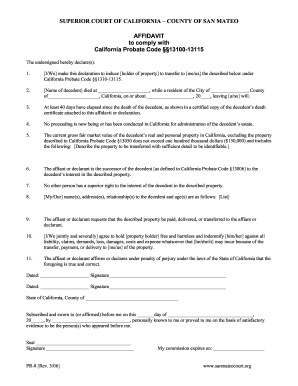
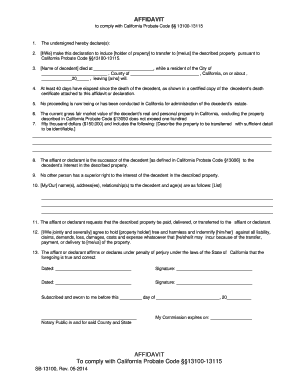
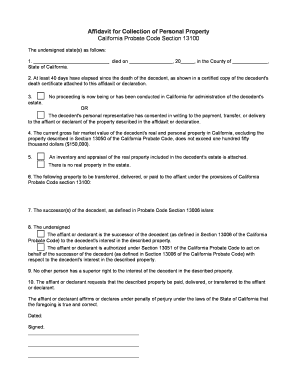
The California Affidavit for Property Transfer is a legal document used by individuals to transfer property of a decedent in California when the estate value does not exceed $150,000.
pdfFiller scores top ratings on review platforms




Who needs CA Property Transfer Affidavit?
Explore how professionals across industries use pdfFiller.

CA Property Transfer Affidavit is needed by:
-
Affiants or Declarants needing to transfer property
-
Notary Publics for notarizing legal documents
-
Executors of estates with limited asset value
-
Heirs or beneficiaries of a decedent's estate
-
Individuals working with probate legal matters
-
Attorneys specializing in estate planning and probate law
Comprehensive Guide to CA Property Transfer Affidavit
What is the California Affidavit for Property Transfer?
The California Affidavit for Property Transfer is a legal document utilized to facilitate the transfer of property when the estate value is under $150,000. This property transfer affidavit serves an essential purpose in streamlining the transfer process after a decedent's death. Key elements included in this document consist of the decedent's details, the specific property being transferred, and the affiant's relationship to the decedent. Understanding the nuances of this California probate form can significantly ease the burden during an estate's transition.
Purpose and Benefits of the California Affidavit for Property Transfer
The California Affidavit for Property Transfer plays a crucial role in simplifying property transfers following a decedent's death. This form is particularly beneficial for small estates, offering various legal advantages such as reduced legal costs and efficient processing. By utilizing this California legal form, individuals can navigate the transfer process with greater ease. Furthermore, the importance of notarization and signing requirements adds a layer of legitimacy that is pivotal for validity.
Who Needs the California Affidavit for Property Transfer?
The parties involved in the California Affidavit for Property Transfer include the affiant, who declares the information, and the notary public, who validates the document. This affidavit is necessary under specific scenarios, particularly small estate proceedings, wherein the estate's total value is limited. Eligibility typically hinges on the affiant's relationship to the decedent, making it essential to understand the requirements outlined in probate code 13100.
Key Features of the California Affidavit for Property Transfer
-
Multiple fillable fields to capture necessary information about the decedent and property.
-
Checkboxes to streamline the signing process and ensure all required elements are addressed.
-
Adherence to regulations outlined in the California probate code to ensure validity.
-
Accessible form-filling options using platforms like pdfFiller, enhancing user convenience.
How to Fill Out the California Affidavit for Property Transfer Online (Step-by-Step)
-
Access the California Affidavit for Property Transfer on pdfFiller.
-
Fill in the specific fields with the decedent’s information, property specifics, and your relationship to the decedent.
-
Carefully review each section to avoid common mistakes, ensuring all details are accurate and complete.
Completing the affidavit online not only enhances efficiency but also guarantees compliance with the required legal standards by utilizing reliable templates.
Notarizing and Signing the California Affidavit for Property Transfer
The notarization process involves a notary public verifying the signatures included in the Colorado Affidavit for Property Transfer. It is important to understand the significance of meeting signature requirements to maintain the document's authencity. Users can consider both digital signatures and wet signatures, noting their acceptability per legal standards. To facilitate notarization, individuals can locate notary public services or exploit eSigning features offered through pdfFiller.
Submitting the California Affidavit for Property Transfer
Submission methods for the completed California Affidavit for Property Transfer include both electronic and physical delivery options, depending on local jurisdiction requirements. When submitting, ensure to include all necessary accompanying documentation as specified by the California probate code. Consider any relevant fees or deadlines associated with the submission process to avoid delays in property transfer.
What Happens After You Submit the California Affidavit for Property Transfer?
Once submitted, the processing timeline may vary, but users can typically expect a confirmation of receipt from the relevant office. It is advisable to have a system in place to track submission status and navigate potential issues. If corrections or amendments to the affidavit become necessary, there are steps to rectify any discrepancies, ensuring compliance with procedural standards.
Security and Compliance when Handling the California Affidavit for Property Transfer
When dealing with sensitive documents such as the California Affidavit for Property Transfer, security is paramount. pdfFiller employs robust security measures to protect user data, including 256-bit encryption and compliance with privacy regulations like HIPAA and GDPR. Ensuring data protection during the form-filling and submission process is crucial for maintaining confidentiality and legal integrity.
Empower Your Property Transfer Process with pdfFiller
Users are encouraged to leverage pdfFiller for an efficient experience in editing, filling, and eSigning their California Affidavit for Property Transfer. With an accessible platform offering various features, pdfFiller ensures a smooth process while maintaining security. The support available for users aids in fulfilling all legal document requirements quickly and effectively.
How to fill out the CA Property Transfer Affidavit
-
1.To access the California Affidavit for Property Transfer form on pdfFiller, navigate to the platform and use the search function to find the specific form.
-
2.Once you locate the form, click on it to open it in the pdfFiller editor, where you will see the fillable fields.
-
3.Before filling out the form, gather necessary information such as the decedent’s details, property descriptions, and your relationship to the decedent to ensure you complete it accurately.
-
4.Begin by filling in the decedent's full name, date of death, and details about the property being transferred.
-
5.Utilize pdfFiller's tools to check off any applicable boxes and complete all required fields indicated on the form.
-
6.Review your filled form carefully for any errors, ensuring names and details are accurate and complete.
-
7.Once everything is filled out correctly, finalize the form by following the instructions for electronic signatures if needed, including obtaining the notary public's signature.
-
8.After finalizing, save your work by clicking the save button. You can also download the completed form to your device or submit it directly through pdfFiller if necessary.

Who is eligible to use the California Affidavit for Property Transfer?
Eligibility to use the California Affidavit for Property Transfer includes individuals who are heirs or beneficiaries of a decedent's estate or those designated as affiants who need to transfer property valued under $150,000.
Are there any deadlines related to this affidavit?
While there are no specific deadlines for submitting the California Affidavit for Property Transfer itself, it is crucial to complete the transfer promptly to avoid complications in estate administration or property management.
How do I submit the completed Affidavit for Property Transfer?
The completed California Affidavit for Property Transfer can typically be submitted to the county recorder where the property is located. Ensure it is properly signed and notarized.
What supporting documents are required with this form?
When submitting this affidavit, you may need to provide copies of the decedent's death certificate, documentation of property ownership, and proof of your relationship to the decedent to validate the transfer.
What common mistakes should I avoid when filling out this form?
Common mistakes include omitting required fields, inaccurate property descriptions, and not having the form properly notarized. Always double-check that all information is complete and correct.
What are the processing times for this affidavit?
Processing times for the California Affidavit for Property Transfer can vary by county. Generally, once submitted, recording may take a few days to a couple of weeks depending on the local government’s workload.
What if I need assistance completing the Affidavit for Property Transfer?
If you need help completing the affidavit, consider consulting with an attorney experienced in probate and estate law or utilizing resources provided by legal aid organizations.
Related Forms


Get the latest insights from our blog


If you believe that this page should be taken down, please follow our DMCA take down process
here
.
This form may include fields for payment information. Data entered in these fields is not covered by PCI DSS compliance.