
Last updated on
Oct 19, 2026

Get the free Quitclaim Deed Corporation to Corporation
We are not affiliated with any brand or entity on this form

Fill out
Complete the form online in a simple drag-and-drop editor.

eSign
Add your legally binding signature or send the form for signing.

Share
Share the form via a link, letting anyone fill it out from any device.

Export
Download, print, email, or move the form to your cloud storage.
Why pdfFiller is the best tool for your documents and forms


End-to-end document management
From editing and signing to collaboration and tracking, pdfFiller has everything you need to get your documents done quickly and efficiently.
Accessible from anywhere
pdfFiller is fully cloud-based. This means you can edit, sign, and share documents from anywhere using your computer, smartphone, or tablet.
Secure and compliant
pdfFiller lets you securely manage documents following global laws like ESIGN, CCPA, and GDPR. It's also HIPAA and SOC 2 compliant.
What is Corp Quitclaim Deed
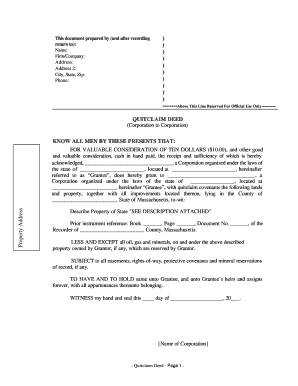
The Quitclaim Deed Corporation to Corporation is a legal document used by corporations to transfer property ownership between entities in Michigan.
pdfFiller scores top ratings on review platforms




Who needs Corp Quitclaim Deed?
Explore how professionals across industries use pdfFiller.

Corp Quitclaim Deed is needed by:
-
Corporations transferring property ownership
-
Legal professionals handling corporate property matters
-
Real estate agents representing corporations
-
Business owners overseeing corporate transactions
-
Investors and stakeholders in corporate entities
Comprehensive Guide to Corp Quitclaim Deed
What is a Quitclaim Deed Corporation to Corporation?
A quitclaim deed is a legal document used in corporate property transfer that allows one corporation to convey its interest in a property to another corporation. This type of deed is particularly useful because it simplifies the process of transferring ownership, but it's important to understand its legal implications. Unlike other deed types such as warranty deeds, a quitclaim deed does not guarantee that the Grantor holds any title to the property. Therefore, as a corporation engaging in a property transfer, it is essential to utilize a quitclaim deed template that complies with Michigan law.
Understanding these distinctions ensures that corporate entities are aware of their rights and limitations under Michigan quitclaim deed regulations, making the transfer process as efficient as possible.
Benefits of Using a Quitclaim Deed for Corporate Transfers
Utilizing a quitclaim deed for corporate transfers presents several advantages. An important benefit is its simplicity; as it requires minimal paperwork and formal requirements compared to other deed types. This facilitates a faster property transfer process, which is crucial for businesses that require efficiency in managing their assets.
Moreover, situations might arise where a corporate quitclaim deed is preferable, such as transferring property between subsidiaries or affiliates. Using this deed helps in reducing title disputes, thereby favoring smooth operations within the corporation.
Key Features of the Quitclaim Deed Corporation to Corporation
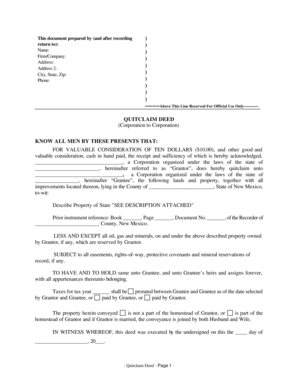
The key features of a quitclaim deed include several essential components. It must contain the names and addresses of the Grantor and Grantee, a legal description of the property, and any prior deed references. It also requires the signatures of all parties involved: the Grantor, witnesses, and a notary public to validate the document.
When preparing a corporate deed template, ensure that all requisite details are accurately filled in, as this not only facilitates proper filing but also upholds legal standards in Michigan.
Eligibility Criteria for the Quitclaim Deed Corporation to Corporation
Eligibility to execute and use a quitclaim deed in Michigan is restricted primarily to corporations. The Grantor must hold legal title to the property being transferred, while the Grantee must be a recognized legal entity capable of receiving such transfers. Under Michigan law, both parties must comply with specific prerequisites to ensure the deed is valid.
Understanding these criteria is essential for any corporation looking to utilize a corporate property deed, as failure to adhere to legal standards may result in complications during the property transfer process.
Step-by-Step: How to Fill Out the Quitclaim Deed Corporation to Corporation Online
To fill out the quitclaim deed corporation to corporation online, follow these steps:
-
Access the pdfFiller platform and select the quitclaim deed template.
-
Enter the legal names and addresses of both the Grantor and Grantee accurately.
-
Provide a complete legal description of the property.
-
Add any pertinent history of the property or previous ownership details.
-
Review all entered information for accuracy before proceeding to signatures.
-
Download or save the completed form to your secure pdfFiller account.
By ensuring that each piece of data is correct, corporations can confidently proceed with their corporate property transfer.
How to Sign and Notarize Your Quitclaim Deed Corporation to Corporation
Signing and notarizing a quitclaim deed involves specific requirements. The Grantor must sign the form in the presence of a witness and a notary public. Witnesses must also provide their signatures to validate the document, ensuring that all parties’ consent is duly recorded.
It’s crucial to note that both digital and wet signatures are accepted in Michigan; however, confirm that your chosen method meets all legal requirements to avoid issues in legitimacy.
Necessary Documentation and Filing Procedures in Michigan
When submitting a quitclaim deed in Michigan, specific supporting documents may be required. These can include:
-
Proof of identity for the Grantor and Grantee.
-
Documentation confirming ownership of the property prior to the transfer.
-
Any additional legal forms relevant to property assessment in your jurisdiction.
To file the quitclaim deed, submit it to the appropriate county register of deeds along with any necessary recording fees. Ensure all documents are filled out correctly to streamline the process.
Common Mistakes and How to Avoid Them When Filing
Common mistakes made when filing a quitclaim deed include:
-
Leaving out required signatures from the Grantor, Witness, or Notary Public.
-
Failing to provide a correct legal description of the property.
-
Omitting relevant prior deed information.
To avoid these pitfalls, it’s advisable to carefully review the completed document for accuracy before submission. Validation of each section can prevent extensive delays in processing.
Safeguarding Your Sensitive Information During the Process
Using pdfFiller assures that your sensitive information is safeguarded throughout the document transfer process. The platform employs advanced security features, including 256-bit encryption, to protect legal documents. Additionally, it adheres to privacy regulations such as HIPAA and GDPR, ensuring compliance and data protection throughout.
Get Started with pdfFiller for Your Quitclaim Deed Corporation to Corporation
pdfFiller offers an intuitive platform for managing your quitclaim deeds with ease. Its key capabilities include eSigning, document editing, and secure storage, making it an ideal choice for corporate entities needing flexibility and security in handling deed transfers. Begin leveraging these features today by accessing the quitclaim deed template on pdfFiller.
How to fill out the Corp Quitclaim Deed
-
1.Access the Quitclaim Deed Corporation to Corporation form on pdfFiller by visiting their website and using the search feature to locate the specific template.
-
2.Once opened, navigate through the form's fields using pdfFiller's editing tools. Click on each field to enter the required details accurately.
-
3.Before starting, gather necessary information such as the exact names of the Grantor and Grantee corporations, their addresses, and the property description to complete the form without delays.
-
4.Carefully review the fields for accuracy. Ensure that all information is complete, especially signatures required from the Grantor, Witness, and Notary Public.
-
5.Utilize pdfFiller's 'preview' feature to inspect your completed form for any errors or missing information before finalizing.
-
6.Save your document frequently during the editing process to avoid losing any data. Once completed, download the form to your computer or submit it electronically as required.

Who is eligible to use the Quitclaim Deed Corporation to Corporation?
Any corporation in Michigan that wishes to transfer property ownership to another corporation can use this Quitclaim Deed. It's essential that the Grantor corporation holds legal title to the property being transferred.
What signatures are required on the deed?
The Quitclaim Deed must be signed by the Grantor, witnessed, and notarized. The Grantee's signature is not necessary for the deed to be valid, but all other roles must provide their signatures.
Are there any fees associated with the filing of a Quitclaim Deed?
Fees may vary based on local regulations and filing requirements. Typically, there may be fees for notarization and any applicable recording fees charged by the county clerk's office.
What information do I need before filling out the form?
Gather essential information including the names and addresses of both the Grantor and Grantee corporations, details about the property being transferred, and any prior related documents.
What should I do if I make a mistake on the form?
If you notice an error while filling out the Quitclaim Deed, use pdfFiller's editing capabilities to correct the mistake. Ensure all changes are accurate before finalizing the document.
How do I submit the completed Quitclaim Deed?
Upon completion of the Quitclaim Deed, you can either print and submit it to the appropriate county recording office or electronically submit it if allowed under Michigan law.
What is the Michigan Right to Farm Act reference in this form?
The reference to the Michigan Right to Farm Act means the quitclaim deed may include provisions that ensure agricultural land use rights are preserved during the property transfer, as per applicable Michigan laws.
Related Content
Related Forms




Get the latest insights from our blog


If you believe that this page should be taken down, please follow our DMCA take down process
here
.
This form may include fields for payment information. Data entered in these fields is not covered by PCI DSS compliance.