
Last updated on
Nov 9, 2026
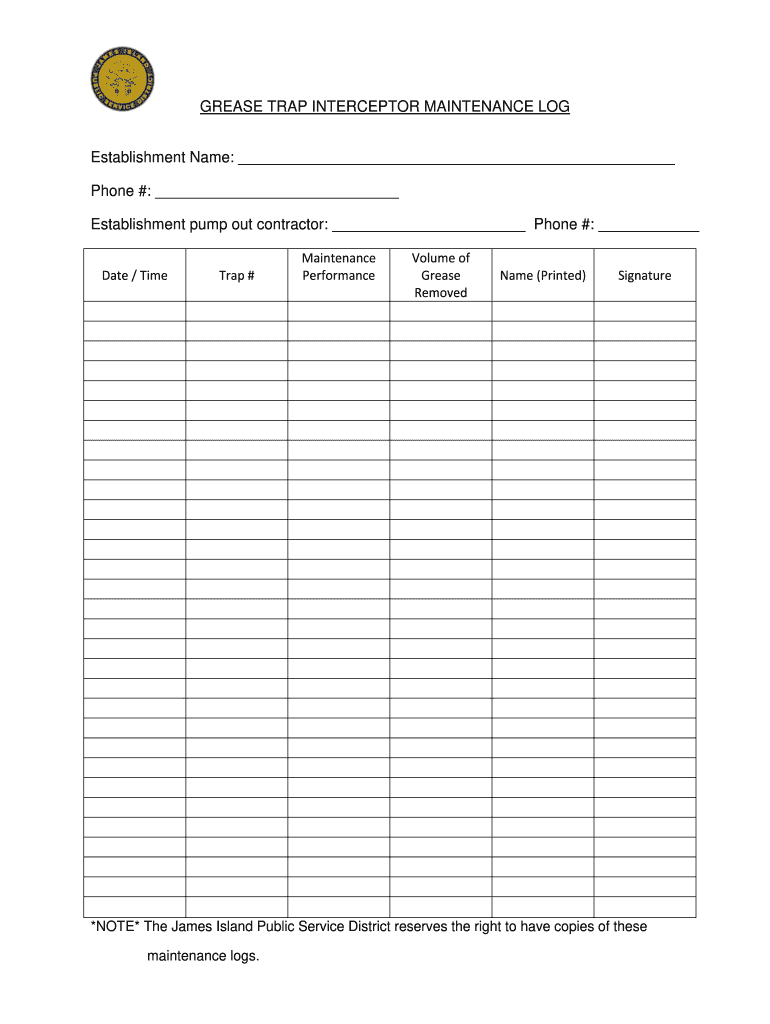
SC James Island Public Service District Grease Trap Interceptor Maintenance Log 2008-2026 free p...
pdfFiller is not affiliated with any government organization

Fill out
Complete the form online in a simple drag-and-drop editor.

eSign
Add your legally binding signature or send the form for signing.

Share
Share the form via a link, letting anyone fill it out from any device.

Export
Download, print, email, or move the form to your cloud storage.
Why pdfFiller is the best tool for your documents and forms


End-to-end document management
From editing and signing to collaboration and tracking, pdfFiller has everything you need to get your documents done quickly and efficiently.
Accessible from anywhere
pdfFiller is fully cloud-based. This means you can edit, sign, and share documents from anywhere using your computer, smartphone, or tablet.
Secure and compliant
pdfFiller lets you securely manage documents following global laws like ESIGN, CCPA, and GDPR. It's also HIPAA and SOC 2 compliant.
What is SC James Island Public Service District Grease Trap Interceptor Maintenance Log
The Grease Trap Interceptor Maintenance Log is a business form used by establishments to record grease trap maintenance activities and ensure compliance with maintenance requirements.
pdfFiller scores top ratings on review platforms




Who needs SC James Island Public Service District Grease Trap Interceptor Maintenance Log?
Explore how professionals across industries use pdfFiller.

SC James Island Public Service District Grease Trap Interceptor Maintenance Log is needed by:
-
Restaurants and food service establishments
-
Pump out contractors performing grease trap maintenance
-
Health department compliance officers
-
Environmental service providers
-
Commercial kitchen operators
Comprehensive Guide to SC James Island Public Service District Grease Trap Interceptor Maintenance Log
What is the Grease Trap Interceptor Maintenance Log?
The Grease Trap Interceptor Maintenance Log is a critical document used to record details about the maintenance of grease traps in commercial settings. It serves as a vital tool for ensuring regulatory compliance, particularly for establishments that must adhere to local health regulations. By maintaining accurate records, establishments can demonstrate their commitment to sanitation and proper waste management.
This log plays an essential role in a facility's operational integrity, as it helps establish a reliable maintenance history. A well-documented log not only aids in regulatory inspections but also enhances the overall efficiency of grease removal processes.
Purpose and Benefits of the Grease Trap Interceptor Maintenance Log
The primary purpose of the Grease Trap Interceptor Maintenance Log is to provide a systematic approach for tracking grease trap maintenance. Utilizing this specific maintenance log offers several advantages, including:
-
Ensuring compliance with local health regulations.
-
Tracking maintenance schedules effectively.
-
Facilitating improved operational efficiency in commercial kitchens.
By utilizing a grease trap log template, establishments can better manage grease trap service frequency and maintain compliance with requirements.
Who Needs the Grease Trap Interceptor Maintenance Log?
This maintenance log is essential for various stakeholders, including:
-
Establishments operating commercial kitchens such as restaurants and cafes.
-
Pump-out contractors who perform grease trap services.
Both parties must sign the log to ensure accountability and accuracy. This signing process verifies that all maintenance activities have been conducted as documented.
How to Fill Out the Grease Trap Interceptor Maintenance Log Online
Completing the Grease Trap Interceptor Maintenance Log online requires following a straightforward process. The necessary information includes:
-
Establishment name.
-
Contact phone number.
-
Details of maintenance performed, including the date and time.
-
Trap number and performance information.
-
Volume of grease removed.
Instructions for signing the form digitally should also be followed to ensure compliance with current regulations.
Field-by-Field Instructions for the Grease Trap Interceptor Maintenance Log
Each field in the Grease Trap Interceptor Maintenance Log has a distinct purpose. For example:
-
Trap number: Identifies the specific grease trap being maintained.
-
Performance: Records how well the trap is performing based on inspection.
Providing detailed and accurate information in all fields is crucial to prevent errors and avoid discrepancies. Retaining copies of filled logs is also advisable for future reference.
Common Errors and How to Avoid Them
When filling out the Grease Trap Interceptor Maintenance Log, users should remain vigilant to prevent common mistakes such as:
-
Incomplete fields that lack necessary information.
-
Inaccuracies in recorded data.
To ensure clarity and correctness, it is vital to proofread the log before submission, as errors can lead to significant compliance issues.
How to Sign the Grease Trap Interceptor Maintenance Log
Effective signing of the Grease Trap Interceptor Maintenance Log is essential for verification purposes. Users have the option to choose between digital signatures and wet signatures. It is important to follow these guidelines:
-
Ensure that both the establishment and the contractor sign the log.
-
Understand what constitutes an acceptable signature for compliance.
Proper signing ensures authorized acknowledgment of the maintenance performed.
Where to Submit the Grease Trap Interceptor Maintenance Log
Once completed, the Grease Trap Interceptor Maintenance Log should be submitted to designated authorities for record-keeping. Users should consider:
-
Specific submission methods which may include online options or postal delivery.
-
Timelines for submission and methods for tracking the log after submission.
Timely submission is important to maintain compliance with regulatory requirements.
Security and Compliance When Using the Grease Trap Interceptor Maintenance Log
Handling the Grease Trap Interceptor Maintenance Log requires attention to data security. Security measures should include:
-
Implementing 256-bit encryption to protect sensitive information.
-
Ensuring compliance with pertinent regulations such as HIPAA and GDPR.
Responsible document management is essential to safeguard the integrity of the information stored in these logs.
Start Filling Out the Grease Trap Interceptor Maintenance Log with pdfFiller Today
Engaging with pdfFiller for your Grease Trap Interceptor Maintenance Log needs is straightforward. With pdfFiller's user-friendly online platform, you can:
-
Utilize comprehensive features that prioritize your information's security.
-
Easily create, edit, and eSign your logs from any browser.
Experience enhanced document management capabilities with pdfFiller's cloud-based solutions.
How to fill out the SC James Island Public Service District Grease Trap Interceptor Maintenance Log
-
1.Access the Grease Trap Interceptor Maintenance Log on pdfFiller by searching for the form name in the search bar or navigating through the category of Business Forms.
-
2.Open the form by clicking on it in the search results. You will be directed to the pdfFiller editing interface.
-
3.Before starting to fill out the form, gather all necessary information such as the establishment's name, phone number, trap number, maintenance details, and the person’s name who performed the service.
-
4.Begin filling out the form by clicking on the blank fields. Input the establishment's name and phone number in the designated areas.
-
5.Next, record the date and time of the maintenance. Ensure these entries are accurate for compliance purposes.
-
6.For each maintenance session, fill in the trap number and performance details. Specify the volume of grease removed during the service.
-
7.After completing the necessary fields, have the individual who performed the maintenance sign the form in the provided signature line.
-
8.Review all entries for any errors or missing information. Double-check dates, numbers, and spelling.
-
9.Once finalized, save your work by clicking on the 'Save' button. You can also download the completed log to your device for your records.
-
10.If needed, submit through pdfFiller or print the log for dispatch to relevant authorities or for your records.

Who needs to fill out the Grease Trap Interceptor Maintenance Log?
The form should be filled out by the establishment's authorized personnel and the pump-out contractor performing the maintenance. It ensures that all maintenance activities are accurately recorded for compliance.
Is there a deadline for submitting the Grease Trap Interceptor Maintenance Log?
Typically, there are no strict deadlines for submission, but establishments should complete the log immediately after maintenance to ensure timely compliance and avoid penalties.
How do I submit the completed Grease Trap Interceptor Maintenance Log?
You can submit the completed log either by saving it to your device and emailing it to the relevant authorities or by providing a printed copy to the health department upon request.
What supporting documents do I need when filling out this form?
You may need maintenance records or service agreements from the pump-out contractor upon filling out the log. Additionally, having past maintenance logs can help maintain continuity and accuracy.
What are some common mistakes to avoid when completing the maintenance log?
Common mistakes include skipping fields, incorrect entry of the grease volume, and missing signatures. Ensure all fields are filled correctly and double-check your entries before finalizing the form.
How long does it take for the log to be processed after submission?
Processing times can vary, but typically, there is no formal processing involved with this log as it is a record maintained by the establishment and contractor. Ensure all details are accurate for your records.
What happens if the Grease Trap Interceptor Maintenance Log is not filled out properly?
Failure to fill out the log correctly may lead to compliance issues, potential fines, and complications with health inspections. It is essential to complete it accurately to avoid such consequences.
Related Forms
Get the latest insights from our blog


If you believe that this page should be taken down, please follow our DMCA take down process
here
.
This form may include fields for payment information. Data entered in these fields is not covered by PCI DSS compliance.