
Last updated on
Oct 31, 2026
Get the free Deed of Waiver of Rights
We are not affiliated with any brand or entity on this form

Fill out
Complete the form online in a simple drag-and-drop editor.

eSign
Add your legally binding signature or send the form for signing.

Share
Share the form via a link, letting anyone fill it out from any device.

Export
Download, print, email, or move the form to your cloud storage.
Why pdfFiller is the best tool for your documents and forms


End-to-end document management
From editing and signing to collaboration and tracking, pdfFiller has everything you need to get your documents done quickly and efficiently.
Accessible from anywhere
pdfFiller is fully cloud-based. This means you can edit, sign, and share documents from anywhere using your computer, smartphone, or tablet.
Secure and compliant
pdfFiller lets you securely manage documents following global laws like ESIGN, CCPA, and GDPR. It's also HIPAA and SOC 2 compliant.
What is Waiver Deed
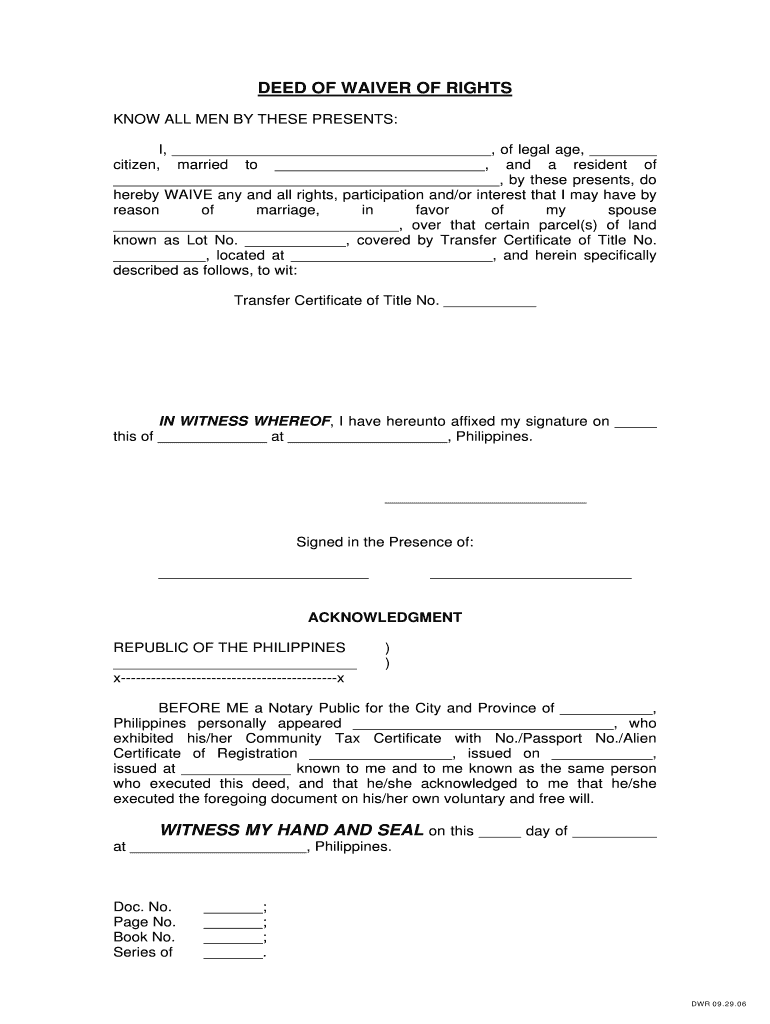
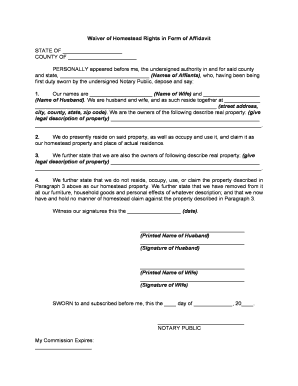
The Deed of Waiver of Rights is a legal document used by individuals in the Philippines to waive their rights to a specific parcel of land in favor of their spouse.
pdfFiller scores top ratings on review platforms




Who needs Waiver Deed?
Explore how professionals across industries use pdfFiller.

Waiver Deed is needed by:
-
Married individuals looking to formalize property arrangements.
-
Estate planners managing a spouse's property rights.
-
Lawyers assisting clients with divorce or separation agreements.
-
Property owners seeking to clarify ownership rights.
-
Individuals involved in estate planning or asset distribution.
Comprehensive Guide to Waiver Deed
Understanding the Deed of Waiver of Rights
The Deed of Waiver of Rights is a legally significant document under Philippine law, which serves multiple functions, particularly in estate planning. This document allows individuals to formally relinquish their claims on specific property, creating clarity in property rights. By waiving certain rights, especially concerning property, couples can prevent potential disputes during events such as divorce or death.
Utilizing a deed of waiver of rights in the Philippines provides noteworthy benefits when entering spousal agreements. It ensures both parties clearly understand their respective rights and interests in shared or inherited properties, making it an essential tool in estate planning.
Purpose and Benefits of the Deed of Waiver of Rights
The primary goal of the Deed of Waiver of Rights is to clarify and solidify property rights between spouses. This document proves instrumental in reducing disputes that may arise over property ownership, particularly in sensitive situations like divorce proceedings or after a spouse's passing.
-
Clarifies shared property rights and responsibilities.
-
Reduces conflicts by establishing explicit rights in writing.
-
Facilitates smoother transitions of property rights during significant life events.
Using a spousal property waiver template can significantly enhance estate planning, allowing both parties to manage their assets more effectively.
Key Features of the Deed of Waiver of Rights
The Deed of Waiver of Rights includes several critical components necessary for its legal standing. Notably, it encompasses essential fields such as the waiving party's full name and details regarding the property involved.
-
Required fields: Name of the waiving party, property details.
-
Notarization is mandatory to validate the document legally.
-
Signatures from both the spouse and a witness are required, ensuring accountability.
It is crucial to comply with these requirements to guarantee the document's effectiveness within the Philippine legal framework.
Who Needs the Deed of Waiver of Rights?
The Deed of Waiver of Rights is particularly relevant for individuals engaged in estate planning who possess property within the Philippines. Spouses managing shared or inherited property rights should consider this document as part of their legal arsenal.
Several scenarios underline the necessity for this waiver:
-
When couples intend to clarify ownership during marriage.
-
In situations where property was inherited and needs clarifying between spouses.
In each case, having a formalized waiver can prevent misunderstandings and complications later on.
How to Fill Out the Deed of Waiver of Rights Online
Accessing the Deed of Waiver of Rights online through pdfFiller offers a straightforward approach to completion. The following steps outline how to fill out the form efficiently:
-
Navigate to the pdfFiller website and locate the waiver form.
-
Use the form editor to make the document fillable as required.
-
Carefully input all necessary information in the designated fields.
-
Review the completed document thoroughly for accuracy.
By following this structured process, users can ensure they fill out the spousal property waiver template correctly before signing.
Signing and Notarizing the Deed of Waiver of Rights
For the Deed of Waiver of Rights to hold legal validity, proper signing and notarization are imperative. Individuals should note the requirements for both digital and wet signatures, as specific circumstances may dictate which form is appropriate.
-
Digital signatures can be accepted under certain conditions.
-
Wet signatures require physical presence during the signing.
-
Notarization must involve both the spouse and a witness, affirming the legitimacy of the document.
Being mindful of these procedural nuances ensures that the waiver maintains its legal standing.
Submitting the Deed of Waiver of Rights
Once the Deed of Waiver of Rights has been completed and notarized, the next step involves submitting the document. Understanding the submission procedures is important to avoid errors and delays.
-
The notarized document must be presented at the appropriate filing office.
-
Be aware of any filing deadlines and associated fees for submission.
Tracking the status of submitted waivers helps maintain an organized approach to estate planning.
Security and Compliance in Handling the Deed of Waiver of Rights
Handling sensitive documents like the Deed of Waiver of Rights demands a commitment to security and compliance with privacy regulations. pdfFiller utilizes encryption to safeguard user information throughout the document management process.
-
256-bit encryption provides solid protection against unauthorized access.
-
Compliance with regulations, including HIPAA and GDPR, ensures user data is handled appropriately.
This dedicated approach to document security reinforces pdfFiller's reliability in managing essential legal documents.
Utilizing pdfFiller for Easy Completion of Your Waiver
pdfFiller offers numerous features that enhance the completion and management of the Deed of Waiver of Rights. Its user-friendly design simplifies the form completion process, making it accessible for all users.
-
Edit text and images as needed for clarity.
-
Utilize eSigning capabilities to finalize your document securely.
-
Share completed waivers with relevant parties effortlessly.
Additionally, pdfFiller provides support throughout the document management journey, ensuring a smooth experience for users handling their waivers.
How to fill out the Waiver Deed
-
1.Begin by accessing pdfFiller and searching for the 'Deed of Waiver of Rights.' You can easily find it by entering the form name in the search bar.
-
2.Once the form is open, familiarize yourself with the layout and sections available. Use the toolbar to navigate through the fields.
-
3.Gather your necessary information beforehand. This includes the name of the waiving party, the spouse’s name, and property details like the land description and title number.
-
4.Start filling in the fields. Click on each text box to enter information. Ensure that you provide accurate and complete details to avoid issues down the line.
-
5.Make good use of pdfFiller's instructions which often accompany forms. Thoroughly read any guidance to understand what information is required in each section.
-
6.Review the completed document carefully. Ensure that all information is correct, including spelling and the proper use of legal terms.
-
7.After final review, save your changes and decide whether to download a copy, submit it electronically, or print it out for physical notarization.

Who is eligible to create a Deed of Waiver of Rights?
Any legally married individual in the Philippines is eligible to create this document to waive property rights in favor of their spouse.
Is notarization required for this form?
Yes, the Deed of Waiver of Rights requires notarization to ensure that it is legally binding and recognized by authorities.
What supporting documents are needed to complete this form?
You will need your identification, proof of marriage, and details regarding the property involved to complete this form adequately.
How do I submit the Deed of Waiver of Rights after filling it out?
You can submit the form by following your local regulations, which may involve filing it at a notary office or local government office. Electronic submissions may also be acceptable in some jurisdictions.
What common mistakes should I avoid when completing this form?
Common mistakes include leaving fields blank, providing inaccurate property details, and failing to get the document notarized. Make sure all information is correct.
How long does it take to process this form?
The processing time can vary depending on the local regulations and whether you have everything ready for notarization. Generally, expect a few days to complete the process.
Can I edit the Deed of Waiver of Rights once it is signed?
Once signed and notarized, the document should not be altered. If changes are necessary, a new waiver will need to be drafted and executed.
Related Forms


Get the latest insights from our blog


If you believe that this page should be taken down, please follow our DMCA take down process
here
.
This form may include fields for payment information. Data entered in these fields is not covered by PCI DSS compliance.