
Last updated on
Oct 31, 2026

Get the free Citing Textual Evidence Rubric
We are not affiliated with any brand or entity on this form

Fill out
Complete the form online in a simple drag-and-drop editor.

eSign
Add your legally binding signature or send the form for signing.

Share
Share the form via a link, letting anyone fill it out from any device.

Export
Download, print, email, or move the form to your cloud storage.
Why pdfFiller is the best tool for your documents and forms


End-to-end document management
From editing and signing to collaboration and tracking, pdfFiller has everything you need to get your documents done quickly and efficiently.
Accessible from anywhere
pdfFiller is fully cloud-based. This means you can edit, sign, and share documents from anywhere using your computer, smartphone, or tablet.
Secure and compliant
pdfFiller lets you securely manage documents following global laws like ESIGN, CCPA, and GDPR. It's also HIPAA and SOC 2 compliant.
What is Textual Evidence Rubric
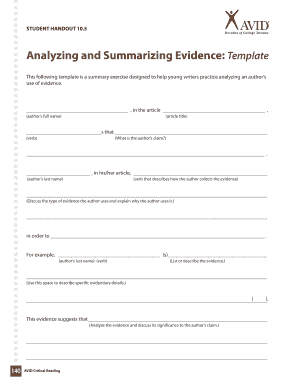
The Citing Textual Evidence Rubric is an educational form used by teachers to assess students' ability to effectively cite and analyze textual evidence in their writing.
pdfFiller scores top ratings on review platforms




Who needs Textual Evidence Rubric?
Explore how professionals across industries use pdfFiller.

Textual Evidence Rubric is needed by:
-
Teachers evaluating student writing skills
-
Academic institutions preparing assessment tools
-
Educational professionals conducting student assessments
-
Curriculum developers creating evaluation criteria
-
Students needing guidance on textual evidence
Comprehensive Guide to Textual Evidence Rubric
What is the Citing Textual Evidence Rubric?
The Citing Textual Evidence Rubric is a crucial tool in academic settings, designed to assist in evaluating students' ability to support their writing with relevant textual evidence. This rubric includes essential fields for students' names, dates, and specified evaluation criteria.
Citing textual evidence is vital in academic writing as it strengthens arguments and enhances analytical skills. It helps students understand how to substantiate their opinions with evidence from texts, ensuring a more rigorous approach to their academic work.
Purpose and Benefits of the Citing Textual Evidence Rubric
The rationale behind utilizing the Citing Textual Evidence Rubric is multifaceted, benefiting both students and educators significantly. For students, this rubric acts as a guideline to assess their skills in integrating textual evidence effectively into their writing.
Educators benefit by standardizing evaluation processes, which leads to more consistent and equitable assessments across different academic environments. Additionally, the rubric plays a pivotal role in improving students’ writing and analytical capabilities.
Key Features of the Citing Textual Evidence Rubric
This rubric is designed with user-friendliness in mind, ensuring effective evaluations. Key features of this academic evaluation form include:
-
A clear structure that outlines grading criteria.
-
Customizable elements to cater to various subjects or assignments.
-
Compatibility with fill-in-the-blank fields for straightforward use.
Who Can Benefit from the Citing Textual Evidence Rubric?
The Citing Textual Evidence Rubric is beneficial for a wide range of users in the educational field. Teachers and school administrators can utilize the rubric to gauge student performances effectively. Furthermore, students can employ it for self-assessment, enhancing their understanding of the writing process.
This rubric is particularly relevant for educational programs that emphasize developing reading and writing skills, making it a valuable resource across different learning environments.
How to Fill Out the Citing Textual Evidence Rubric Online (Step-by-Step)
To fill out the Citing Textual Evidence Rubric digitally on pdfFiller, follow these steps:
-
Access the Citing Textual Evidence Rubric form on pdfFiller.
-
Complete each required field accurately, ensuring that each entry corresponds to the specific prompts.
-
Review the information entered for accuracy and completeness before submitting.
-
Validate the completed form by checking for any errors.
Security and Compliance for the Citing Textual Evidence Rubric
Users can confidently use pdfFiller to fill out the Citing Textual Evidence Rubric, knowing that stringent security measures are in place. Data protection is ensured through robust encryption and compliance with regulations such as HIPAA and GDPR.
Additionally, pdfFiller maintains a clear privacy policy, outlining the safe handling of user information to foster trust and security during form completion.
Common Errors and How to Avoid Them When Using the Citing Textual Evidence Rubric
To avoid common mistakes while using the Citing Textual Evidence Rubric, users should be aware of typical pitfalls in filling out the rubric. Here are some key tips:
-
Correct misapplications in citing textual evidence by following the rubric’s guidance closely.
-
Use a checklist to ensure all aspects of the rubric are completed accurately.
-
Edit and review the form digitally before submission to enhance accuracy.
How to Save and Share the Citing Textual Evidence Rubric
Once the Citing Textual Evidence Rubric is completed, it is essential to understand how to save and share your work. Users can download the filled rubric in various formats and explore sharing options directly from pdfFiller.
Emailing the rubric or sharing via links are convenient methods available for collaboration, alongside options to print physical copies when needed.
Explore pdfFiller for Your Citing Textual Evidence Rubric Needs
pdfFiller provides an efficient platform for creating and completing the Citing Textual Evidence Rubric. Users can benefit from the easy-to-navigate interface and additional tools for form filling.
Features like digital signature options and collaboration functionalities enhance the user experience, ultimately transforming the approach to academic assessments.
How to fill out the Textual Evidence Rubric
-
1.Access pdfFiller and log in to your account. Search for the Citing Textual Evidence Rubric template in the document library to begin. Click on the form to open it.
-
2.Begin by filling in the student's name, date, and period in the appropriate fields. Use your keyboard to type directly into the designated areas of the form.
-
3.Review the criteria for evaluating textual evidence provided in the rubric. Ensure you understand what each criterion entails before assessing a student’s work.
-
4.Gather necessary information such as the student’s essay or written assignment that includes textual evidence. Ensure you have the text ready for accurate assessment.
-
5.Utilize pdfFiller’s commenting tools if required to highlight specific parts of the student’s text that will be referenced in the rubric. This can help clarify your evaluations.
-
6.Once the fields are filled and evaluations are made, review all provided information for accuracy. Make sure each section is complete before finalizing the form.
-
7.To save your completed form, click the save icon on the top right of the pdfFiller interface. You can also download it directly to your device or choose to send it via email.

Who should use the Citing Textual Evidence Rubric?
The Citing Textual Evidence Rubric is designed for teachers, academic evaluators, and educational professionals who need a standardized tool to assess students' skills in citing and analyzing textual evidence.
Are there any specific eligibility requirements for using this form?
There are no specific eligibility requirements for using the Citing Textual Evidence Rubric. It is appropriate for any educational setting that focuses on writing and textual analysis.
How do I submit the completed rubric?
You can submit the completed Citing Textual Evidence Rubric digitally via email, or print and hand it to students. Check your institution’s submission guidelines for the preferred method.
What common mistakes should I avoid when filling out this form?
Common mistakes include neglecting to provide specific examples of textual evidence, misinterpreting rubric criteria, and not proofreading for clarity and completeness before submission.
How long does it take to create and finalize the rubric?
Creating and finalizing the Citing Textual Evidence Rubric can typically be completed in about 15 to 30 minutes, depending on the detail of the assessment.
Can I modify the rubric template for my specific needs?
Yes, the Citing Textual Evidence Rubric template can be customized within pdfFiller. You can adjust the criteria or add additional fields that meet your specific educational requirements.
Is there an option to save the rubric for later use?
Absolutely! pdfFiller allows you to save your completed forms. You can also create copies of the rubric for future assessments, minimizing redundant work.
Related Forms



Related Catalogs
Get the latest insights from our blog


If you believe that this page should be taken down, please follow our DMCA take down process
here
.
This form may include fields for payment information. Data entered in these fields is not covered by PCI DSS compliance.