
Last updated on
Nov 6, 2026

Get the free Creditor Release Form
We are not affiliated with any brand or entity on this form

Fill out
Complete the form online in a simple drag-and-drop editor.

eSign
Add your legally binding signature or send the form for signing.

Share
Share the form via a link, letting anyone fill it out from any device.

Export
Download, print, email, or move the form to your cloud storage.
Why pdfFiller is the best tool for your documents and forms


End-to-end document management
From editing and signing to collaboration and tracking, pdfFiller has everything you need to get your documents done quickly and efficiently.
Accessible from anywhere
pdfFiller is fully cloud-based. This means you can edit, sign, and share documents from anywhere using your computer, smartphone, or tablet.
Secure and compliant
pdfFiller lets you securely manage documents following global laws like ESIGN, CCPA, and GDPR. It's also HIPAA and SOC 2 compliant.
What is Estate Release Form
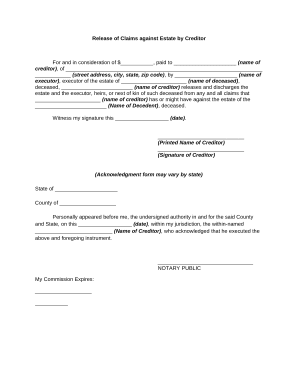
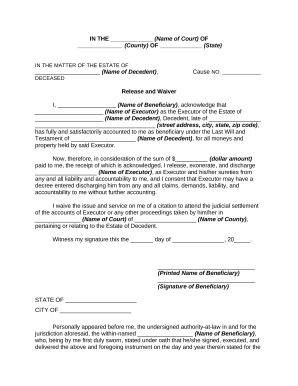
The Creditor Release Form is a legal document used by creditors and estate administrators to release a creditor's claims against a decedent's estate.
pdfFiller scores top ratings on review platforms




Easy to use, so many options for forms and templates I didn't even realize could be so helpful in my business. Very satisfied!
Easy to use
Very easy to use.
GREAT
GREAT, QUICK AND EASY
good
I was new and filled my form till I erased a part of original text and then I got stuck, the help from chat was more than satisfactory
I like it. It is a struggle to get usess to it, but I'm getting there.
Who needs Estate Release Form?
Explore how professionals across industries use pdfFiller.

Estate Release Form is needed by:
-
Creditors seeking to release claims on an estate
-
Estate administrators managing the settlement process
-
Legal professionals handling estate matters
-
Heirs and beneficiaries involved in estate settlements
-
Notaries public for notarizing the document
Comprehensive Guide to Estate Release Form
What is the Creditor Release Form?
The Creditor Release Form serves a vital role in estate management by facilitating the release of claims against a decedent's estate. This legal document is employed primarily to mitigate disputes after debts are settled with a creditor. A creditor is an entity or individual to whom money is owed, while the administrator oversees the estate. This form is an integral part of estate planning documents, ensuring all parties acknowledge the conditions following debt resolution.
This form is essential for protecting the estate from further claims and confirming that all debts have been satisfied.
Purpose and Benefits of the Creditor Release Form
The use of the Creditor Release Form is pivotal for several reasons, providing unique advantages to involved parties. Firstly, it affords protection for estates by preempting any claims that might arise after the settlement process has concluded. Secondly, the form simplifies the settlement procedure for administrators, making the overall estate management process less burdensome. Thirdly, it gives creditors legal certainty regarding their claims following the acknowledgment of their payments.
Utilizing this form not only streamlines estate dealings but also enhances trust between creditors and administrators.
Key Features of the Creditor Release Form
Understanding the distinct features of the Creditor Release Form is crucial for proper usage. Key components include:
-
Essential fields such as court information, creditor details, and confirmations of payment.
-
Requirements for notarization and the necessity of signatures from both the creditor and the administrator.
-
A structured format with designated blank fields meant for user input.
These elements are fundamental to ensuring the form’s validity and effectiveness.
Who Needs the Creditor Release Form?
The Creditor Release Form is relevant for various parties involved in estate transactions. Creditors, who can be individuals or organizations, typically require the form to confirm that their claims have been satisfied. Administrators, tasked with the management of the estate, must also use the form in situations where debts have been addressed. Furthermore, the complexity of the estate plays a key role in determining the necessity for this form, especially in more intricate cases.
This document becomes particularly critical after debts are settled, providing clarity on the status of those financial obligations.
How to Fill Out the Creditor Release Form Online (Step-by-Step)
To fill out the Creditor Release Form online effectively, follow these steps:
-
Access the form via a reliable online platform.
-
Begin by entering the court details relevant to the estate.
-
Add all necessary creditor information, including name and contact details.
-
Confirm payment acknowledgments to validate the release of claims.
-
Review all entries for accuracy before final submission.
Attention to detail is essential in each step to avoid any errors that could delay processing.
Signing and Notarizing the Creditor Release Form
For the Creditor Release Form to be legally binding, proper signing and notarization are required. Users must understand the distinctions between digital and wet signatures, which can vary based on jurisdiction. The notarization process necessitates the presence of a notary public, who will authenticate the signatures and ensure that all parties are properly identified. This step is crucial as it reinforces the legitimacy of the document.
Scheduling a notarization appointment should be done promptly to prevent delays in the filing process.
Where to Submit the Creditor Release Form
Once completed, the Creditor Release Form can be submitted through various channels. Users may opt for physical submission to the appropriate court or utilize electronic methods if available in their state. Additionally, it's important to verify submission requirements specific to one’s state, as these can affect processing timelines. Be aware of any fees associated with filing and explore potential options for waivers.
Timely submission is critical to ensure compliance with legal standards.
What Happens After You Submit the Creditor Release Form?
After submission of the Creditor Release Form, users can expect several follow-up steps. Typically, a confirmation of submission will be provided, along with options for tracking the status of the form. Processing times may vary depending on the court's workload, and users should be prepared for possible outcomes, including requests for additional information. Knowing what to anticipate can alleviate uncertainties during this phase.
Staying informed about the progress of your submission is essential for maintaining clarity throughout the process.
Ensuring Security and Compliance When Using the Creditor Release Form
Handling sensitive documents like the Creditor Release Form demands vigilance regarding security and compliance. Utilizing platforms like pdfFiller ensures that personal and legal information is secured through robust measures, such as 256-bit encryption. It's crucial to adhere to privacy regulations while managing documents, safeguarding users against data breaches. Maintaining document confidentiality remains a primary responsibility of all parties involved.
Prioritizing security helps protect against potential risks associated with handling sensitive information.
Maximizing Your Experience with pdfFiller for the Creditor Release Form
Enhancing your experience with pdfFiller can significantly streamline the process of handling the Creditor Release Form. The platform offers multiple benefits, including editing capabilities, eSigning features, and convenient ways to share documents. User-friendly tools like fillable forms and document storage are invaluable for keeping track of important papers. Additionally, pdfFiller's commitment to security and privacy sets a trustworthy standard for users.
Leveraging these features will maximize efficiency and ease throughout your form-filling journey.
How to fill out the Estate Release Form
-
1.Access the Creditor Release Form by visiting pdfFiller's website and searching for the specific form name.
-
2.Once located, click on the form to open it in pdfFiller's editing interface.
-
3.Begin by gathering all necessary information, such as creditor details, court information, and payment acknowledgment.
-
4.Fill in each blank field carefully, ensuring all relevant information is accurately included.
-
5.Utilize pdfFiller's tools to help navigate through the fields and ensure you input information in the correct sections.
-
6.After completing the form, review all entries for accuracy and completeness.
-
7.Once confirmed, proceed to finalize the document by following pdfFiller's prompts for signatures.
-
8.Ensure both the creditor and the administrator sign the form and that it is notarized, as required.
-
9.After finalizing, you can save the completed form on pdfFiller, download a copy, or submit it as instructed.

Who is eligible to use the Creditor Release Form?
The Creditor Release Form is designed for creditors and estate administrators involved in the process of settling an estate. Both parties must agree to the release of claims.
What information is required to fill out the form?
You will need details including creditor information, court details, acknowledgment of payment, and necessary signatures from both the creditor and the administrator.
Does the form need to be notarized?
Yes, the Creditor Release Form must be notarized to ensure its validity. It requires an acknowledgment from a notary public after the signatures are provided.
How should I submit the form after completing it?
Once completed and notarized, you can submit the Creditor Release Form to the appropriate court or agency as dictated by your specific situation or jurisdiction.
What are common mistakes to avoid when using this form?
Avoid leaving blank fields, failing to secure necessary signatures, or not notarizing the document, as these can result in invalidation of the form.
How long does it take to process the Creditor Release Form?
Processing times can vary based on jurisdiction and court schedules. Generally, allow several weeks for processing after submission.
Are there any fees associated with submitting the form?
Possible fees may apply depending on the court where the form is submitted. Check with your local court for specific fee information.
Related Forms




Related Catalogs
Get the latest insights from our blog


If you believe that this page should be taken down, please follow our DMCA take down process
here
.
This form may include fields for payment information. Data entered in these fields is not covered by PCI DSS compliance.