
Last updated on
Oct 2, 2026
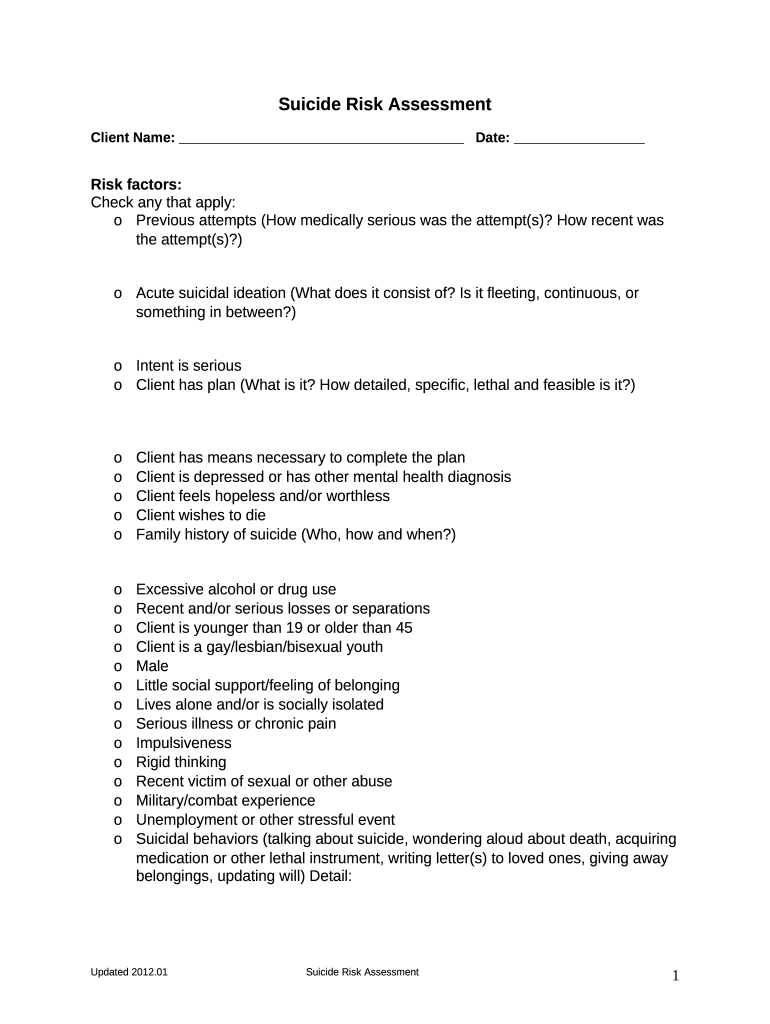
WI WAFCA Suicide Risk Assessment 2012-2026 free printable template
pdfFiller is not affiliated with any government organization

Fill out
Complete the form online in a simple drag-and-drop editor.

eSign
Add your legally binding signature or send the form for signing.

Share
Share the form via a link, letting anyone fill it out from any device.

Export
Download, print, email, or move the form to your cloud storage.
Why pdfFiller is the best tool for your documents and forms


End-to-end document management
From editing and signing to collaboration and tracking, pdfFiller has everything you need to get your documents done quickly and efficiently.
Accessible from anywhere
pdfFiller is fully cloud-based. This means you can edit, sign, and share documents from anywhere using your computer, smartphone, or tablet.
Secure and compliant
pdfFiller lets you securely manage documents following global laws like ESIGN, CCPA, and GDPR. It's also HIPAA and SOC 2 compliant.
What is WI WAFCA Suicide Risk Assessment
The Suicide Risk Assessment Form is a medical consent document used by healthcare professionals to evaluate a client's risk of suicide.
pdfFiller scores top ratings on review platforms




Who needs WI WAFCA Suicide Risk Assessment?
Explore how professionals across industries use pdfFiller.

WI WAFCA Suicide Risk Assessment is needed by:
-
Mental health professionals conducting assessments
-
Therapists evaluating client safety
-
Healthcare providers managing risk evaluations
-
Clients seeking mental health evaluations
-
Caregivers involved in client support
-
Insurance companies assessing treatment needs
Comprehensive Guide to WI WAFCA Suicide Risk Assessment
What is the Suicide Risk Assessment Form?
The Suicide Risk Assessment Form plays a crucial role in evaluating the risk factors associated with suicide. This comprehensive mental health assessment form is essential for therapists and mental health professionals as it aids in identifying critical aspects of a client's emotional state. The form is structured into specific sections that include risk factors, mediating factors, the client's level of risk, and actions to be taken following the assessment.
By utilizing this form, professionals can systematically document findings, which enhances the quality of mental health evaluations and interventions.
Purpose and Benefits of the Suicide Risk Assessment Form
Understanding the purpose of the Suicide Risk Assessment Form is vital for effective mental health care. Assessing suicide risk in clients is paramount in providing timely interventions that can save lives. This healthcare form offers structured documentation that benefits both clients and therapists during assessments.
Utilizing the form can streamline the evaluation process, empowering therapists to facilitate intervention and support for individuals who may be at risk. Structured documentation creates a lasting record that can be referenced in future assessments.
Who Needs the Suicide Risk Assessment Form?
The Suicide Risk Assessment Form is designed for therapists, mental health professionals, and clients seeking evaluations. Understanding when to use this form is key—initial assessments and follow-up evaluations are typical scenarios. Involving clients in the assessment process fosters awareness of their emotional health and encourages open communication with their therapists.
Encouraging engagement from clients in their evaluations can lead to more accurate assessments and the development of tailored intervention strategies.
How to Fill Out the Suicide Risk Assessment Form Online (Step-by-Step)
Completing the Suicide Risk Assessment Form online requires attention to detail. Here are the essential steps to follow:
-
Gather necessary information regarding risk factors and mediating responses.
-
Access the online form and ensure you have a stable internet connection.
-
Fill out each section meticulously, paying attention to specific prompts.
-
Review all entries for accuracy and completeness.
-
Submit the form following the provided instructions.
Ensuring thoroughness in responses can significantly impact the quality of the assessment and the proposed interventions.
Review and Validation Checklist for the Suicide Risk Assessment Form
Before submitting the Suicide Risk Assessment Form, it is imperative to perform a thorough review. Common errors can jeopardize the accuracy of the assessment. Here are tips to ensure proper completion:
-
Check each section for missing information.
-
Verify the accuracy of all responses and data provided.
-
Ensure that signatures from both the client and therapist are included.
This checklist promotes thorough validation of the information presented in the form, enhancing the standard of care provided.
How to Sign the Suicide Risk Assessment Form
Understanding the signing procedure for the Suicide Risk Assessment Form is essential for compliance and documentation. Clients and therapists can choose between digital signatures and wet signatures. The signing process is straightforward, but security remains a top priority.
-
For digital signatures, follow the eSigning prompts provided in the online form.
-
For wet signatures, print the completed form and sign it physically.
It is vital to handle signed forms securely to maintain confidentiality and protect client information.
Submission Methods for the Suicide Risk Assessment Form
Submitting the completed Suicide Risk Assessment Form can be done through various methods based on user preference. Available options include:
-
Submissions through the pdfFiller platform.
-
Using a PDF filler application to complete and send the form.
-
Mailing a printed version to the relevant office or agency.
Tracking submissions and confirming receipt is recommended to ensure timely processing, along with maintaining a copy for personal records.
Security and Compliance for Handling the Suicide Risk Assessment Form
Security is a critical concern when handling sensitive documents like the Suicide Risk Assessment Form. pdfFiller employs 256-bit encryption and complies with HIPAA regulations to safeguard client data. Understanding the measures in place can reassure users about the protection of their information during the assessment process.
Data protection practices are crucial in mental health settings, where confidentiality is paramount for creating a safe environment for clients.
Engaging with pdfFiller to Enhance Your Experience with the Suicide Risk Assessment Form
Utilizing pdfFiller's platform can significantly enhance the experience of filling out the Suicide Risk Assessment Form. The platform streamlines the processes of filling, signing, and submitting the form, making it user-friendly. Features such as cloud-based editing and easy sharing contribute to the usability.
Creating an account with pdfFiller allows users to explore additional tools for managing healthcare forms, ensuring comprehensive support during their mental health evaluations.
How to fill out the WI WAFCA Suicide Risk Assessment
-
1.Access pdfFiller and log in to your account. Use the search bar to locate the 'Suicide Risk Assessment Form' by entering the form name.
-
2.Open the form by clicking on it in the search results. The form will load in the pdfFiller editing interface where you can begin filling in the required fields.
-
3.Before you start, gather necessary information such as the client’s personal details, any prior mental health history, and specific risk factors. This information will assist in accurately completing the form.
-
4.Start by filling in the client's information section. Input details like name, age, and any relevant identification numbers. Ensure all personal information is accurate.
-
5.Proceed to the risk factors section. Use the available options to indicate known risk factors. Utilize the checkboxes and fields to mark any relevant information based on your assessment.
-
6.Next, focus on the mediating factors section. Fill in the factors that may reduce the risk of suicide for the client. This could include support systems or coping mechanisms.
-
7.Complete the level of risk section. Provide an honest evaluation based on the information gathered. This is crucial for tailored interventions.
-
8.Detail any actions taken in the final section as required. This could include referrals, treatment plans or other relevant notes that could assist further evaluations.
-
9.Review the entire form for accuracy before obtaining the required signatures. Check for any missed fields or inaccuracies.
-
10.Once verified, use the signature line fields for both the client and therapist to sign. Ensure that everyone involved is aware of what they are signing.
-
11.After signing, you can save the completed form by clicking the 'Save' button. Choose the desired format for download or opt to share it directly via pdfFiller’s sharing options.
-
12.Finally, download or submit the form according to your needs, ensuring that you retain a copy for your records.

Who needs to complete the Suicide Risk Assessment Form?
The form is primarily for clients seeking mental health evaluations and therapists conducting assessments. It helps professionals evaluate a client's risk of suicide effectively.
Is there a deadline for submitting the Suicide Risk Assessment Form?
There isn't a specific deadline for submission. However, it should be completed as soon as possible after the assessment to ensure timely interventions and safety planning.
What are the submission methods for this form?
The completed form can be submitted digitally via pdfFiller, or it can be printed out and submitted physically to healthcare providers or relevant agencies.
Are there any documents needed to accompany the form?
Typically, no supporting documents are required with this form, but having the client's mental health history or notes from previous consultations can aid in filling it out accurately.
What common mistakes should be avoided while filling out the form?
Common mistakes include leaving fields blank, inaccurately reporting risk factors, and failing to obtain the necessary signatures. Be thorough and double-check your inputs.
How long does it take to process the form?
Processing time varies but should be prompt. Once submitted, healthcare professionals usually review it quickly to address any immediate concerns regarding client safety.
Can I edit the form once it's filled out?
Yes, if using pdfFiller, edits can be made to the form until it's finalized and submitted. Always save a draft before finalizing to prevent loss of information.
Related Forms



Related Catalogs
Get the latest insights from our blog


If you believe that this page should be taken down, please follow our DMCA take down process
here
.
This form may include fields for payment information. Data entered in these fields is not covered by PCI DSS compliance.