
Last updated on
Nov 7, 2026
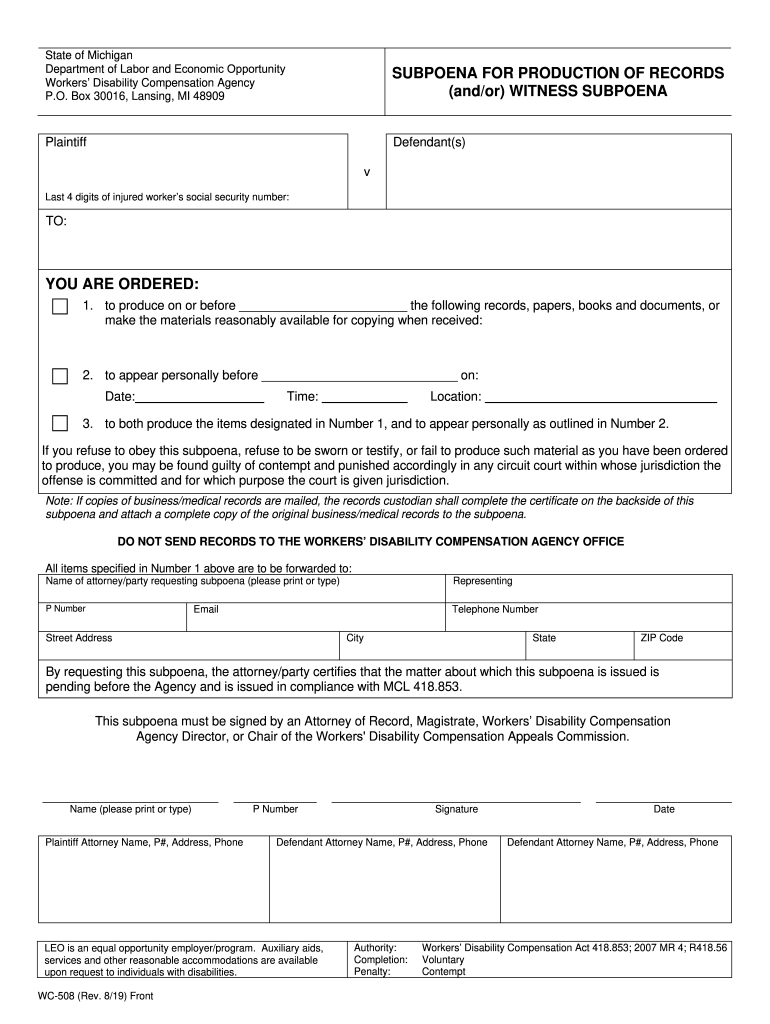
MI WC-508 2019-2026 free printable template
pdfFiller is not affiliated with any government organization

Fill out
Complete the form online in a simple drag-and-drop editor.

eSign
Add your legally binding signature or send the form for signing.

Share
Share the form via a link, letting anyone fill it out from any device.

Export
Download, print, email, or move the form to your cloud storage.
Why pdfFiller is the best tool for your documents and forms


End-to-end document management
From editing and signing to collaboration and tracking, pdfFiller has everything you need to get your documents done quickly and efficiently.
Accessible from anywhere
pdfFiller is fully cloud-based. This means you can edit, sign, and share documents from anywhere using your computer, smartphone, or tablet.
Secure and compliant
pdfFiller lets you securely manage documents following global laws like ESIGN, CCPA, and GDPR. It's also HIPAA and SOC 2 compliant.
What is MI WC-508
The Michigan Subpoena for Production of Records is a legal document used by the Workers’ Disability Compensation Agency to order the production of records related to a workers' compensation case.
pdfFiller scores top ratings on review platforms




Who needs MI WC-508?
Explore how professionals across industries use pdfFiller.

MI WC-508 is needed by:
-
Records Custodians responsible for maintaining documents.
-
Notary Publics for certifying signatures.
-
Legal professionals working on workers' compensation cases.
-
Individuals involved in disputes requiring record evidence.
-
Employers managing workers' compensation claims.
Comprehensive Guide to MI WC-508
What is the Michigan Subpoena for Production of Records?
The Michigan Subpoena for Production of Records is a legal document used primarily in workers' compensation cases. Its purpose is to formally request the production of relevant records, papers, books, and documents necessary for legal proceedings. This subpoena underlines the importance of gathering proper documentation to support claims and ensure transparency in the legal process.
Utilizing this document can significantly affect the outcome of a case, emphasizing its necessity in various legal contexts. With its structured format, the Michigan subpoena template streamlines the record-collection process, allowing for efficient handling of essential information.
Purpose and Benefits of the Michigan Subpoena for Production of Records
The legal necessity of the Michigan Subpoena for Production of Records cannot be overstated, especially within the framework of workers' disability compensation. This form serves as an official request, compelling individuals or organizations to provide relevant documentation pertinent to the case.
-
Facilitates compliance with legal obligations during compensation cases
-
Helps to collect vital evidence that can influence case results
-
Ensures accurate and thorough documentation, reducing misunderstandings
Employing a legal subpoena form can greatly enhance the efficacy of legal processes by validating claims and substantiating the information that supports them.
Key Features of the Michigan Subpoena for Production of Records
Understanding the key components of the Michigan Subpoena for Production of Records is essential for effective use. This form contains several critical sections designed to guide users in its proper application.
-
Recipient details, which identify who is required to produce records
-
Specifications regarding the exact records needed
-
Requirements for notarization and the necessary signatures
These features ensure that the subpoena is comprehensive, legally binding, and clear, protecting all parties involved throughout the legal process.
Who Needs the Michigan Subpoena for Production of Records?
Various individuals and organizations may require the Michigan Subpoena for Production of Records. This includes roles such as the Records Custodian, who is responsible for maintaining the documents requested, and the Notary Public, who verifies the authenticity of signatures.
-
Used by legal representatives during hearings
-
Applicable in investigations where documentation is critical
-
Essential for plaintiffs or defendants in compensation cases
This subpoena is instrumental in ensuring that relevant evidence is obtained and that all legal protocols are followed correctly.
How to Fill Out the Michigan Subpoena for Production of Records Online
Filling out the Michigan Subpoena for Production of Records online can be accomplished with a systematic approach. Begin by accessing the appropriate platform that supports electronic form completion, such as pdfFiller.
-
Enter the case details, including involved parties and case number.
-
Specify the documents needed by providing a detailed description.
-
Review the completed sections for accuracy and completeness.
Following these steps ensures that users submit a correctly filled legal subpoena form, minimizing the likelihood of errors that could impede the legal process.
Signing and Notarization of the Michigan Subpoena for Production of Records
Proper signing and notarization of the Michigan Subpoena for Production of Records are crucial for its validity. Users must understand the distinctions between digital and wet signatures, as both can have implications for legal acceptance.
-
Digital signatures may be sufficient under specific legal frameworks
-
Wet signatures often require direct involvement from a Notary Public
-
The notarization process adds a level of authenticity and legality
Ensuring that the subpoena is signed and notarized appropriately is fundamental in meeting legal requirements and upholding the integrity of the document.
How to Submit the Michigan Subpoena for Production of Records
Submitting the completed Michigan Subpoena for Production of Records can be accomplished through various methods. Understanding the options available will help ensure timely and effective processing.
-
Online submission, using a designated legal platform
-
Mailing the completed subpoena to the appropriate authority
It is advisable to keep a record of the submission for tracking purposes, ensuring that the document reaches the intended destination to maintain legal standing.
Consequences of Not Filing or Late Filing the Michigan Subpoena for Production of Records
Failure to file the Michigan Subpoena for Production of Records on time carries significant legal implications. Neglecting the deadlines can adversely affect a worker's compensation case, potentially hindering the legal process.
-
May result in missed opportunities to obtain crucial evidence
-
Possible legal penalties for non-compliance with procedural requirements
Timely submission is critical; understanding these consequences may motivate parties to adhere to established timelines and legal protocols.
Security and Compliance for Handling the Michigan Subpoena for Production of Records
Users can manage their Michigan Subpoena for Production of Records with confidence, knowing that proper security measures are in place. Platforms like pdfFiller employ stringent protocols to protect sensitive documents against unauthorized access.
-
Utilizes 256-bit encryption for data security
-
Complies with SOC 2 Type II, HIPAA, and GDPR regulations
These security measures ensure that personal and sensitive information remains protected, reinforcing the importance of compliance in legal document handling.
Easily Manage Your Michigan Subpoena for Production of Records with pdfFiller
pdfFiller provides an efficient way to manage the Michigan Subpoena for Production of Records. Users can benefit from a range of features designed to streamline the process.
-
Edit text and images directly in the form
-
Utilize eSigning capabilities for quick approvals
-
Share documents securely with involved parties
These user-friendly functionalities not only save time but also bolster the security and accessibility of important legal documents.
How to fill out the MI WC-508
-
1.Access the Michigan Subpoena for Production of Records on pdfFiller by searching for the form name or browsing the Legal Forms category.
-
2.Open the form in the editable interface of pdfFiller. Familiarize yourself with the various fields present on the document.
-
3.Before starting, gather all necessary information including names, dates, and specific records being requested for production.
-
4.Begin filling out the required fields. Click on each section to enter information directly. Ensure accuracy in the details provided to avoid mistakes.
-
5.Use pdfFiller's tools to navigate between fields easily and utilize any tips or instructions that may appear to assist with completion.
-
6.After filling out the form, review the entered information meticulously. Check for any missing fields and ensure that all required details are accurate.
-
7.Finalize your form in pdfFiller by placing your signature in the designated area. Remember that the form must be signed by an authorized party.
-
8.Once complete, save your document using the save feature in pdfFiller. You can also download the completed form directly to your device.
-
9.If needed, use the submission options available in pdfFiller to submit directly to the appropriate agency or party.

Who can issue the Michigan Subpoena for Production of Records?
The Michigan Subpoena for Production of Records can be issued by authorized parties, primarily within the Workers’ Disability Compensation Agency or individuals involved in the legal process.
What is the deadline for responding to this subpoena?
The subpoena will typically specify a deadline by which the requested records must be produced. Ensure to pay attention to the 'to produce on or before' line when completing the form.
Can I submit the subpoena electronically?
Submission methods can vary. Check with the Workers’ Disability Compensation Agency for their preferred submission methods, as they may allow electronic submissions under certain conditions.
What types of documents need to be attached?
It's essential to include any records, papers, or documents directly relevant to the workers' compensation case as specified in the subpoena. This may include medical records or employment documents.
What are common mistakes to avoid when completing this form?
Common mistakes include missing signatures, failing to notarize the document, or incorrectly filling out critical fields like names or dates, which could delay processing.
How can I ensure the accuracy of the records I produce?
Certify the accuracy of the documents by having the records custodian review them before submission. Additionally, ensure that copies of original documents are clear and legible.
How long does processing take after submission?
Processing times can vary based on the agency's workload. It's best to follow up directly with the Workers’ Disability Compensation Agency after submission to check on the status.
MI WC-508 Form Versions
Related Content
Related Forms




Get the latest insights from our blog


If you believe that this page should be taken down, please follow our DMCA take down process
here
.
This form may include fields for payment information. Data entered in these fields is not covered by PCI DSS compliance.