
Last updated on
Sep 22, 2026

Get the free Court Notice of Summons and Complaint
We are not affiliated with any brand or entity on this form

Fill out
Complete the form online in a simple drag-and-drop editor.

eSign
Add your legally binding signature or send the form for signing.

Share
Share the form via a link, letting anyone fill it out from any device.

Export
Download, print, email, or move the form to your cloud storage.
Why pdfFiller is the best tool for your documents and forms


End-to-end document management
From editing and signing to collaboration and tracking, pdfFiller has everything you need to get your documents done quickly and efficiently.
Accessible from anywhere
pdfFiller is fully cloud-based. This means you can edit, sign, and share documents from anywhere using your computer, smartphone, or tablet.
Secure and compliant
pdfFiller lets you securely manage documents following global laws like ESIGN, CCPA, and GDPR. It's also HIPAA and SOC 2 compliant.
What is Summons & Complaint Notice
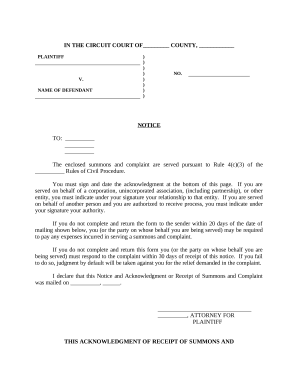
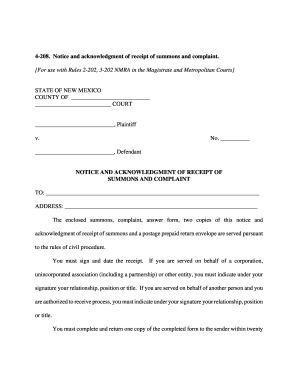
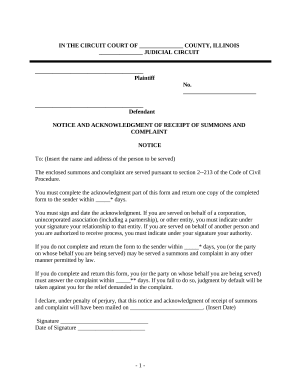
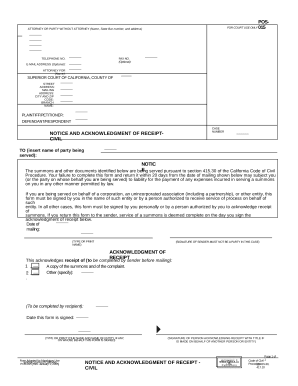
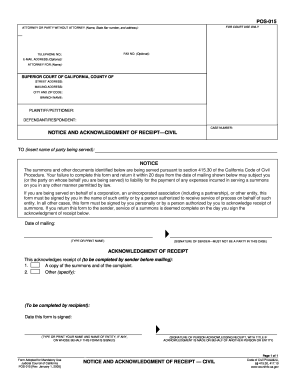
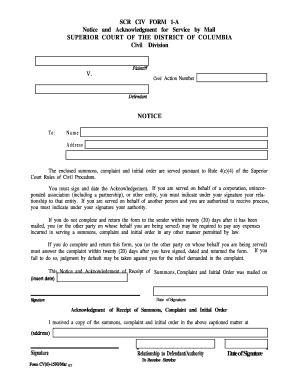
The Court Notice of Summons and Complaint is a legal notice document used by civil court parties to acknowledge receipt of a summons and complaint.
pdfFiller scores top ratings on review platforms




Who needs Summons & Complaint Notice?
Explore how professionals across industries use pdfFiller.

Summons & Complaint Notice is needed by:
-
Recipients of civil court summons
-
Attorneys representing plaintiffs
-
Notaries public validating legal documents
-
Individuals involved in court disputes
-
Persons acknowledging legal notifications
Comprehensive Guide to Summons & Complaint Notice
What is the Court Notice of Summons and Complaint?
The Court Notice of Summons and Complaint is a critical document in civil court proceedings, serving as an official notification to a recipient. Its significance lies in the obligation to inform all parties involved, including the plaintiff and notary, ensuring transparency and compliance. Acknowledging receipt of this document is not just procedural; it can influence the outcome of the case if proper protocol isn't followed.
Purpose and Benefits of the Court Notice of Summons and Complaint
Understanding the role of the Court Notice of Summons and Complaint is essential for navigating legal processes. This form acts as a standardized legal notice that streamlines communication among parties. Using a legal notice form template offers several benefits, including clarity and consistency. Timely filing of this notice is crucial to avoid potential penalties related to non-compliance.
Key Features of the Court Notice of Summons and Complaint
This legal notice includes several key features that enhance its functionality. Required signatures must be obtained from the recipient, the attorney for the plaintiff, and a notary public. The notarization section is essential for verifying authenticity and ensuring the document’s compliance with legal standards. Key fields in the form, such as dates and signatures, facilitate its legal validity and enforceability.
Who Needs the Court Notice of Summons and Complaint?
Understanding who requires the Court Notice of Summons and Complaint is vital for all parties involved in civil court cases. Key roles include the recipient, the plaintiff's attorney, and the notary public. This form is typically needed in various scenarios, such as when initiating a lawsuit or responding to legal actions. All parties must cooperate to ensure the process runs smoothly.
Steps to Fill Out the Court Notice of Summons and Complaint Online (Step-by-Step)
-
Access the form using pdfFiller's platform.
-
Enter the necessary details in each designated field.
-
Ensure that the recipient, attorney for the plaintiff, and notary public sign and date accordingly.
-
Review all information for accuracy before submission.
-
Submit the completed form electronically to the relevant court.
How to Sign or Notarize the Court Notice of Summons and Complaint
Signing the Court Notice of Summons and Complaint can be executed in either digital or traditional formats, depending on legal requirements. Understanding the differences between a digital signature and a wet signature is crucial for compliance. Notarizing the document is essential in many jurisdictions; accurate signatures ensure the form's legal validity and effectiveness within civil proceedings.
Submission Methods and Deadlines for the Court Notice of Summons and Complaint
After completing the Court Notice of Summons and Complaint, proper submission is essential. The document can be delivered to relevant court offices directly or electronically. Adhering to submission deadlines is crucial, as late returns may incur additional fees and legal complications. Mark your calendar with key dates to avoid issues.
What Happens After You Submit the Court Notice of Summons and Complaint?
Once the Court Notice of Summons and Complaint is submitted, it enters a post-submission process involving court review. You can track the status of your submission through the court's official channels to ensure all legal requirements are met. Depending on the recipient's actions, possible next steps may include responding to the complaint or preparing for court proceedings.
Security and Compliance When Using the Court Notice of Summons and Complaint
When using pdfFiller for the Court Notice of Summons and Complaint, robust security measures are in place. The platform features 256-bit encryption and complies with regulations such as HIPAA and GDPR to ensure document safety throughout the process. Prioritizing privacy and data protection is essential when dealing with legal notices.
Experience Seamless Form Filling with pdfFiller
Utilizing pdfFiller to complete the Court Notice of Summons and Complaint enhances efficiency. The platform offers numerous benefits, including ease of use, secure document handling, and compliance with legal standards. By streamlining the form-filling process, pdfFiller ensures a smoother experience for users navigating legal challenges.
How to fill out the Summons & Complaint Notice
-
1.Access pdfFiller and search for 'Court Notice of Summons and Complaint'. Open the form.
-
2.Once the form is displayed, navigate through the fields appearing on your screen. Begin by filling in your personal details in the designated recipient area.
-
3.Ensure you have the summons and complaint information handy, as these details will need to be entered systematically.
-
4.Look for the signature fields and sign where required. You can use the pdfFiller signature tool for this.
-
5.As you complete each section, refer back to the document for any instructions included and answer all prompts accurately.
-
6.After filling in all necessary fields, review the entire document for correctness. Make sure that no fields are left blank unless specified.
-
7.Finalize the form by saving the changes made in pdfFiller. You can also download the filed document for your records.
-
8.Once saved, choose the appropriate submission method available in pdfFiller to ensure timely processing. Follow prompts for electronic submission or printed mailing options.

Who is eligible to use the Court Notice of Summons and Complaint?
This form is intended for recipients of a civil court summons, typically involved in legal cases. Attorneys for plaintiffs and notaries who oversee legal documentation are also eligible.
What is the deadline for returning the completed form?
Recipients must return the completed form within 20 days to avoid extra service charges. Failure to do so may affect legal proceedings.
How can I submit the completed form?
You can submit the form electronically through pdfFiller or print it and mail it to the appropriate court or legal entity as per your situation.
What supporting documents are needed when filling this form?
Typically, you will need the original summons and complaint document, along with any identification or legal representation details required in the fields of this form.
What mistakes should I avoid when completing this form?
Common mistakes include missing signatures, incorrect dates, and overlooking specific instructions on where to submit the form after completion.
How long does it take to process the Court Notice of Summons and Complaint?
Processing times can vary based on the court's workload. Generally, it is advisable to allow at least a few weeks and follow up if there are concerns.
Are notarization requirements mandatory for this form?
Yes, notarization is required. Ensure that a notary public validates the form where indicated to confirm its legal standing.
Related Content
Related Forms


Get the latest insights from our blog


If you believe that this page should be taken down, please follow our DMCA take down process
here
.
This form may include fields for payment information. Data entered in these fields is not covered by PCI DSS compliance.