
Last updated on
Oct 31, 2026
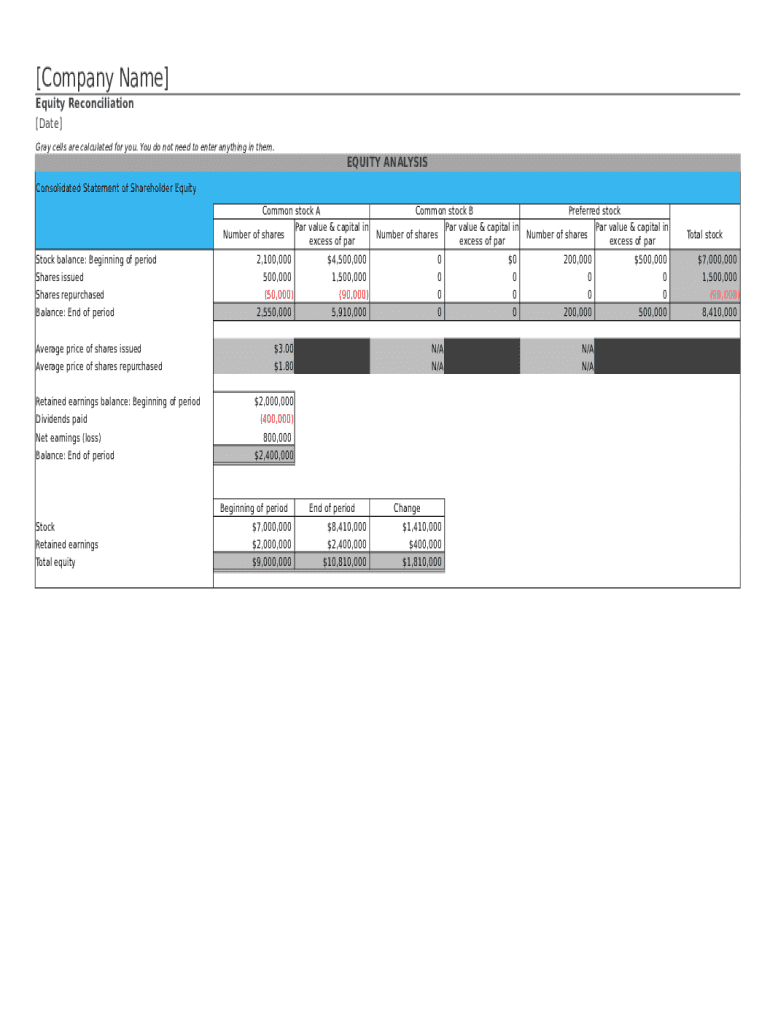
Shareholder Equity Report free printable template
We are not affiliated with any brand or entity on this form

Fill out
Complete the form online in a simple drag-and-drop editor.

eSign
Add your legally binding signature or send the form for signing.

Share
Share the form via a link, letting anyone fill it out from any device.

Export
Download, print, email, or move the form to your cloud storage.
Why pdfFiller is the best tool for your documents and forms


End-to-end document management
From editing and signing to collaboration and tracking, pdfFiller has everything you need to get your documents done quickly and efficiently.
Accessible from anywhere
pdfFiller is fully cloud-based. This means you can edit, sign, and share documents from anywhere using your computer, smartphone, or tablet.
Secure and compliant
pdfFiller lets you securely manage documents following global laws like ESIGN, CCPA, and GDPR. It's also HIPAA and SOC 2 compliant.
What is Shareholder Equity Report
The Equity Reconciliation Form is a financial document used by businesses to track and analyze changes in shareholder equity over time.
pdfFiller scores top ratings on review platforms




Who needs Shareholder Equity Report?
Explore how professionals across industries use pdfFiller.

Shareholder Equity Report is needed by:
-
Business owners looking to manage equity
-
Finance professionals analyzing financial statements
-
Investors evaluating shareholder investments
-
Accountants preparing balance sheets
-
Auditors conducting financial reviews
-
Financial analysts performing stock assessments
Comprehensive Guide to Shareholder Equity Report
What is the Equity Reconciliation Form?
The Equity Reconciliation Form is a crucial tool for businesses, allowing them to monitor and document changes in shareholder equity over time. This financial statement template enables organizations to track different components of equity, such as common stock, preferred stock, and retained earnings. By using this form, businesses can maintain accurate records of equity fluctuations, which is essential for effective financial analysis.
This form serves as an integral part of financial tracking and reporting, ensuring that all changes in shareholder equity are captured and analyzed systematically.
Purpose and Benefits of the Equity Reconciliation Form
The primary purpose of the Equity Reconciliation Form is to provide a structured approach to tracking shareholder equity. Accurate financial reporting is vital for any business, and this form helps ensure precision by organizing data in a systematic manner. Key benefits of using the form include:
-
Facilitates a clear understanding of equity changes over a specific period.
-
Enhances accuracy in financial statements for better strategic decisions.
-
Streamlines the process of equity analysis by consolidating relevant data.
Using a well-structured template can significantly improve financial analysis while assisting organizations in adhering to compliance standards.
Key Features of the Equity Reconciliation Form
The Equity Reconciliation Form boasts several features that simplify the process of inputting and analyzing equity-related data. Some of its notable elements include:
-
Sections designated for common stock, preferred stock, and retained earnings.
-
Calculated fields that automatically update based on user input, reducing the risk of errors.
-
Visual aids that depict changes in equity, helping users quickly grasp financial trends.
These features collectively enhance the user experience while ensuring that essential data is accurately captured and analyzed.
Who Needs the Equity Reconciliation Form?
The Equity Reconciliation Form is designed for a diverse range of users who are involved in financial reporting and analysis. Key stakeholders include:
-
Business owners who need to monitor their equity status.
-
Accountants responsible for preparing accurate financial statements.
-
Financial analysts seeking to assess the performance of an organization.
Any organization that reports shareholder equity can greatly benefit from utilizing this form, making it a valuable asset for various business environments.
How to Fill Out the Equity Reconciliation Form Online (Step-by-Step)
Filling out the Equity Reconciliation Form online is straightforward with the following step-by-step instructions:
-
Begin by entering the number of shares issued and par value in the designated fields.
-
Complete the sections for common and preferred stock, ensuring all relevant information is accurate.
-
Utilize the gray calculated fields to automatically generate totals; do not enter any data in these fields.
-
Review the data entered carefully to avoid common mistakes, such as miscalculating shares or not including all sections.
By following these steps, users can efficiently complete the form while minimizing errors in data entry.
Submission and Processing of the Equity Reconciliation Form
Once the Equity Reconciliation Form is completed, users have several options for submission. It can typically be submitted online or through traditional channels such as mail. Consider the following factors when submitting the form:
-
Check for any associated fees related to submission methods.
-
Be aware of processing times, which can vary depending on the submission channel chosen.
Understanding these aspects can facilitate a smoother submission process and ensure timely processing of the form.
Security and Compliance with the Equity Reconciliation Form
When handling the Equity Reconciliation Form, security and compliance are paramount concerns. pdfFiller incorporates robust security features, including encryption and adherence to regulatory standards such as HIPAA and GDPR. It is essential to protect sensitive financial data throughout the form creation and submission processes. Users can trust that their documents are safe and compliant with industry regulations while using this platform.
Sample or Example of a Completed Equity Reconciliation Form
For users new to the Equity Reconciliation Form, having a visual reference can be incredibly helpful. Providing an illustrative example of a completed form allows users to see how to fill out each section accurately.
When reviewing the example, pay close attention to the key areas emphasized in the form, such as calculations and proper entries for common and preferred stocks. This will guide users in accurately completing their own forms.
Why Use pdfFiller for Your Equity Reconciliation Form?
pdfFiller offers a range of valuable features that enhance the user experience when completing the Equity Reconciliation Form. Key capabilities include:
-
Editing options for text and images embedded in the form.
-
eSigning capabilities that facilitate swift approvals and validations.
-
Cloud storage for easy access to forms from any device.
These features empower users to handle their financial documents with ease, ensuring that they can focus on making informed decisions based on accurate information.
Take Action Forward with Your Equity Reconciliation Needs
Utilizing pdfFiller for your Equity Reconciliation Form needs positions you for improved accuracy and efficiency in financial reporting. By embracing the benefits of this platform, you can simplify the form completion process and ensure your financial documentation is well-organized and compliant.
Start using pdfFiller today to elevate your approach to equity reconciliation and streamline your financial management efforts.
How to fill out the Shareholder Equity Report
-
1.Access the Equity Reconciliation Form on pdfFiller by searching for it in the templates section or using the provided link.
-
2.Once the form is open, familiarize yourself with the different sections, including common stock, preferred stock, and retained earnings.
-
3.Before filling out the form, gather necessary information such as the number of shares, their par value, and any capital in excess of par.
-
4.Fill in the 'Number of shares' and the respective fields for 'Shares issued' and 'Shares repurchased' as required.
-
5.Ensure you leave the gray cells as they are, as they will automatically calculate for you and don’t need manual input.
-
6.Review all entered information for accuracy, verifying calculations and totals displayed in the visual representation of the equity changes.
-
7.Once satisfied with the completion of the form, utilize pdfFiller’s save functionality to store your document, or download it in your preferred format.
-
8.If applicable, submit the completed form electronically through pdfFiller’s submission options or print it for physical delivery.

Who can use the Equity Reconciliation Form?
The Equity Reconciliation Form is designed for businesses, finance professionals, and individuals involved in managing and analyzing equity, including business owners and accountants.
What information do I need to complete this form?
To successfully complete the form, you will need details such as the number of shares, par value, and information related to common and preferred stock, as well as retained earnings.
Are there any deadlines for submitting the Equity Reconciliation Form?
While the form itself doesn’t have a submission deadline, it's important to complete it in accordance with your financial reporting timelines or auditor requirements.
How can I submit the Equity Reconciliation Form?
You can submit the Equity Reconciliation Form electronically via pdfFiller’s submission options. Alternatively, you may print the form and submit it by mail or in-person, if required.
What common mistakes should I avoid when filling out this form?
Common mistakes include forgetting to fill out certain fields, entering incorrect figures for shares, and overlooking the automatic calculations in gray cells. Always double-check your entries to ensure accuracy.
Is notarization required for this form?
No, notarization is not required when completing the Equity Reconciliation Form, making it easier to fill out and submit without additional steps.
How long does it take to process the Equity Reconciliation Form?
Processing time can vary depending on the specific requirements of your review process. However, if the form is only for internal use, it does not require external approval and can be processed immediately.
Related Forms

Get the latest insights from our blog


If you believe that this page should be taken down, please follow our DMCA take down process
here
.
This form may include fields for payment information. Data entered in these fields is not covered by PCI DSS compliance.