
Last updated on
Oct 7, 2026

Affidavit of Domicile 2013-2026 free printable template
pdfFiller is not affiliated with any government organization

Fill out
Complete the form online in a simple drag-and-drop editor.

eSign
Add your legally binding signature or send the form for signing.

Share
Share the form via a link, letting anyone fill it out from any device.

Export
Download, print, email, or move the form to your cloud storage.
Why pdfFiller is the best tool for your documents and forms


End-to-end document management
From editing and signing to collaboration and tracking, pdfFiller has everything you need to get your documents done quickly and efficiently.
Accessible from anywhere
pdfFiller is fully cloud-based. This means you can edit, sign, and share documents from anywhere using your computer, smartphone, or tablet.
Secure and compliant
pdfFiller lets you securely manage documents following global laws like ESIGN, CCPA, and GDPR. It's also HIPAA and SOC 2 compliant.
What is Affidavit of Domicile
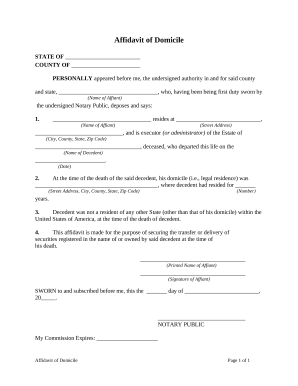
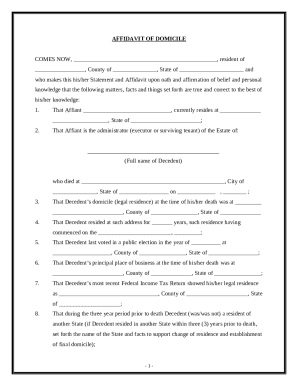
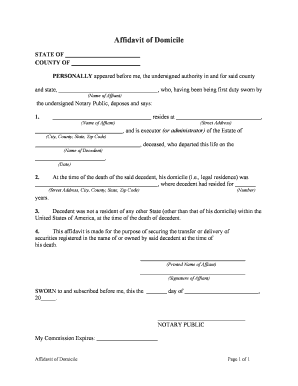
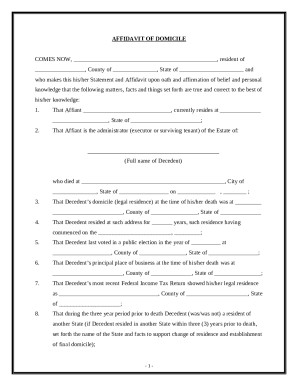
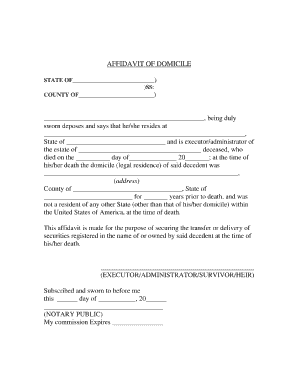
The Affidavit of Domicile is a legal document used by authorized representatives to confirm the legal residence of a deceased individual for property transfer purposes.
pdfFiller scores top ratings on review platforms




Who needs Affidavit of Domicile?
Explore how professionals across industries use pdfFiller.

Affidavit of Domicile is needed by:
-
Executors managing an estate
-
Surviving joint tenants of a property
-
Trustees settling trusts
-
Administrators of deceased estates
-
Spouses claiming property
-
Personal representatives handling affairs
-
Successors inheriting property
Comprehensive Guide to Affidavit of Domicile
What is the Affidavit of Domicile?
The Affidavit of Domicile is a legal document used to confirm the legal residence of a deceased individual. This affidavit serves a critical role in the transfer of property owned by the decedent at the time of death. It becomes particularly necessary in situations where confirming the decedent’s legal domicile is essential for property transfer and estate management.
In specific scenarios, such as settling the estate or executing a will, an Affidavit of Domicile is required to affirm that all debts and claims against the estate have been settled before transferring assets. Typically, this affidavit is submitted by Executors, Surviving Joint Tenants, or other legal representatives responsible for managing the deceased's estate.
Purpose and Benefits of the Affidavit of Domicile
The Affidavit of Domicile plays an instrumental role in estate management, providing clarity on the legal residency of the decedent. One of the critical benefits is its role in simplifying the transfer of property, allowing estate representatives to proceed with confidence.
-
Helps establish the decedent's legal residency, which is crucial for settling debts and transferring property.
-
Provides legal enforceability, ensuring recognition of the affidavit across different jurisdictions.
-
Supports timely estate settlement by clarifying the residence during inheritance proceedings.
Key Features of the Affidavit of Domicile
This affidavit includes essential components needed for its completion. It typically contains sections such as the decedent's name, date and place of death, and information about the affiant.
An important detail is the requirement for notarization, which enhances the legal validity of the affidavit. As a practical solution, many users benefit from utilizing a fillable form template to simplify the completion process.
Who Needs the Affidavit of Domicile?
The roles that may need to complete and submit the Affidavit of Domicile include:
-
Executors responsible for managing the estate.
-
Surviving Joint Tenants who hold property jointly.
-
Successor Trustees overseeing the trust.
-
Administrators managing the estate when no will exists.
-
Spouses of the deceased who may need to confirm residency.
-
Personal Representatives tasked with settling the estate’s affairs.
-
Successors who inherit property directly.
Each role has specific responsibilities regarding the affidavit and must ensure its accurate completion during typical estate settlement scenarios.
How to Fill Out the Affidavit of Domicile Online
Filling out the Affidavit of Domicile can be straightforward when using an online platform like pdfFiller. Follow these simple steps:
-
Access the Affidavit of Domicile form on pdfFiller’s platform.
-
Gather all necessary information, including the decedent’s details and your role.
-
Carefully fill in the form, ensuring accuracy in every section.
-
Review the information to validate its correctness before submission.
How to Notarize the Affidavit of Domicile
Notarization is a crucial step that enhances the validity of the Affidavit of Domicile. The process involves verifying the identities of the signers and ensuring documents are executed in accordance with legal requirements.
There are different options available for notarization:
-
In-person notarization with a licensed notary public.
-
Digital notarization solutions that allow for remote verification.
Users should research local notary services and confirm their requirements, including whether they support digital signatures.
Where to Submit the Affidavit of Domicile
Submission locations for the Affidavit of Domicile vary based on jurisdiction. Typically, the affidavit must be filed with the appropriate county or state office.
Consider the following when preparing for submission:
-
Check for any associated filing fees and inquire about waiver options.
-
Familiarize yourself with submission methods, which may include in-person filing, mail, or electronic submissions if permitted.
Security and Compliance Considerations for the Affidavit of Domicile
Security is paramount when handling sensitive documents like the Affidavit of Domicile. pdfFiller employs robust security measures, such as 256-bit encryption, to protect user data.
Users should be aware of privacy concerns surrounding personal and estate information. Secure storage of the completed affidavit and related documents ensures compliance with regulations like HIPAA and GDPR.
Your Next Steps with the Affidavit of Domicile
Completing the Affidavit of Domicile is a critical step in managing property transfers and estate settlements. Utilizing pdfFiller’s platform allows for seamless editing and submission processes.
With its user-friendly interface for filling out and eSigning documents, pdfFiller is equipped to meet your document needs efficiently and securely.
How to fill out the Affidavit of Domicile
-
1.Access pdfFiller and search for the Affidavit of Domicile form in the search bar.
-
2.Click on the form to open it in the pdfFiller editor interface.
-
3.Review the form's fields and make note of the information required, such as the decedent's name and details.
-
4.Gather necessary supporting details including the decedent's date and place of death, domiciliary state, and any documents verifying your legal standing.
-
5.Begin filling out the form in pdfFiller by clicking on each field to input information.
-
6.Use the text tools to ensure your entries are clear and legible, following instructions to print your name and date effectively.
-
7.As you complete the form, check each section to confirm all data is accurate and matches your supporting documents.
-
8.Once you have filled in all required fields, review the entire form carefully to catch any errors or omissions.
-
9.Utilize pdfFiller's tools to save your progress as a draft if needed, allowing you to return for final edits.
-
10.When satisfied with the document, use pdfFiller to either download the completed form, print it directly, or submit it electronically if applicable.

Who is eligible to file the Affidavit of Domicile?
Typically, executors, administrators, surviving joint tenants, or personal representatives of a deceased estate can file the Affidavit of Domicile to confirm the deceased's legal residence.
Are there any deadlines for submitting the Affidavit of Domicile?
While the Affidavit of Domicile should ideally be filed promptly after death, specific deadlines can vary based on local laws and estate processes. Consult local regulations or an attorney for guidance.
What supporting documents are required to accompany the Affidavit of Domicile?
It's common to provide a death certificate and documents that establish your relationship to the deceased, as well as any previous legal documents related to property ownership.
How should I submit the Affidavit of Domicile after completion?
After completing the Affidavit of Domicile, you should submit it to the appropriate local authorities or court, depending on your jurisdiction's requirements for property transfer.
What common mistakes should I avoid when filling out the Affidavit of Domicile?
Ensure all names are spelled correctly, dates are accurate, and required fields are completed. Double-check that the form is signed and notarized correctly.
How long does it take to process the Affidavit of Domicile?
Processing times can vary based on local courts and jurisdictions. It may take several weeks, so it's advisable to submit the affidavit as soon as possible.
Do I need to notarize the Affidavit of Domicile?
Yes, the Affidavit of Domicile must be notarized to be legally binding. Ensure that a notary public witnesses the signing of the document.
Related Forms





Related Catalogs
Get the latest insights from our blog


If you believe that this page should be taken down, please follow our DMCA take down process
here
.
This form may include fields for payment information. Data entered in these fields is not covered by PCI DSS compliance.