
Last updated on
Oct 31, 2026

India State Bank Form COS 540 2003-2026 free printable template
We are not affiliated with any brand or entity on this form

Fill out
Complete the form online in a simple drag-and-drop editor.

eSign
Add your legally binding signature or send the form for signing.

Share
Share the form via a link, letting anyone fill it out from any device.

Export
Download, print, email, or move the form to your cloud storage.
Why pdfFiller is the best tool for your documents and forms


End-to-end document management
From editing and signing to collaboration and tracking, pdfFiller has everything you need to get your documents done quickly and efficiently.
Accessible from anywhere
pdfFiller is fully cloud-based. This means you can edit, sign, and share documents from anywhere using your computer, smartphone, or tablet.
Secure and compliant
pdfFiller lets you securely manage documents following global laws like ESIGN, CCPA, and GDPR. It's also HIPAA and SOC 2 compliant.
What is India State Bank Form COS 540
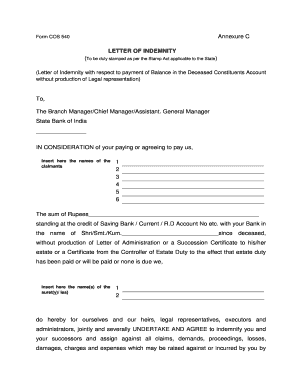
The Letter of Indemnity for Deceased Account is a legal document used by heirs in India to indemnify banks for releasing funds from a deceased account holder's account without official legal documents.
pdfFiller scores top ratings on review platforms




Who needs India State Bank Form COS 540?
Explore how professionals across industries use pdfFiller.

India State Bank Form COS 540 is needed by:
-
Heirs of a deceased bank account holder
-
Claimants seeking access to funds
-
Legal representatives handling estates
-
Banks requiring authorization for disbursement
-
Individuals needing indemnity forms for accounts
-
Practitioners working in estate management
-
Financial advisors assisting clients with claims
Comprehensive Guide to India State Bank Form COS 540
What is the Letter of Indemnity for Deceased Account?
The Letter of Indemnity for Deceased Account is a legal document utilized within the Indian banking system. Its primary purpose is to protect banks when disbursing funds from a deceased individual's account without requiring formal legal documentation. This document plays a crucial role under Indian banking laws, allowing claimants to access funds smoothly while indemnifying the bank against potential claims. Key parties involved in this process are the claimants—often the heirs of the deceased—and the sureties, who guarantee the indemnity.
Purpose and Benefits of the Letter of Indemnity for Deceased Account
This letter serves as an essential tool for heirs and claimants of deceased account holders. By using this document, claimants can avoid lengthy legal procedures typically associated with accessing deceased accounts. Some benefits include:
-
Simplified access to funds without a need for Letters of Administration or legal certificates.
-
Reduced risks of delays when claiming rights to the deceased's assets.
Overall, it facilitates a more straightforward process for heirs, allowing them to secure the funds efficiently.
Key Features of the Letter of Indemnity for Deceased Account
Understanding the key features of this legal document is vital for effective use. The letter typically includes essential fields like:
-
Details of claimants and sureties.
-
Amount to be released from the account.
-
Account information of the deceased.
Additionally, legal requirements dictate that all parties must sign the document and that it must be adequately stamped in compliance with the applicable Stamp Act.
Who Needs the Letter of Indemnity for Deceased Account?
This document is necessary for individuals acting on behalf of a deceased account holder, including heirs and legal representatives. It is specifically required in situations where the claimants seek to recover funds from the deceased's bank accounts without possessing formal legal documentation. The relationship between the claimants and sureties also should be clear, ensuring accountability and protection for all involved parties.
Eligibility Criteria for Using the Letter of Indemnity for Deceased Account
To utilize the Letter of Indemnity, one must meet specific eligibility criteria, including:
-
A direct relationship to the deceased, such as being a spouse, child, or designated heir.
-
Verification of identity and appropriate documentation to support claims.
Maintaining proper identification and documentation ensures that the process runs smoothly and complies with legal standards.
How to Fill Out the Letter of Indemnity for Deceased Account Online
Filling out the Letter of Indemnity digitally can be a streamlined process. Here’s a suggested method:
-
Gather all necessary information, including claimant names and amounts to be claimed.
-
Access the online form and enter details accurately.
-
Ensure signatures from both claimants and sureties are present before submission.
Certain sections require heightened attention, such as the amount being claimed and the identification of all parties involved, to avoid processing issues.
Common Errors and How to Avoid Them
When completing the Letter of Indemnity, users often encounter frequent mistakes. Common issues include:
-
Incorrect or missing signatures from claimants and sureties.
-
Inaccurate amounts listed for claims.
To ensure accuracy, it’s crucial to double-check all provided information and confirm that all required fields are filled out completely prior to submission.
Submission Methods for the Letter of Indemnity for Deceased Account
Submitting the Letter of Indemnity involves several options, including:
-
Online submissions via designated banking platforms.
-
In-person delivery at the bank branch handling the deceased's accounts.
It's essential to be aware of the associated timelines for processing and the security measures taken by banks to protect sensitive information during submission.
What Happens After Submission of the Letter of Indemnity for Deceased Account?
Following the submission of the Letter of Indemnity, claimants can expect a series of confirmations regarding their application. Typical processes include receiving updates about the status and timelines for fund disbursement. Claimants should maintain communication with the bank to track their submission effectively.
Experience the Ease of Filling Out Your Letter of Indemnity for Deceased Account with pdfFiller
Utilizing pdfFiller can greatly enhance the form-filling experience. The platform offers features such as digital signing, the ability to make easy edits, and secure storage of sensitive documents. With a commitment to data protection, pdfFiller ensures users can manage their forms in a trustworthy environment.
How to fill out the India State Bank Form COS 540
-
1.To access the form on pdfFiller, go to the site and use the search bar to find the 'Letter of Indemnity for Deceased Account'. Click on the form to open it in pdfFiller's editor.
-
2.Once the form is open, navigate through the document using the tools available in the pdfFiller interface. Use the fillable fields to enter required details such as names of claimants and sureties, account information, and the amount to be indemnified.
-
3.Before starting to fill the form, gather necessary information such as the deceased account holder's name, account number, and the amount required. Ensure you have details for all claimants and sureties who will sign the document.
-
4.After filling out the information, review the form carefully. Check for accuracy in all the details, ensuring all signatures are marked in the appropriate places, and confirm that the document aligns with legal requirements.
-
5.To save or download the form once completed, click on the 'Save' button in pdfFiller. You can choose to save it locally or submit it directly through your preferred method, whether it's email or direct upload.

Who is eligible to use the Letter of Indemnity for Deceased Account?
Any heir or legal representative of a deceased bank account holder can use the Letter of Indemnity to request the release of funds from the account without legal representation.
Are there any deadlines for submitting this form?
While there are generally no strict deadlines for submitting the form, it is advisable to submit it promptly after the account holder's death to avoid complications in accessing funds.
How do I submit the completed Letter of Indemnity?
You can submit the completed Letter of Indemnity either by handing it directly to the bank or via email if your bank accepts digital submissions. Always confirm your bank's preferred method.
What supporting documents do I need to include?
You typically need the death certificate of the account holder and identification proof for the claimants and sureties. Verify with your bank if additional documentation is required.
What common mistakes should I avoid when filling out this form?
Ensure all fields are accurately completed, including names, account details, and signatures. Avoid leaving any required fields blank, which may delay processing.
How long does it take for the bank to process this form?
The processing time can vary by bank, but typically it may take a few days to a couple of weeks. Contact your bank for specific timelines.
Will this form require notarization?
No, the Letter of Indemnity for Deceased Account typically does not require notarization. However, check with your bank for their specific requirements to be certain.
Related Forms



Related Catalogs
Get the latest insights from our blog


If you believe that this page should be taken down, please follow our DMCA take down process
here
.
This form may include fields for payment information. Data entered in these fields is not covered by PCI DSS compliance.