What are Construction Order Templates?

Construction Order Templates are pre-designed documents that outline the details of a construction project, including the scope of work, materials needed, timeline, and budget. These templates help streamline the process of creating construction orders and ensure that all necessary information is included.

What are the types of Construction Order Templates?

There are several types of Construction Order Templates available, including: 1. General Construction Order Template – for overall project management 2. Material Order Template – for ordering construction materials 3. Work Order Template – for detailing specific tasks and assignments 4. Subcontractor Order Template – for hiring subcontractors 5. Change Order Template – for making modifications to the original construction order.

General Construction Order Template
Material Order Template
Work Order Template
Subcontractor Order Template
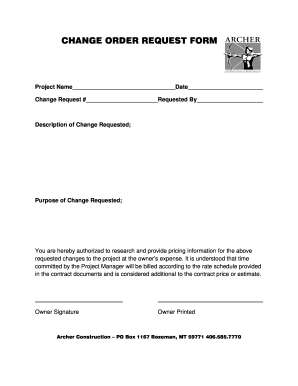
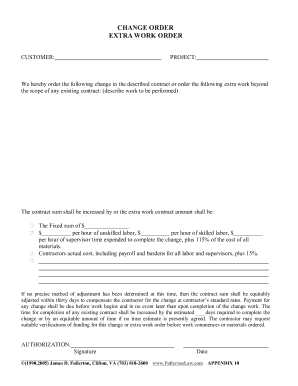
Change Order Template

How to complete Construction Order Templates

Completing Construction Order Templates is a straightforward process that involves filling in the required information accurately. Follow these steps to complete a Construction Order Template: 1. Download the template from a reputable source or use an online platform like pdfFiller. 2. Fill in the project details, including the scope of work, materials, timeline, and budget. 3. Review the completed template to ensure all information is accurate and complete. 4. Save and share the completed Construction Order Template with the relevant parties.

01
Download or use an online platform like pdfFiller
02
Fill in project details
03
Review completed template
04
Save and share with relevant parties

pdfFiller empowers users to create, edit, and share documents online. Offering unlimited fillable templates and powerful editing tools, pdfFiller is the only PDF editor users need to get their documents done.
Video Tutorial How to Fill Out Construction Order Templates

Thousands of positive reviews can’t be wrong

Read more or give pdfFiller a try to experience the benefits for yourself
4.0
Time saver!
Time saver! I have used PDFfiller for several months now and love it. It is a great tool which makes it extremely easy for me to quickly and efficiently fill out PDFs and return them to the sender. Wether it be filling out forms or signing a contract, it has saved me many many hours in the long run - and is a pleasure to use! There aren't really any cons to this plugin - it does exactly what it says it will do. However the user interface could be improved
James C.
4.0
FINDING NEW THINGS I CAN DO EVERY DAY.
FINDING NEW THINGS I CAN DO EVERY DAY. WOULD LIKE TO SEE MORE HELP / TROUBLESHOOTING GUIDES OR A VIDEO TUTORIAL SHOWING THE DIFFERENT PROCESSES YOU CAN DO WITH PDFFILLER.
SANDRA S.
5.0
Simple and TIME SAVING.
Simple and TIME SAVING. Allows me to easily create professional proposals, estimates and contracts.
Wayne N.

Questions & answers

Here's the process: Step 1: Design. During this phase, the client places a project for bidding. Step 2: Pre-Construction. Step 3: Procurement. Step 4: Construction. Step 5: Commissioning. Step 6: Owner Occupancy. Step 7: Project Closeout.
The major sequences of construction are marking, excavation, concreting, brick masonry, roof laying, flooring and finishing.
6 Steps of a Construction Project Step 1: Conception. Step 2: Team & Delivery Method Selection. Step 3: Design. Step 4: Preconstruction & Procurement. Step 5: Construction. Step 6: Close-Out.
What Are the Five Phases of the Construction Life Cycle? Project Initiation and Conception. Like with all things, the first step to the construction life cycle is merely to begin. Project Planning and Definition. Project Execution and Launch. Project Performance. Project Close.
Here's the process: Step 1: Design. During this phase, the client places a project for bidding. Step 2: Pre-Construction. Step 3: Procurement. Step 4: Construction. Step 5: Commissioning. Step 6: Owner Occupancy. Step 7: Project Closeout.